Martin
Nineteen Eighty-FourMartin, the white-jacketed servant of O'Brien, appears in only one extended scene in Nineteen Eighty-Four, yet he is one of the novel's quiet structural hinges. It is through Martin that the reader first sees the Brotherhood as a concrete network rather than a rumour, and it is his unreadable, masklike face that gives the conspiracy its most disturbing image. O'Brien names him plainly as "one of us" and then, for ten minutes, orders him to stop being a servant and take part in the conversation, making Martin the only other member of the secret organisation to be actually encountered in the action.
Identity and Appearance
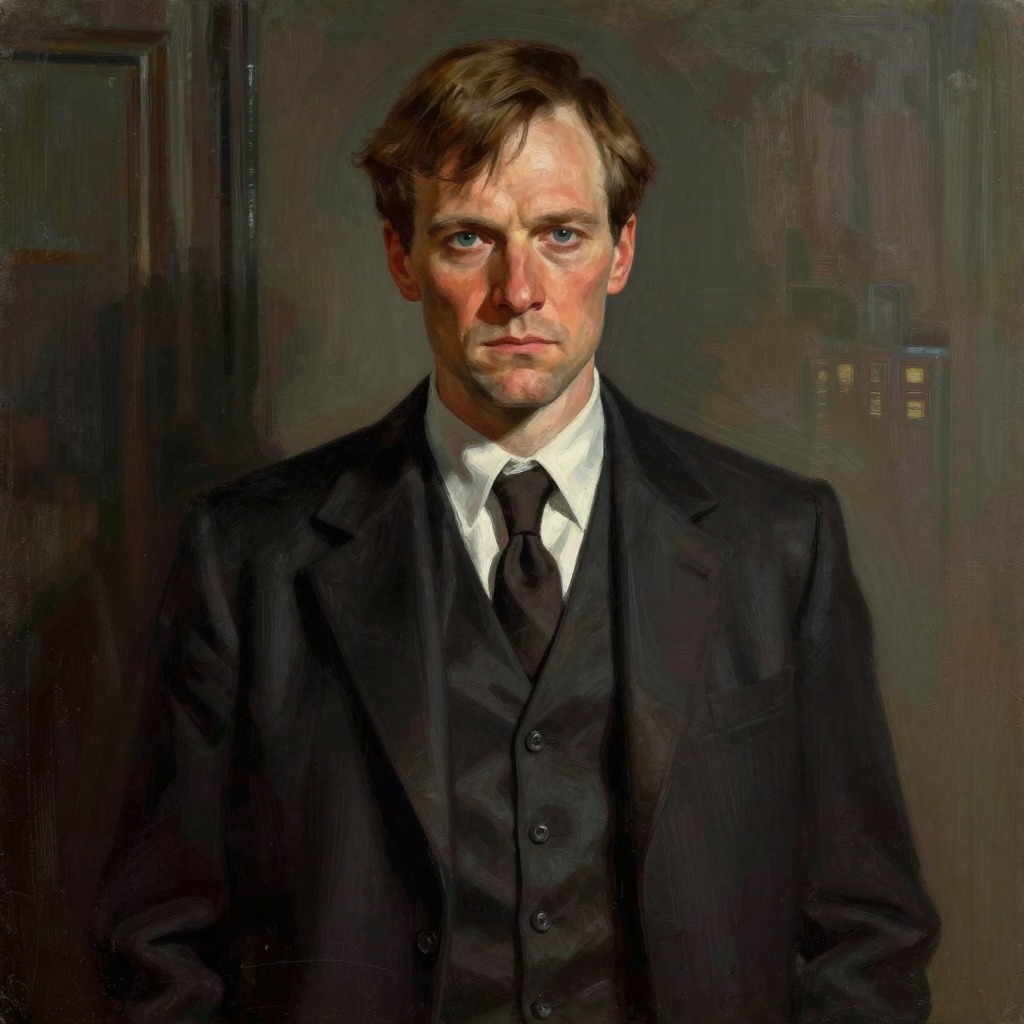
Martin is a small, dark-haired man in a white jacket, with a diamond-shaped, completely expressionless face which might have been that of a Chinese. He is first seen as the servant who admits Winston and Julia to O'Brien's flat without demur, leading them through a softly carpeted, cream-papered passage that is itself intimidating to visitors accustomed to grimy Ministry walls. Winston later notes Martin's Mongolian face and the fact that he can see no scars on it, even though O'Brien has just spoken of surgeons who can alter people beyond recognition, and the thought crosses his mind that a synthetic face was perhaps incapable of changing its expression.
Role in the Meeting with O'Brien
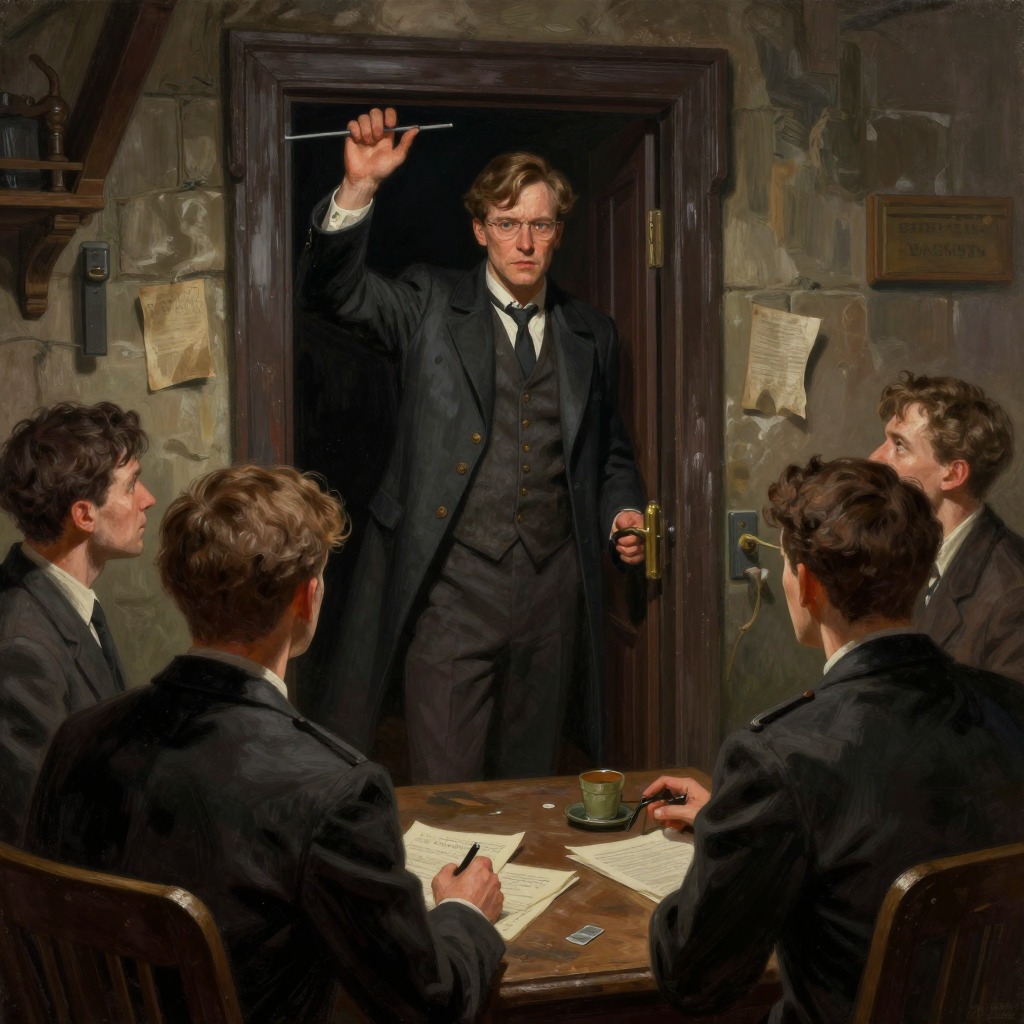
At the climax of the meeting Martin enters without knocking, carrying a tray with a decanter and glasses. O'Brien reveals his status at once: 'Martin is one of us,' he says, before telling him to bring the drinks over, put them on the round table, sit down himself and treat the next ten minutes as business. The little man sits "quite at his ease, and yet still with a servant-like air, the air of a valet enjoying a privilege." Winston watches him and feels that Martin's whole life is playing a part, and that it would be dangerous for him to drop his assumed personality even for a moment.
Before the conspirators talk, O'Brien makes a point of having Martin memorise the faces of the two visitors: 'Take a good look at these comrades' faces before you go. You will be seeing them again. I may not.' Martin obeys, his dark eyes flickering over Winston and Julia exactly as they had done at the front door, without a trace of friendliness, memorising their appearance without appearing to feel any interest in them. He then leaves without speaking or giving any kind of salutation, closing the door silently behind him. Later O'Brien tells Winston that if the Brotherhood finds it necessary to communicate with them, it will be through Martin, one of the three or four contacts who are renewed from time to time as they disappear.
Significance: Mask and Contact
Martin's flatness is the point. Where Winston had imagined a huge underworld of conspirators recognising one another by code-words and movements of the hand, the Brotherhood turns out to be a chain of isolated cells, and Martin is the link the reader actually sees: a servant whose identity is a performance and whose face reveals nothing. His synthetic expressionlessness prefigures the novel's deeper argument that the Party and its enemies alike are committed to annihilating the private self; unlike Mr Charrington, whose benevolent disguise is later torn away to reveal a Thought Police officer, Martin is not unmasked as an enemy but simply remains a mask. He also makes the conspiracy feel real at the very moment Winston commits himself to it, and his silent exit leaves the reader, like Winston, with only O'Brien's word for what lies behind the mask.