Parsons
Nineteen Eighty-FourParsons is a minor character in Nineteen Eighty-Four, Winston Smith's colleague at the Ministry of Truth and fellow tenant of Victory Mansions, who embodies the Party's perfect loyal subject. He is a fattish but active man of paralysing stupidity, a mass of imbecile enthusiasms, and one of those completely unquestioning, devoted drudges on whom, more even than on the Thought Police, the stability of the Party depended. His brief arc is severe: the man so orthodox that Winston privately speculates he will never be vaporized is arrested for thoughtcrime after muttering "Down with Big Brother" in his sleep, denounced by his own seven-year-old daughter. His story shows that in Oceania no loyalty, however mindless, is proof against the machine.
Identity and Background
Parsons is thirty-five, a tubby, middle-sized man with fair hair and a froglike face, already running to rolls of fat at neck and waistline, yet moving with brisk, boyish energy. His whole appearance is that of a little boy grown large: even in the regulation blue overalls he still suggests the blue shorts, grey shirt and red neckerchief of the Spies, and he eagerly reverts to shorts whenever a community hike or any physical activity gives him an excuse. His most distinctive physical fact is sweat. The air around him carries an intense smell of it, beads of moisture stand out on his pink face, and at the Community Centre the handle of his table-tennis bat is always damp. His body, in its perpetual dampness, seems to testify to the strenuousness of his life even when he is doing nothing.
At the Ministry of Truth he occupies a subordinate post for which intelligence is not required, but his real function is organisational enthusiasm. He is a leading figure on the Sports Committee and on all the committees that organise community hikes, spontaneous demonstrations, savings campaigns and voluntary activities, and he announces with quiet pride, between whiffs of his pipe, that he has put in an appearance at the Community Centre every evening for four years. His Party history is entirely institutional: he stayed in the Spies for a year beyond the statutory age and was only unwillingly evicted from the Youth League at thirty-five. In the canteen he is equally devoted to the machinery of enthusiasm, collecting Winston's two-dollar subscription for the Hate Week house-by-house fund in a small notebook kept with the neat handwriting of the illiterate and promising that Victory Mansions will put on a tremendous show.
Household and Family
Parsons's domestic life reproduces the same emptiness on a smaller scale. His flat in Victory Mansions is bigger than Winston's but dingy and battered, as though visited by some large violent animal: hockey sticks, boxing gloves, a burst football and sweaty shorts lie over the floor, scarlet banners of the Youth League and the Spies hang on the walls, and a full-sized poster of Big Brother presides over the boiled-cabbage smell of the building, shot through with the sharper reek of sweat belonging to someone not present. His wife, Mrs Parsons, is a crushed, colourless woman of about thirty who looks much older, with wispy hair, a lined face and dust in the creases of her skin. She cannot repair a blocked kitchen sink and summons Winston to do it, explaining that Tom is not home and that "He loves anything like that." The helplessness is structural: Victory Mansions, built in 1930 or thereabouts, is falling to pieces, and repairs must be sanctioned by remote committees that can hold up even the mending of a window-pane for two years.
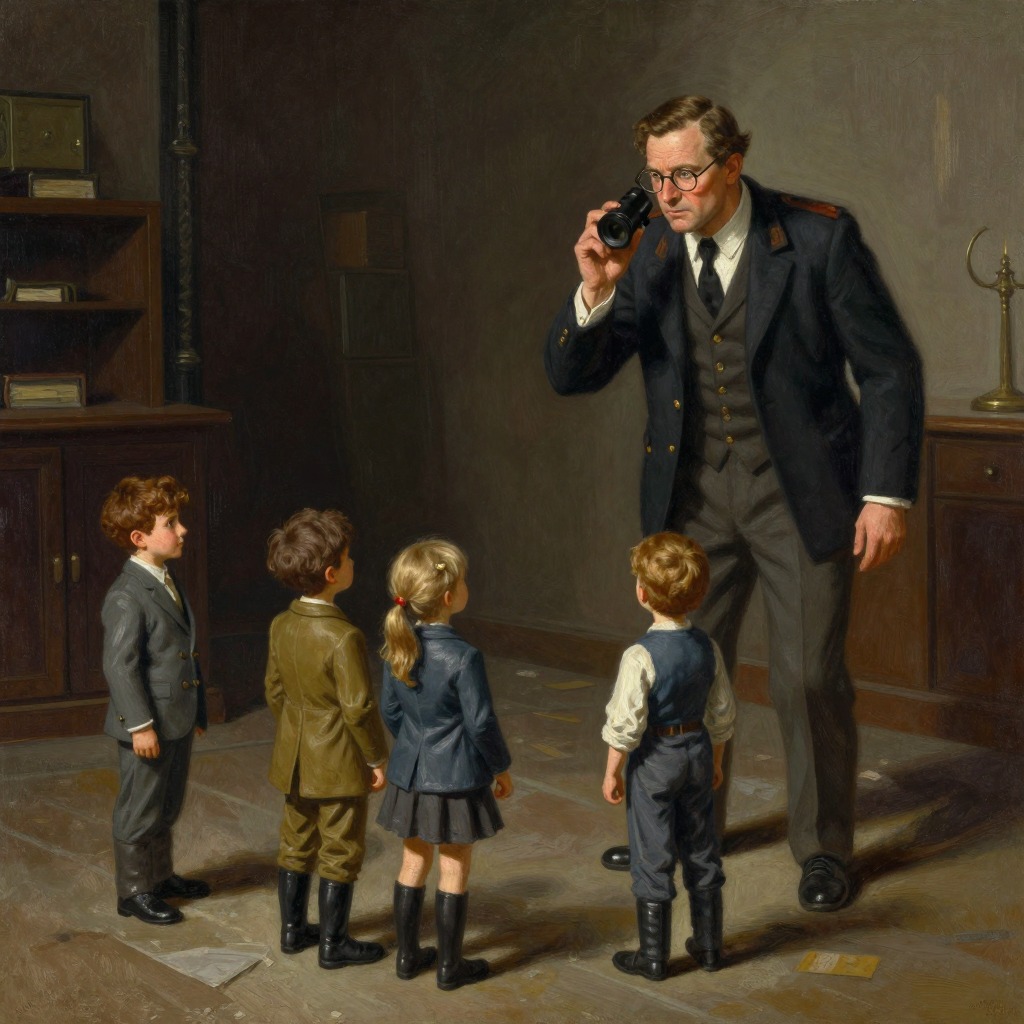
The children are the true terror of the household. A handsome, tough-looking boy of nine, with a small sister about two years younger, wears the blue shorts, grey shirt and red neckerchief of the Spies, springs out shouting "Up with your hands!", calls Winston a traitor, a thought-criminal and a Eurasian spy, and threatens to shoot him, vaporise him and send him to the salt mines. Winston finds their gambolling slightly frightening, like tiger cubs that will soon grow into man-eaters. When he leaves, the boy shoots him in the back of the neck with a catapult and shouts "Goldstein!" as the door closes. Parsons treats it as high spirits, saying he gave the boy a dressing-down, and the same child, prevented from attending an execution, rages that he wants to see the hanging. The daughter is already a competent little agent: on a Spies hike near Berkhamsted she slipped away from her troop, followed a strange man through the woods for two hours and handed him over to the patrols because his shoes looked foreign, and Parsons tells the story with pride, miming a rifle shot. His children, he boasts, set fire to an old market-woman's skirt because she was wrapping sausages in a poster of Big Brother, and the Spies have issued them ear trumpets for listening through keyholes. Such children are the "child hero" figures of the Times, eavesdroppers who denounce their own parents.
Orthodoxy in Action
In the Ministry canteen Parsons is a figure of pure comic conformity. Syme greets his approach with a tone that seems to add "that bloody fool," and Parsons, threading his way across the room, greets everyone with a cheery "Hullo, hullo!" and settles down at the table, radiating heat and dampness. Syme's strip of paper and ink-pencil draw the comment "Look at him working away in the lunch hour," and Parsons responds with his usual keenness, immediately turning to Winston about the subscription he forgot to pay. The exchange is all institutional friction: a quarter of one's salary goes to voluntary subscriptions, so numerous that keeping track of them is difficult, and Parsons, as block treasurer for the house-by-house fund, is making an all-out effort for Hate Week. The conversation also turns to razor blades, a commodity that has vanished from the Party shops; both Syme and Parsons ask Winston for one, and Winston, who is hoarding two unused blades, denies it.
His mental processes are on full display when the telescreen announces that the standard of living has risen by 20 per cent and that the chocolate ration has been raised to twenty grammes a week. Winston remembers that only yesterday it was announced the ration would be reduced to twenty grammes. Parsons swallows the new claim easily, with the stupidity of an animal; he cannot follow the figures but is aware that they are somehow a cause for satisfaction, and he declares that the Ministry of Plenty has certainly done a good job this year. The statistics themselves, as Winston knows from his own work in the Records Department, are routinely manufactured: forecasts are rewritten after the fact, and numbers like the boot-output figures are adjusted so that the quota can be shown overfulfilled. Parsons is the ideal consumer of such lies, a man in whom contradiction leaves no mark.
As Hate Week approaches, Parsons is in his native element. He organises squads of volunteers stitching banners, painting posters, erecting flagstaffs on the roofs and slinging wires across the street for streamers, and he boasts that Victory Mansions alone will display four hundred metres of bunting. The heat and manual work give him a pretext for reverting to shorts and an open shirt, and he is everywhere at once, pushing, pulling, sawing, hammering, jollying everyone along with comradely exhortations while giving out from every fold of his body what seems an inexhaustible supply of acrid-smelling sweat. The febrile atmosphere of the period, with rocket bombs falling on London and crowds whipped into patriotic frenzy, is one he absorbs without friction.
Arrest and Aftermath
The turn comes in Part III, when Parsons walks into Winston's cell in the Ministry of Love. He is wearing khaki shorts and a sports-shirt, and the wave of air from the door carries a powerful smell of cold sweat. His knees tremble, his eyes stare, and he is almost blubbering. Charged with thoughtcrime, he is incredulous that the word could apply to him: surely they do not shoot a man who has only had thoughts, not actions. He pleads for a fair hearing, reminds Winston of his record, calls himself not a bad chap in his way, "Not brainy, of course, but keen," and hopes for five years, or even ten, in a labour-camp where a willing worker could make himself useful. Then, with a servile glance at the telescreen, he confesses at once, because the Party would not arrest an innocent man. The offence, he explains, happened in his sleep: he talked in his sleep, and they heard him saying "Down with Big Brother" over and over. He is almost grateful, and plans to thank the tribunal for saving him before it was too late.
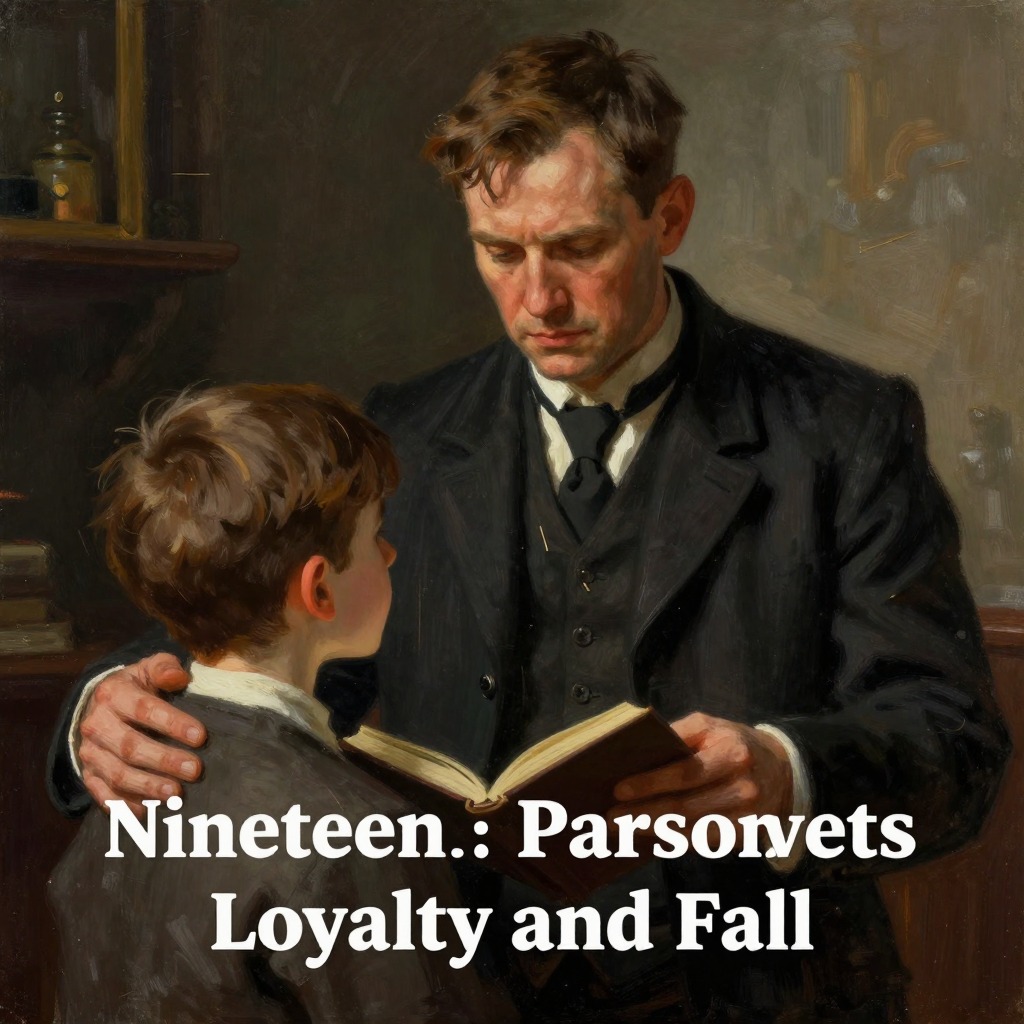
His daughter denounced him. The same seven-year-old who had followed the stranger at Berkhamsted listened at the keyhole, heard the sleeping mutter, and nipped off to the patrols the next day. Parsons reports this with doleful pride: he bears her no grudge, he is proud of her, it shows he brought her up in the right spirit. The family in Oceania, as Winston reflects elsewhere, has become in effect an extension of the Thought Police, a device by which everyone is surrounded night and day by informers who know him intimately; Parsons has educated his own accuser. In the cell, he uses the defective lavatory loudly and abundantly, and the resulting stench, like his sweat, remains as the only trace he is allowed to leave.
His arrest changes what the reader understands about Oceania. A Party member lives from birth to death under the eye of the Thought Police, and in Oceania there is no law: the endless purges, arrests and vaporisations do not punish crimes actually committed but wipe out persons who might commit a crime at some time in the future. The naturally orthodox man, the goodthinker of Newspeak, should by definition be beyond suspicion, yet Parsons is caught by the one part of himself he could not control, his sleeping mind. He believed his devotion was entirely conscious and voluntary, but Winston has written in his diary that thoughtcrime does not entail death but is death, and it can be committed without waking.
Narrative Role and Evaluation
Parsons exists to measure what Winston is not. In the canteen Winston silently runs through the people around him, foreseeing that Mrs Parsons, Syme, Winston himself and O'Brien will be vaporized, while Parsons, on the other hand, would never be vaporized. His stupidity is a form of protection, a saving stupidity that Syme conspicuously lacks. Syme sees too clearly and speaks too plainly and is marked for vaporisation; Parsons asks no questions and registers no contradictions. When the chocolate ration is silently restored, Parsons swallows it. He is the human material the Party is built on, the unquestioning, devoted drudge more important to its stability than the Thought Police itself.
His function is also satirical. He remains a little boy grown large, an eternal Spies member whose dimpled knees and damp bat handle belong to a world of parades and community hikes; his inner life is made entirely of the Party's slogans and timetables. The novel uses him to show that orthodoxy is unconsciousness: he does not need doublethink because he never notices there are two thoughts to hold. And in the end the same system that produced him consumes him. The perfect loyalist is denounced by the perfect product of the Spies, and the last image of him, trembling, grateful and fouling the cell, completes the portrait of a machine that devours even its own most faithful products.