Photograph of Jones, Aaronson and Rutherford
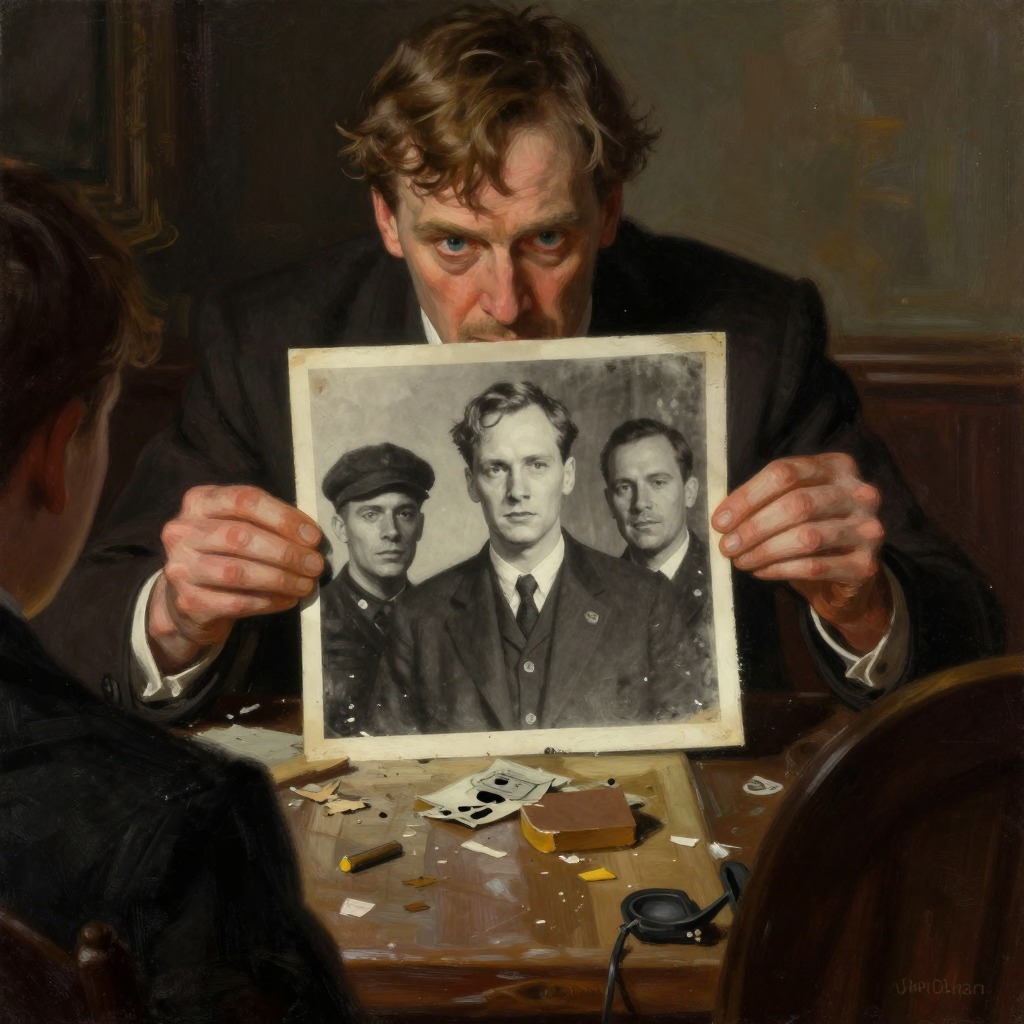
Nineteen Eighty-FourThe Photograph of Jones, Aaronson and Rutherford is a fragment of forbidden evidence in Nineteen Eighty-Four: a half-page torn from the Times, roughly a decade old when it surfaced, which shows the three disgraced Party leaders at a Party function in New York. Found by Winston Smith among the documents on his desk in the Records Department of the Ministry of Truth, it was the one concrete, documentary proof he ever held that the Party's account of the past was false. Because the three men had confessed at their trials to being on Eurasian soil on that very day, the photograph carried the explosive implication that their confessions were lies, and it became the emblem of the novel's governing slogan: 'Who controls the past controls the future: who controls the present controls the past.'
Finding the Fragment
The discovery came in 1973, about five years after the second trial and execution of Jones, Aaronson and Rutherford, when Winston was unrolling a wad of documents that had flopped out of the pneumatic tube onto his desk. A fragment of paper had evidently been slipped in among the others and then forgotten. It was the top half of a page torn from the Times of about ten years earlier, so that the date was preserved, and it carried a photograph of the delegates at some Party function in New York; in the middle of the group, unmistakable even without the names printed in the caption at the bottom, stood Jones, Aaronson and Rutherford. The context made the survival extraordinary. The Ministry of Truth existed to prevent such survivals: every superseded document was supposed to be collected, destroyed and replaced by a corrected copy, with history scraped clean and re-inscribed as often as necessary, so that in no case could a falsification ever be proved. That a single page had evaded the process made it a kind of fossil inside an otherwise perfect machine.
What the Photograph Proved
The photograph's significance lay in what the three men had sworn to. At both their trials Jones, Aaronson and Rutherford had confessed that on the date in question they had been on Eurasian soil, having flown from a secret airfield in Canada to a rendezvous in Siberia, where they conferred with the Eurasian General Staff and betrayed military secrets. Winston remembered the date because it chanced to be midsummer day. The photograph placed all three men in New York on that same day and so forced the conclusion that the confessions were lies. The conclusion was not in itself new: Winston had never imagined that the people wiped out in the purges had actually committed the crimes they were accused of. But this was concrete evidence, a fragment of the abolished past, 'like a fossil bone which turns up in the wrong stratum and destroys a geological theory.' It gave documentary form to what existed otherwise only in his own consciousness, and it proved that the past, though endlessly altered, had once been different.
Destruction and Denial
Winston did not keep it. He had held it between his fingers for as long as thirty seconds, covered it with another sheet of paper, waited what he judged to be ten minutes while fearing that a draught or the beating of his heart would betray him, and then dropped it into the memory hole along with other waste papers, so that within a minute it would be ashes. Even afterwards the fact of having held it seemed to him to make a difference, though the photograph itself and the event it recorded existed only in memory. Years later, in the Ministry of Love, O'Brien demonstrated how completely the Party could dispose of such evidence: he produced what was unmistakably another copy of the same photograph, held it before Winston's eyes for perhaps five seconds, then dropped it into a memory hole in the wall and said of it, 'It does not exist. It never existed.' When Winston protested that it existed in memory, O'Brien answered, 'I do not remember it,' and Winston felt the full force of doublethink: if O'Brien had genuinely forgotten, then he would already have forgotten his denial of remembering, and the act of forgetting itself.
A Relic of a Contested Past
The photograph's fate illuminates the difference between Winston's world and the one he tries to defend. When he later told Julia the story of Jones, Aaronson and Rutherford and the momentous slip of paper, she asked whether the three men were friends of his and concluded that she would never risk anything 'for bits of old newspaper.' For Julia the past was not worth dying for; for Winston it was the ground on which sanity and freedom rested, as he tried to explain when he called the glass paperweight in the room above Mr Charrington's shop 'a little chunk of history that they've forgotten to alter.' The photograph was another such chunk, with the crucial difference that it was not inert: it contradicted the official record and could have planted doubt, had anyone dared to show it. That the Party's answer to such contradictions was total — no laws, no trials, no records independent of the Party, and the systematic surveillance of every Party member — made the photograph's destruction, and its later denial, not an exception but the normal working of power. Its half-page survival, and the thirty seconds it spent in Winston's hands, stand as the closest the novel comes to a direct physical confrontation between private memory and the machinery of history.