Proles and animals are free
Nineteen Eighty-Four'Proles and animals are free' is a Party slogan in Nineteen Eighty-Four that arrives at the end of Winston Smith's long inward look at the class the regime calls the proles. On its face it grants liberty; in context it withholds everything that liberty might mean. The proles are free, the Party explains, because they are beneath suspicion—too negligible to police, too disregarded to indoctrinate—and the sentence thus compresses the whole machinery of Ingsoc into a single act of doublethink. It is a freedom issued as a verdict, and Winston, hearing the contempt in it, will nevertheless build his last hope upon it.
The Freedom of the Disregarded
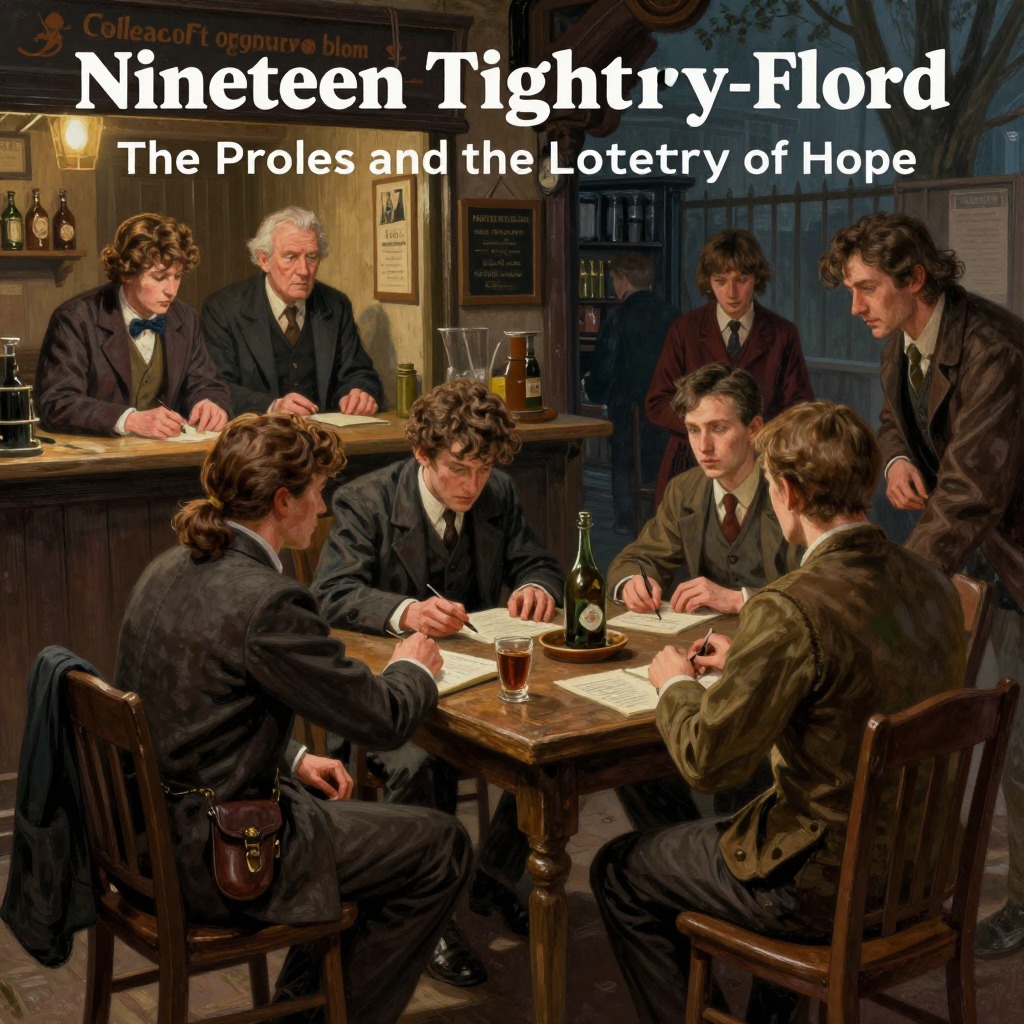
Winston's meditation begins with the admission that the Party could not be overthrown from within, and that only the proles—85 per cent of Oceania's population, the swarming disregarded masses—could ever generate the force to destroy it. Left to themselves, the Party believes, the proles have reverted to an ancestral pattern: born in the gutters, at work by twelve, married at twenty, middle-aged at thirty, dead at sixty, their horizons filled with films, football, beer and above all gambling. No attempt is made to indoctrinate them with Party ideology, and what is required of them is only a primitive patriotism that can be invoked when longer working-hours or shorter rations must be accepted. Most prole homes have no telescreens, the civil police interfere with them very little, and the vast criminality of London—thieves, bandits, prostitutes, drug-peddlers—is dismissed as unimportant because it happens among the proles themselves. In moral questions they are allowed their ancestral code: promiscuity goes unpunished, divorce is permitted, and even religious worship would be allowed if they showed any sign of wanting it. That is the reality the slogan names. Freedom here means neglect.
A Lawless State and the Party Member's Captivity
How different is the condition of a Party member, for whom no such careless freedom exists. When Winston first opens his diary he reflects that the act is not illegal—there are no laws anymore—but that detection would mean death or at least twenty-five years in a forced-labour camp. A Party member lives from birth to death under the eye of the Thought Police and can never be sure of being alone; his friendships, his behaviour towards his wife and children, the expression of his face in solitude, the words he mutters in sleep are all scrutinised. Because Oceania has no law, offences need not be formally forbidden: the endless purges, arrests and vaporisations simply wipe out people who might commit a crime at some time in the future, and the member is required to have not merely the right opinions but the right instincts. Behind the whole system stands the Ministry of Love, a windowless building that cannot be entered except on official business, through barbed wire, steel doors and hidden machine-gun nests. The freedom of the proles is the negative image of this captivity: they are let alone because nothing they could ever think or do is taken seriously.
Doublethink in Action
The slogan is a small monument to what Orwell, writing in March 1948, called a schizophrenic manner of thinking, in which words like democracy can bear two irreconcilable meanings and concentration camps can be right and wrong simultaneously. The Ministry of Truth is the administrative engine of that thinking, rewriting the past minute by minute so that every Party prediction proves correct and every inconvenient record disappears. The Ministry of Plenty performs the same trick in public: one day the chocolate ration is reduced from thirty grammes to twenty; the next, the telescreen announces that it has been raised to twenty grammes, and the same announcement is accompanied by claims that the standard of living has risen by no less than 20 per cent, with irrepressible spontaneous demonstrations of gratitude to Big Brother. The man of animal stupidity swallows it, the fanatic swallows it with fury, the intellectual Syme swallows it by way of doublethink, and only Winston is left wondering whether he alone possesses a memory. 'Proles and animals are free' is cut from the same cloth: the word 'free' is emptied of political content and refilled with a biological meaning, exactly as Newspeak empties and refills every dangerous word.
Enemies, Rumours and the Slogan's Place
The Party concentrates its hatred on Emmanuel Goldstein, the renegade who once stood almost level with Big Brother, was condemned to death and mysteriously escaped. He is the principal figure in every Two Minutes Hate, the primal traitor from whose teaching all later heresies, sabotages and deviations are held to spring, and it is around him that rumours crystallise: the Brotherhood, a vast shadowy army of conspirators, and a terrible book, a compendium of all heresies, known simply as the book. None of this apparatus is wasted on the proles. They are too unimportant to be hated, too formless to be conspirators, and the Party can afford to grant them freedom precisely because nothing in their lives or thoughts threatens the state. The flip side of that indifference is that the proles escape the ideological machinery altogether: they are not indoctrinated, not invited to the hatred, not even required to know the name of the enemy.
Winston's Hope and the Author's Warning
The same contemptuous formula becomes, in Winston's mind, the foundation of the novel's one heretical hope. He writes in his diary that if there is hope it lies in the proles, because only they can destroy the Party; and he formulates the circle that until they become conscious they will never rebel, and until after they have rebelled they cannot become conscious. The Party's neglect may be exactly what preserves them: untaught, unregulated, left to their ancestral loyalties, they remain the only human material the regime has not remade. Orwell's own politics stood behind this. He had gone to Spain in 1937 to fight Franco, had learned there the difference between real and phony anti-fascism, and declared that every line of serious work he had written since 1936 was written against totalitarianism and for democratic socialism. 'Proles and animals are free' is the satirical reverse of that faith—a liberation proclaimed by a state that believes in neither liberty nor the people it insults; but the insult is also, for Winston, an unintended promise, since what the Party does not watch it has not yet conquered.