Records Department
Nineteen Eighty-FourThe Records Department is the falsification engine inside the Ministry of Truth, the daily workplace of Winston Smith, and the machinery through which Oceania makes its past obedient to the Party. It forms one branch of the Ministry of Truth, one of the four Ministries between which the entire apparatus of government is divided, the Ministry concerned with news, entertainment, education and the fine arts. The Ministry's declared function may be to supply citizens with everything from a statue to a slogan, but the Records Department is where the supply is adjusted backwards in time: its real product is corrected memory, or what the Party calls reality control and Newspeak calls doublethink.
The Hall and Its Daily Life
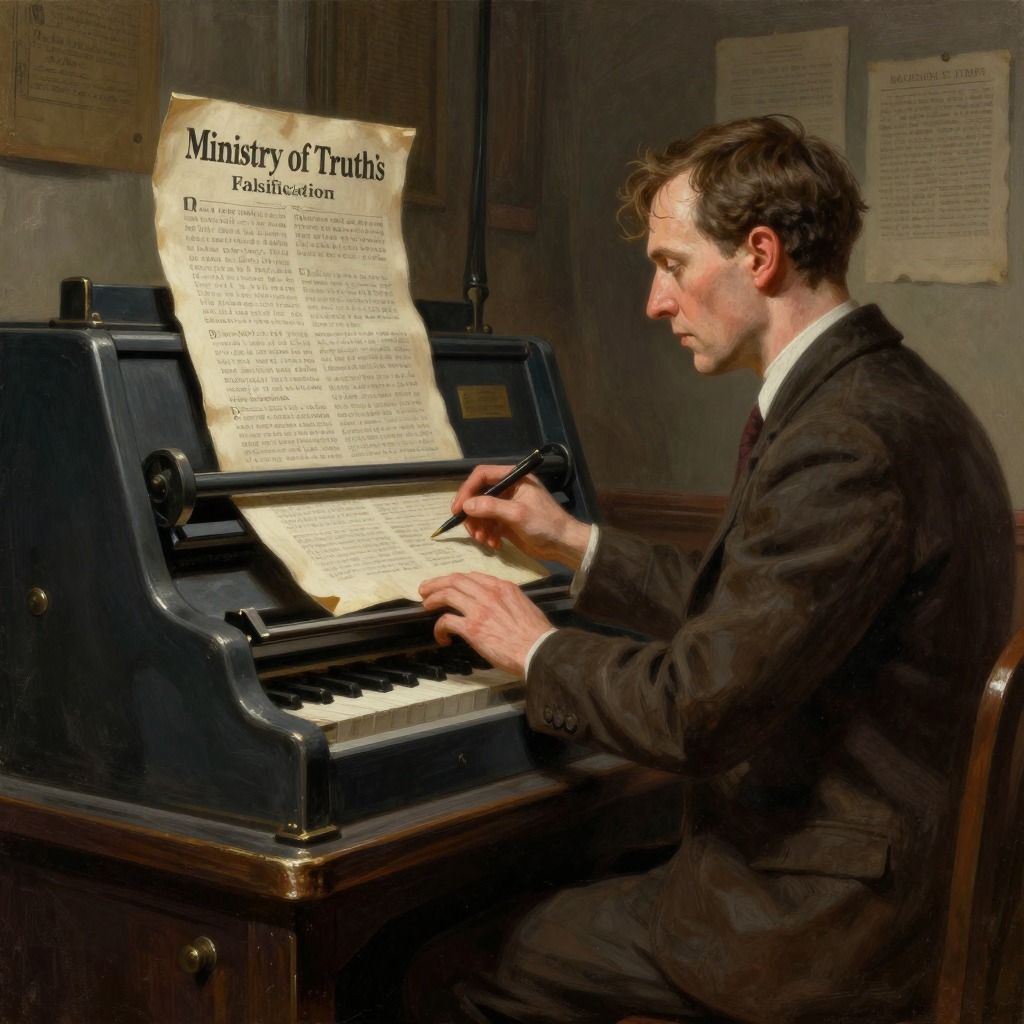
The department occupied a long, windowless hall with a double row of cubicles, built for concentration rather than comfort. On ordinary mornings the air filled with the rustle of paper and the murmur of voices dictating into speakwrites; when the Two Minutes Hate was due, the chairs were dragged out and grouped in the centre of the hall opposite the big telescreen. It was in that formation, at nearly eleven hundred, that O'Brien, an Inner Party member whose post was so important and remote that Winston had only a dim idea of its nature, came into the room and sat down a couple of places away, while the dark-haired girl from the Fiction Department who would later be known as Julia took a place immediately behind Winston. Across the hall, in the corresponding cubicle, the small, precise Tillotson worked with a folded newspaper on his knee and his mouth close to his speakwrite, returning Winston's look with a hostile flash of his spectacles.
The Work of Rectification
Rectification was the official word for the department's labour. When a number of the Times had been supplied with all necessary corrections, that issue was reprinted, the original copy destroyed, and the corrected copy placed on the files in its stead. The process was applied not merely to newspapers but to books, periodicals, pamphlets, posters, leaflets, films, sound-tracks, cartoons and photographs — to every kind of literature or documentation that might carry political or ideological significance. Day by day and almost minute by minute the past was brought up to date; every prediction Big Brother had made could then be shown by documentary evidence to have been correct, and no inconvenient item was allowed to remain on record. All history was a palimpsest, scraped clean and re-inscribed as often as was necessary, and once the deed was done no one could prove that any falsification had taken place.
The largest section of the Records Department was not Winston's own; it consisted simply of people whose duty was to track down and collect every copy of books, newspapers and other documents that had been superseded and were due for destruction, so that copies of the Times which had been rewritten a dozen times could still stand on the files bearing their original dates, with no other copy in existence to contradict them. Winston's own days followed the same rhythm. Messages slid out of the pneumatic tube in abbreviated internal jargon, were dealt with, and their originals dropped into the memory hole; simple matters he disposed of before the Two Minutes Hate interrupted him, and after the Hate he returned to his cubicle, took the Newspeak dictionary from the shelf, pushed the speakwrite to one side, cleaned his spectacles and settled down to the main job of the morning.
Control of the Past as Control of the Present
The department's true significance lies in what its daily work does to the distinction between truth and falsehood. The Party said that Oceania had never been in alliance with Eurasia; Winston Smith knew, from his own imperfectly controlled memory, that the alliance had existed a mere four years earlier. But that knowledge existed only in his own consciousness, which must soon be annihilated, and once all records told the same tale the lie passed into history and became truth. Hence the axiom that underlies the whole operation — whoever controls the past controls the future, and whoever controls the present controls the past. The technique was called reality control in Oldspeak and doublethink in Newspeak. Newspeak was the official language of Oceania, designed to serve the ideological needs of Ingsoc, and by 1984 the leading articles of the Times were already written in it; the department's forgery therefore fed an instrument that was itself being forged into a perfect vehicle of orthodoxy.
Evidence and Its Destruction
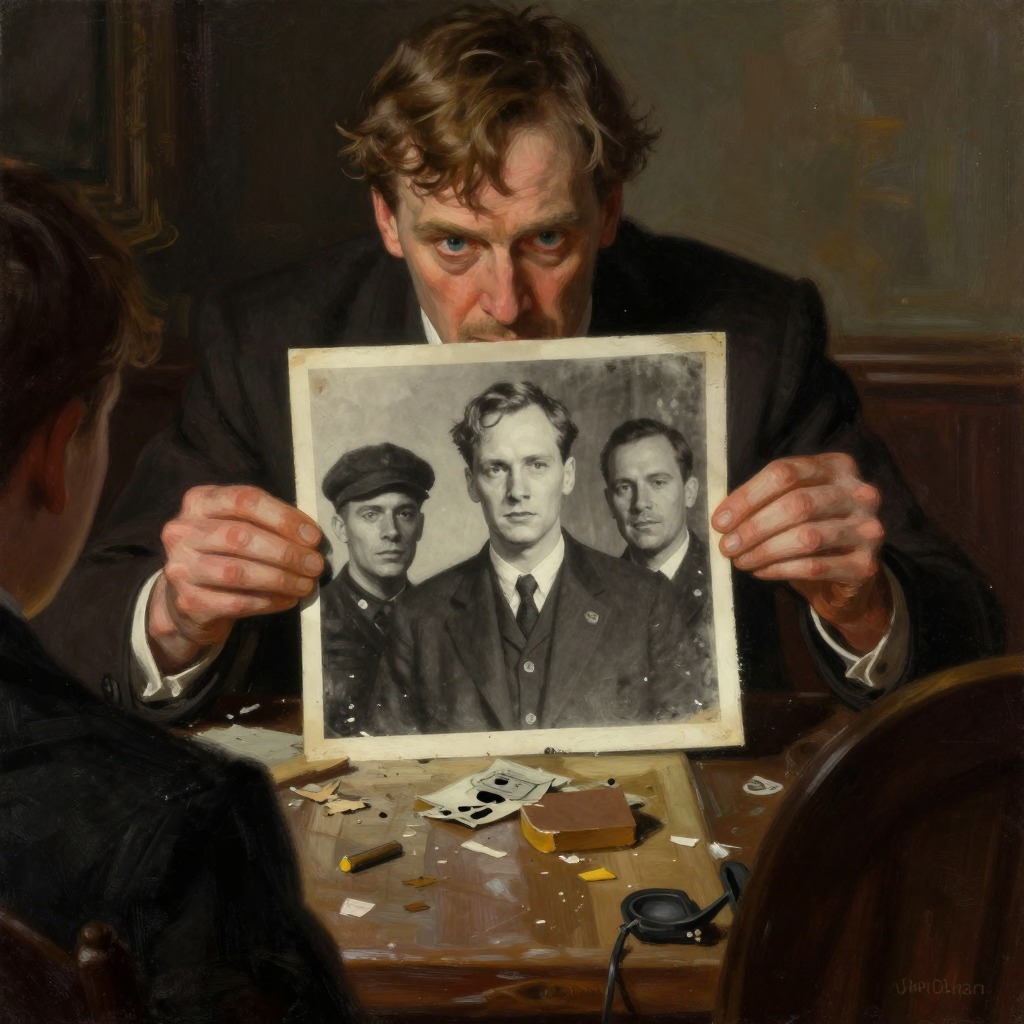
Yet the system had its fragile points, and the department itself occasionally floated a fragment of the abolished past to the surface. Winston once unrolled a wad of documents and found a half-page torn from an old issue of the Times: a photograph of Jones, Aaronson and Rutherford at a Party function in New York, taken on a midsummer day on which all three had confessed to being on Eurasian soil and conferring with the Eurasian General Staff. The only possible conclusion was that the confessions were lies, and Winston dropped the photograph into the memory hole within minutes. Such concrete evidence could not survive; what survived instead were objects the department never thought to alter. The glass paperweight Winston bought in Mr Charrington's shop seemed to him "a little chunk of history that they’ve forgotten to alter," a message from a hundred years ago if one knew how to read it. The Records Department existed to make sure that no such message could ever be read.