Red Sash
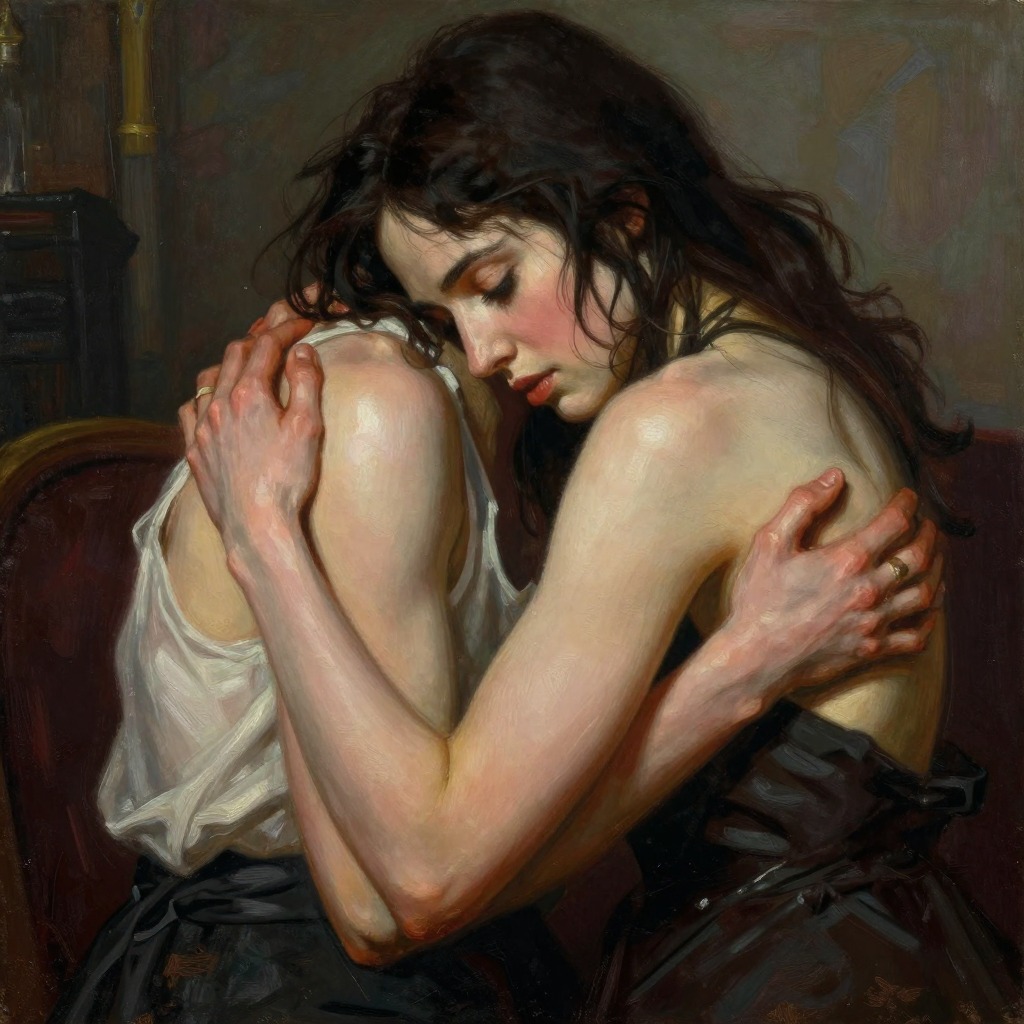
Nineteen Eighty-FourThe Red Sash is the narrow scarlet band that Julia wears wound several times round the waist of her blue Party overalls, the emblem of the Junior Anti-Sex League. It enters the novel as a badge of ideological purity and sexual self-denial, and it becomes the most intimately handled symbol of the affair that defies both. The same strip of cloth that marks Julia as a model Party girl in public is torn off in private, and in that contrast the sash condenses the Party's war on the sex instinct and the small, bodily rebellion Winston and Julia mount against it.
Emblem of Chastity
The sash makes its first appearance at the Two Minutes Hate, when the girl who will turn out to be Julia walks into the Records Department. She is a bold-looking girl of about twenty-seven, with thick dark hair, a freckled face and swift, athletic movements, known to Winston only as someone from the Fiction Department who sometimes has oily hands and carries a spanner, evidence of some mechanical job on the novel-writing machines. "A narrow scarlet sash, emblem of the Junior Anti-Sex League, was wound several times round the waist of her overalls, just tightly enough to bring out the shapeliness of her hips." It is the first thing Winston learns about her, and it colours everything he thinks he knows: the sash seems to carry with it the atmosphere of hockey-fields and cold baths and community hikes and general clean-mindedness, and it convinces him she is more dangerous than most, perhaps even an agent of the Thought Police.
Winston's hatred returns to the sash at the climax of the Two Minutes Hate. Transferring his rage from Goldstein to the dark-haired girl behind him, he imagines flogging her to death with a rubber truncheon, tying her naked to a stake and shooting her full of arrows like Saint Sebastian, ravishing her and cutting her throat at the moment of climax. The reason he gives himself is that she is young and pretty and sexless, and that "round her sweet supple waist, which seemed to ask you to encircle it with your arm, there was only the odious scarlet sash, aggressive symbol of chastity." He wants to go to bed with her and knows he never will; the belt of cloth is the visible form of that refusal. The sash, in other words, is from the start an object of desire as much as of denial.
A Mask of Orthodoxy
In the clearing in the Golden Country, Julia herself explains what the sash is for. "It's this bloody thing that does it," she says, ripping off the scarlet sash and flinging it onto a bough, and only then produces the slab of black-market chocolate. She describes herself as "that sort of girl, to look at": good at games, a troop-leader in the Spies, a volunteer three evenings a week for the Junior Anti-Sex League, hours spent pasting "their bloody rot" all over London, always carrying one end of a banner in the processions, always cheerful, never shirking anything. "Always yell with the crowd, that's what I say. It's the only way to be safe." The sash is the visible certificate of that performance. Winston had already sensed the danger of such a mask: in the canteen he noticed her watching him and reflected that the amateur spy was the greatest danger of all, and that an improper expression on the face was itself a punishable offence known in Newspeak as facecrime. The sash made Julia look exactly like the kind of zealous woman who would denounce him; in fact it was the disguise that let her move safely towards him. Winston, for his part, had to set his features into the expression of quiet optimism advisable when facing the telescreen, a small daily performance of the same kind.
Removal and Restoration
The sash marks the transitions of the affair. On the walk to the clearing, before their first embrace, Winston watches Julia's strong slender body moving ahead of him "with the scarlet sash that was just tight enough to bring out the curve of her hips, the sense of his own inferiority was heavy upon him." After she tears it off, he notices "how much softer her waist seemed to feel now that the sash was gone." When she wakes from their lovemaking, the mood changes: she becomes alert and businesslike, puts her clothes on, "knotted the scarlet sash about her waist" and starts arranging the journey home, insisting that he never go home the same way as he went out, leaving first while he waits half an hour. The sash is re-tied as armour. Its return restores the public identity under which the rebellion is hidden, and its absence in the clearing was the one condition under which that rebellion could exist.
The Sash as Ideological Knot
The sash's career traces the Party's attempt to destroy the sex instinct. The Junior Anti-Sex League advocated complete celibacy for both sexes, and the Party, as Winston understands, was "trying to kill the sex instinct, or, if it could not be killed, then to distort it and dirty it." Julia's sash is the wearable form of that doctrine, and her tearing it off is the novel's most direct bodily refusal of it. Yet the emblem of the institution is never destroyed; it is only put on again. The re-knotted sash shows that even rebellion inside Oceania needs the mask of orthodoxy, and that the act of love itself was always, as Winston reflects, "a blow struck against the Party", "a political act." The red sash ends as it began: a narrow band of cloth on which the Party and the lovers fight over the same body.