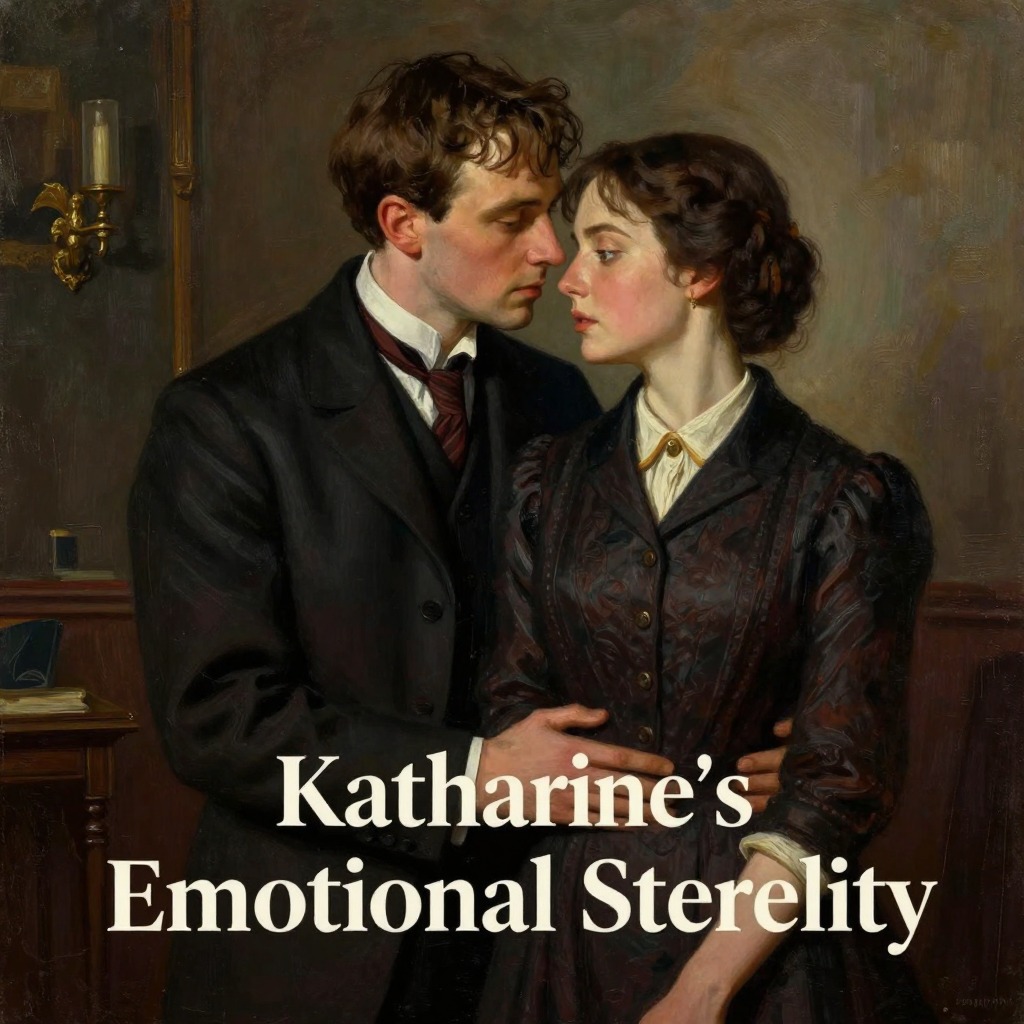
The only recognised purpose of marriage was to beget children for the service of the Party
Nineteen Eighty-FourMarriage in Oceania is not a private bond but a Party-administered obligation: its only recognised purpose is to beget children for the service of the Party. The rule is one clause in a much wider programme of sexual control, for the Party's real, undeclared purpose is 'to remove all pleasure from the sexual act', and its enemy is 'not love so much as eroticism', inside marriage and outside it. Every marriage between Party members has to be approved by a committee, and permission is always refused when the couple appear physically attracted to one another. In Winston Smith's marriage to Katharine, in Julia's deliberate defiance, and in the windowless rooms of the Ministry of Love where the rule is ultimately enforced, the novel shows the Party trying to make procreation a state function and to turn the family into a transmission belt of its power.
A Rule Embedded in the War on Desire
Within the Party's doctrine the marriage rule appears as one strand of a coherent policy. Its aim was not merely to prevent men and women from forming loyalties which the Party might not be able to control; the deeper object was to strip the sexual act of all pleasure. Sexual intercourse was to be looked on as 'a slightly disgusting minor operation, like having an enema', and the principle was never put into plain words but rubbed into every Party member from childhood onwards. Organisations such as the Junior Anti-Sex League went further, advocating complete celibacy for both sexes, while there was even talk of all children being begotten by artificial insemination, called artsem in Newspeak, and brought up in public institutions. The Party, Winston reflects, was trying to kill the sex instinct or, if it could not be killed, to distort it and dirty it.
Enforcement in a Lawless State
The rule operated without being anchored in any legal code. In Oceania there is no law: nothing is illegal, yet writing a private diary, if detected, means death or at least twenty-five years in a forced-labour camp. A Party member lives from birth to death under the eye of the Thought Police and can never be sure that he is alone; his friendships, his behaviour towards his wife and children, even the words he mutters in sleep, are all scrutinised. The marriage rule is one of those requirements that is never plainly stated, but a naturally orthodox Party member, a goodthinker, knows the right instinct in all circumstances. The endless purges, arrests, tortures and vaporisations are not punishments for crimes actually committed but the wiping-out of persons who might perhaps commit a crime in the future. The Ministry of Love, the institution that ultimately polices such deviations, is a windowless building surrounded by barbed-wire entanglements, steel doors and hidden machine-gun nests, impossible to enter except on official business. The sexual rule is thus continuous with the whole machinery of terror rather than a separate moral code.
Winston and Katharine: The Rule in Practice
Winston's marriage shows exactly what the rule makes of daily life. Katharine, his wife, is described as a tall, fair-haired girl with a bold, aquiline face and, behind it, the most stupid, vulgar, empty mind that he had ever encountered; there was not a thought in her head that was not a slogan. Whenever he touched her she seemed to wince and stiffen; to embrace her was like embracing a jointed wooden image, and she would lie there with shut eyes, neither resisting nor co-operating, but submitting. It was Katharine who insisted that the performance continue, once a week quite regularly; she called it 'making a baby' and, in one of the novel's most chilling phrases, 'our duty to the Party'. No child appeared, and the marriage ended in separation, which the Party encouraged in cases where there were no children even though it did not permit divorce. Winston's private verdict is plain: 'The sexual act, successfully performed, was rebellion. Desire was thoughtcrime.' Even to have awakened Katharine, he thought, would have been like a seduction, although she was his wife.
Julia's Counter-Rule
Julia is the marriage rule's living refutation. She works in the Fiction Department and wears the scarlet sash of the Junior Anti-Sex League as camouflage, yet she tells Winston she is 'corrupt to the bones'. She had her first love affair at sixteen with a Party member of sixty, and has done it, as she puts it, 'scores of times' with Party members since. Her understanding of the Party's sexual policy is more direct than Winston's: love-making uses up energy and leaves a person happy, and 'they can't bear you to feel like that'; all the marching and cheering and waving of flags is 'simply sex gone sour'. In the room above Mr Charrington's shop she paints her face, wears scent, and announces that in this room she is going to be 'a woman, not a Party comrade'. The rule eventually catches her: after the arrest she is broken, and when she and Winston meet again her body has thickened and stiffened, her face is sallower and scarred, and she tells him flatly, 'I betrayed you'. Her fate is the proof of the Party's power to get inside people, the very thing she had once assured Winston it could never do.
The Rule's Place in the Party's Theory of Power
The marriage rule is not an isolated piece of puritanism; it belongs to the Party's theory of power. O'Brien states this with complete frankness when he tells Winston that the Party seeks power entirely for its own sake, that power means inflicting pain and humiliation, and that the world being created is the exact opposite of the stupid hedonistic Utopias that the old reformers imagined, a world founded upon hatred. In such a world marriage can only be a production unit and sex only a duty; O'Brien even announces that 'we shall abolish the orgasm'. The same regime that makes children the official purpose of marriage is the regime that falsifies reality: Winston's work at the Ministry of Truth consists of 'the substitution of one piece of nonsense for another', as when the Ministry of Plenty's forecast of a hundred and forty-five million pairs of boots is marked down to fifty-seven millions so that the quota can be claimed over-fulfilled, and Winston reflects that the truly characteristic thing about modern life is not its cruelty and insecurity but its bareness, its dinginess, its listlessness. Orwell himself, as Thomas Pynchon's introduction makes clear, wrote against totalitarianism and for democratic socialism, and was appalled by a Left that could hold two irreconcilable meanings of the word 'democracy' in mind at once; the marriage rule is the intimate point where that schizophrenic thinking is imposed on the body. Its final triumph is Winston's ending: after torture, betrayal and re-education he sits in the Chestnut Tree Café, and in the closing sentence of the novel he has at last learned what smile is hidden beneath the dark moustache. 'He loved Big Brother.' The rule about marriage, like every other Party rule, exists to produce that surrender.