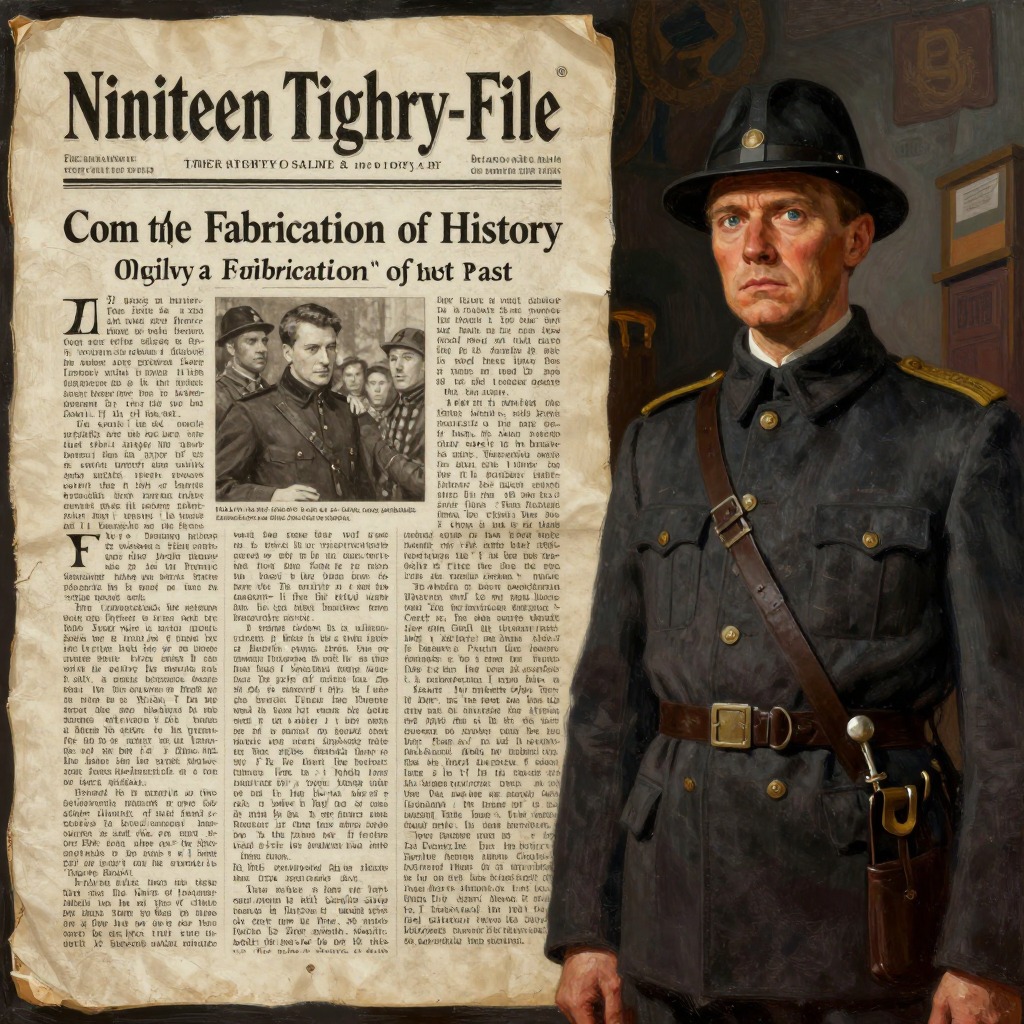
Tillotson
Nineteen Eighty-FourTillotson is a minor official in the Records Department of the Ministry of Truth in Nineteen Eighty-Four, glimpsed only in the early chapters through the wary eyes of Winston Smith. A small, precise-looking, dark-chinned man who works in the cubicle opposite Winston's, he is defined almost entirely by one repeated gesture: the hostile flash of his spectacles whenever he looks up from his secretive work. That gesture, and the questions it raises in Winston's mind, make him a small but telling emblem of the mutual suspicion on which the Party's apparatus of falsification depends.
Identity and Working Habits
Tillotson is introduced during a lull in the Records Department, with a folded newspaper on his knee and his mouth held very close to the mouthpiece of his speakwrite, as though trying to keep what he is saying a secret between himself and the telescreen. Winston, who barely knows him and has no idea what work he is employed on, notices the precision of his manner and the aggressive glitter that meets him across the hall. The scene establishes that in the long, windowless workroom people do not discuss their jobs; Tillotson's crouching posture is the normal posture of a departmental life in which every colleague is a potential informer, and even the telescreen is something to be kept at bay.
A Possible Rival in Forgery
Later that day Winston catches Tillotson again, still hunched secretively over his speakwrite, and again receives the hostile spectacle-flash. The thought that follows fixes Tillotson's narrative function: it is perfectly possible that he is engaged on the same job as Winston himself. The work is too tricky to be entrusted to one person, yet too shameful to be given to a committee, so perhaps as many as a dozen people are working on rival versions of what Big Brother actually said, until some master brain in the Inner Party selects one version, re-edits it, and allows the chosen lie to pass into the permanent records. Tillotson never confirms or denies his part in this; he remains a shape in the opposite cubicle whose only communication is a glare.
Bureaucratic Isolation and the Fabricated Past
Tillotson's function belongs to a wider pattern of engineered isolation. The Party's real, undeclared purpose, Winston reflects, is to prevent men and women from forming loyalties it cannot control; marriages must be approved by committees and are refused when couples show physical attraction, and only the proles have stayed human by remaining loyal to one another. In the Ministry itself the same logic operates on a smaller scale, turning adjacent desks into rival cells. The work that goes on in those cubicles is largely the substitution of one piece of nonsense for another: figures are rectified so that false forecasts become true ones, and a statistician can mark the boot output down to fifty-seven million pairs merely to allow for the claim that the quota has been over-fulfilled. Winston perceives that the truly characteristic thing about modern life is not its cruelty but its bareness and listlessness; Tillotson, seen only as a bent back and a glare, is the human residue of that system, a man reduced to his function and cut off from the private loyalties and spontaneous emotions that Winston finds surviving among the proles.
Narrative Role
Tillotson is a deliberately flat figure in a novel whose major characters are rounded. He speaks no word, receives no name beyond his surname and the ironic title Comrade, and exists solely to return Winston's glance with hostility on two occasions. That double flash of the spectacles is enough to make him a rival in Winston's imagination, and the uncertainty is the point: in a world where the Thought Police can be anyone, a colleague's averted face becomes a source of terror. He is also a function of the novel's focalization, observed entirely from outside, so that the reader shares Winston's ignorance of whether Tillotson is a fellow forger, a zealous amateur spy, or simply a nervous man guarding his own secrets. He never reappears, but the suspicion he leaves behind continues to haunt the Records Department.