memory hole chute
Nineteen Eighty-FourFew fixtures of the Ministry of Truth are more ordinary in appearance and more devastating in function than the memory hole chute: a large oblong slit, protected by a wire grating, set into the wall of every work cubicle within easy reach of the seated employee's arm. The same slit ran through the building in thousands or tens of thousands of copies, not only in every room but at short intervals in every corridor, so that nobody engaged in making the official record was ever more than a few steps from a place to destroy it. Whatever was dropped through the flap was whirled away on a current of warm air to the enormous furnaces hidden in the recesses of the building, and the staff's nickname for the device — "memory holes" — named with exactness what it did. The memory hole chute is the physical instrument of the Party's control over the past: the point at which superseded newspapers, inconvenient photographs and the records of disgraced comrades are consumed so that the corrected version alone survives as history. It is the material form of doublethink, the machinery through which the Party's members carry out what they call "reality control."
Design and Operation
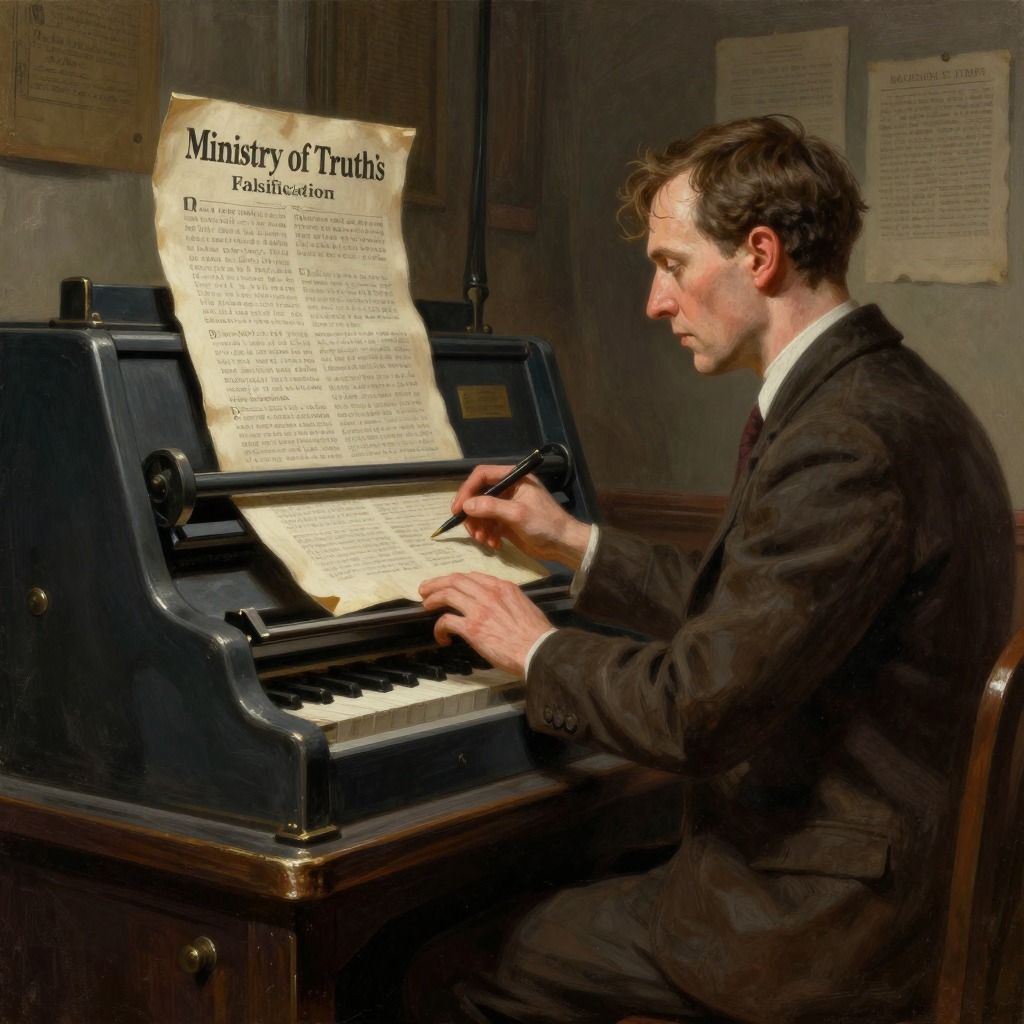
Within the cubicles of the Records Department the memory hole chute was the third of three conduits built into the walls: to the right of the Speakwrite ran a small pneumatic tube for written messages, to the left a larger one for newspapers, and in the side wall, directly within reach of the seated worker's arm, the oblong slit reserved for the disposal of waste paper. The placement made destruction as easy as reception. Use of the chute became automatic — Winston Smith, having dealt with the morning's messages and pushed his speakwritten corrections back through the pneumatic tube, would crumple the original message and any notes he had made and drop them into the memory hole "to be devoured by the flames," in "a movement which was as nearly as possible unconscious." Even a scrap of waste paper lying about produced the same reflex in any Party employee: the nearest flap was lifted and the scrap whirled away. Because the slits were repeated at short intervals in every corridor of the labyrinthine Ministry, the annihilation of the past was never a special ceremony but an ambient condition of work, as unremarked as the air current that carried each document away.
The Engine of Rewritten History
Winston's daily labour showed what the chute was for. Each message that slid out of the pneumatic tube demanded the rectification of some already-published record: a speech of Big Brother's that had predicted a quiet South Indian front had to be rewritten so that he had predicted the offensive that actually came; the Ministry of Plenty's promise, known officially as a "categorical pledge," that the chocolate ration would not be reduced during 1984 had to be replaced by a warning that a reduction might be necessary in April. As soon as the corrected copy was clipped to the appropriate issue of the Times and returned through the tube, the original copy was destroyed and the corrected copy placed on the files in its stead. The process of continuous alteration was applied not only to newspapers but to "books, periodicals, pamphlets, posters, leaflets, films, sound-tracks, cartoons, photographs" — to every kind of literature or documentation that might conceivably hold political or ideological significance; "Day by day and almost minute by minute the past was brought up to date." All history became a palimpsest, scraped clean and re-inscribed exactly as often as was necessary, and once the deed was done it was impossible to prove that any falsification had taken place: the memory hole had already eaten the evidence. A section of the Records Department far larger than Winston's existed solely to track down and collect every superseded copy of a book, newspaper or document due for destruction, so that an issue of the Times rewritten a dozen times still stood on the files bearing its original date, with no other copy anywhere to contradict it. This was the machinery behind the maxim Winston copied into his diary: "Who controls the past," ran the Party slogan, "controls the future: who controls the present controls the past." The chute is where that control is executed on paper.
The Photograph and the Furnaces
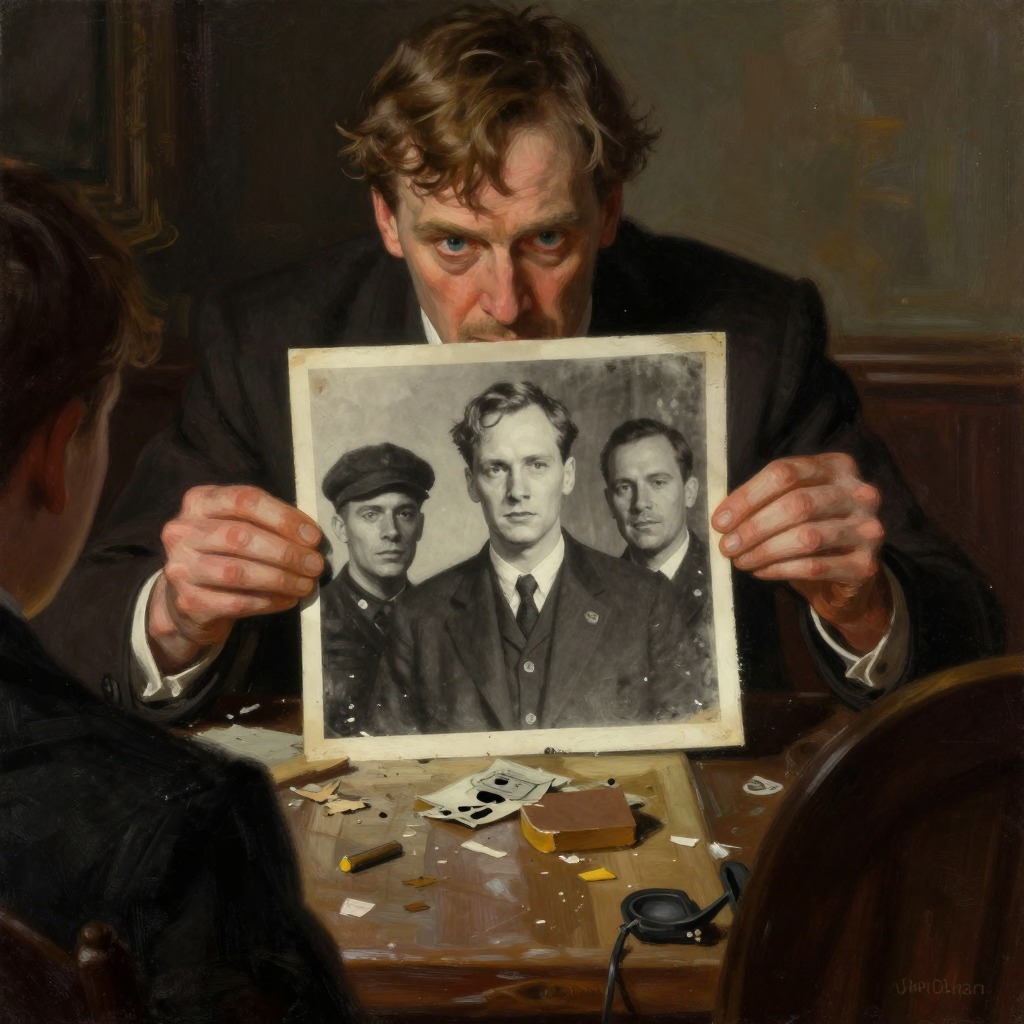
The chute's true gravity is measured by the most precious object ever fed into it. In 1973 Winston had found among the documents on his desk a half-page torn from an old issue of the Times: a photograph of delegates at a Party function in New York, with Jones, Aaronson and Rutherford prominent in the middle of the group. At both their trials the three men had confessed that on that very date — midsummer day, the date that had stuck in Winston's memory — they had been on Eurasian soil, flown from a secret airfield in Canada to a rendezvous somewhere in Siberia where they had conferred with members of the Eurasian General Staff and betrayed important military secrets. The photograph proved the confessions were lies. It was the one time in his whole life that Winston held in his hands unmistakable documentary proof of the falsification of a historical fact: concrete evidence, a fragment of the abolished past. He covered it with another sheet, endured ten minutes of terror lest the telescreen detect the beating of his heart, and then, without uncovering it again, dropped it into the memory hole along with some other waste papers; within another minute it would have crumbled into ashes. He wondered for years afterwards whether the Party's hold upon the past was less strong because a piece of evidence which existed no longer had once existed. The Ministry of Love supplied the answer's shape. During the interrogation, O'Brien drew from between his fingers another copy of the very same photograph, allowed Winston perhaps five seconds to see it, and then crossed to a memory hole in the opposite wall; unseen, the frail slip of paper was whirled away on the current of warm air and vanished in a flash of flame. "Ashes," said O'Brien. "Not even identifiable ashes. Dust. It does not exist. It never existed." The chute performs the Party's most radical act: not the defeat of the heretic but the annihilation of the fact, so that the lie, once consumed, becomes the only history there has ever been.
The Machine Against Memory
The memory hole chute defines by contrast the few things the Party has left intact. The glass paperweight that Winston buys from Mr Charrington appeals to him precisely because, as he tells Julia, "It's a little chunk of history that they've forgotten to alter. It's a message from a hundred years ago, if one knew how to read it." Where the chute consumes everything that bears words, the paperweight survives because it bears none; in Winston's darker formulation, whatever survives of the abolished past is "a few solid objects with no words attached to them, like that lump of glass there." The same project of extinguishing alternative thought proceeds on a second front described in the Appendix: Newspeak, the official language of Oceania, was devised to meet the ideological needs of Ingsoc and was expected to supersede Oldspeak altogether by about the year 2050, its purpose being that a heretical thought should become literally unthinkable, at least so far as thought depends on words. The memory hole and Newspeak are parallel machines: one destroys the records in which a different past could be found, the other destroys the words in which a different future could be conceived. Between them they enforce the Party's deepest claim — that the past, though of its nature alterable, has never been altered at all, because the destroyed evidence leaves no trace by which any other version could be tested.
The Chute and the Vaporized
The device also gives material form to the Party's vocabulary of disappearance. Contemplating his own likely end, Winston reflects that the diary will be reduced to ashes and himself to vapour; and "vaporized" is the usual word for the fate of a Party member who has been abolished — his name removed from the registers, every record of everything he had ever done wiped out, his one-time existence denied and then forgotten. In the world of 1984 a human being is, for official purposes, a set of documents, and the memory hole chute is where those documents go: the same current of warm air that carried off the photograph of Jones, Aaronson and Rutherford will one day carry off the diary that Winston has written at such risk, and Winston himself with it. The horrifying power of the chute lies in its quietness. It is never presented as an instrument of terror; it is a convenience, a slot in a wall, an "automatic action" performed thousands of times a day by people who mean no harm. That is the measure of the society it serves — the past is not argued away in Oceania, it is incinerated, and the incineration has become so routine that almost no one notices the warmth.