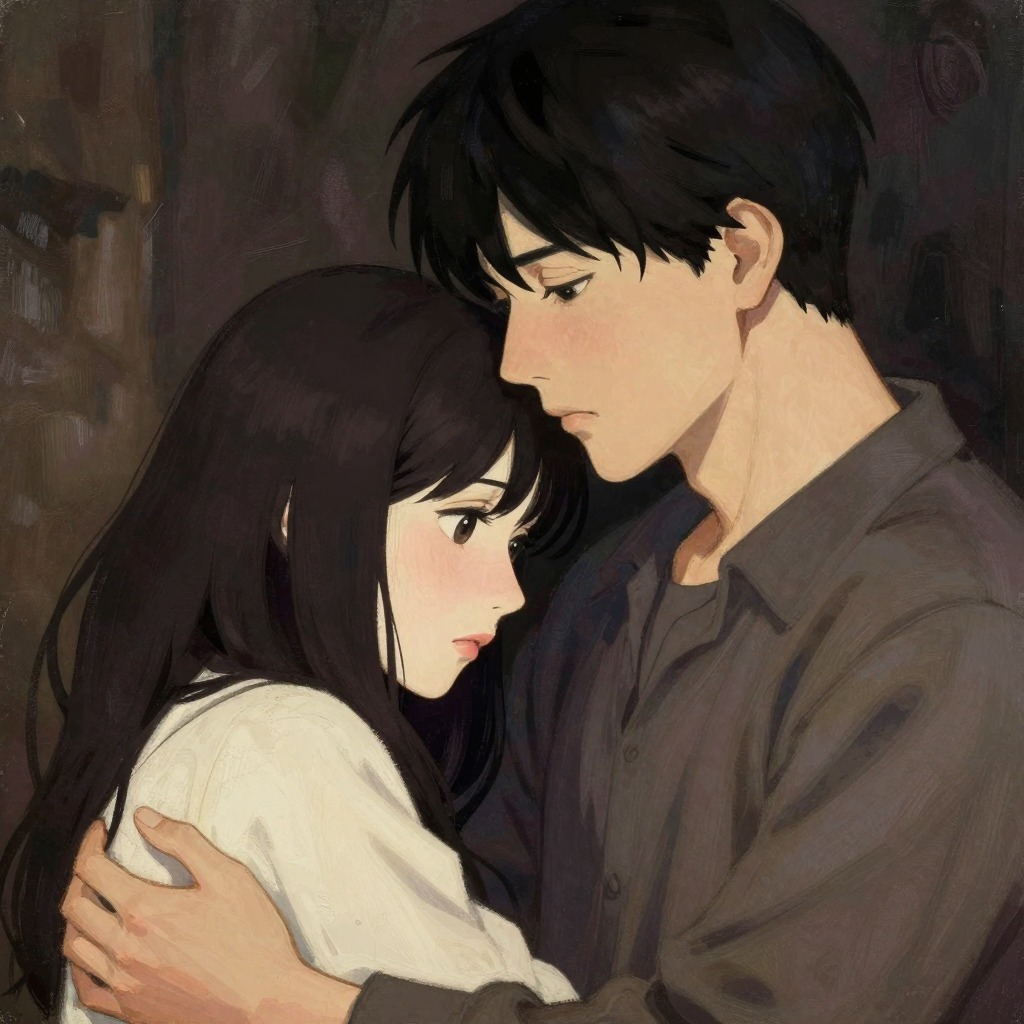
Asakusa
No Longer HumanAsakusa, a bustling entertainment district of Tokyo, appears in Yozo's notebooks as the setting for the final, decisive hours before his first suicide attempt. It is the place where his last shred of self-deception as a rich man's son is stripped away, and where the abstract desire for death hardens into an irrevocable act.
The Morning of the Suicide
On the morning after he and Tsuneko have resolved to die together, Yozo and Tsuneko wander through Asakusa. They enter a lunch stand and drink a glass of milk. This mundane act, in a district known for its theaters and crowds, is the calm before the catastrophe. When the bill comes, Yozo opens his wallet to find only three copper coins. The humiliation is not merely financial; it is the sudden, unbearable clarity of his total destitution. He sees before him his empty lodging room, his only possessions the clothes on his back. It is in this moment, standing in the Asakusa lunch stand, that he perceives with absolute clarity that he cannot go on living. The district, a place of cheap pleasures and anonymous crowds, becomes the stage for a reckoning with poverty so stark that it transforms his lingering hesitation into a genuine commitment to death.
The Geography of Humiliation
Asakusa is not merely a backdrop but an active agent in Yozo's degradation. The very ordinariness of the place—a lunch stand, a glass of milk—intensifies the shame. Tsuneko looks into his wallet and says, "Is that all you have?" Her voice, which he describes as the voice of the first woman he has ever loved, cuts him more deeply than any accusation. The humiliation is "more strange than any I had tasted before," a compound of poverty, love, and the exposure of his helplessness. It is a humiliation he cannot live with. Asakusa, with its tawdry vitality, offers no shelter from this truth. The district's function in the narrative is to compress Yozo's lifelong dread of human society into a single, unbearable transaction: three copper coins cannot buy even a glass of milk, and the woman he loves sees him for what he is.
The Path to the Sea
From Asakusa, the trajectory is fixed. The district is the last place Yozo inhabits as a free man before he and Tsuneko take the train to Kamakura and enter the sea. The memory of Asakusa is thus bound to the moment of his most complete surrender to despair. Later, in his years of decline, the district recurs as a site of drunken, solitary wandering. He staggers through the rows of saloons behind the Ginza, singing softly to himself, and vomits blood into the snow. The geography of his suffering is urban, anonymous, and relentlessly public. Asakusa, like the Ginza, is a place where a man can disappear into the crowd, but also where his degradation is exposed to the indifferent street. It is a landscape of last resorts, where the final, failed gestures of a life are played out.
The Pharmacy and the Final Refuge
Years later, after his release from the mental hospital, Yozo is living in a thatch-covered house by the sea, attended by an old servant named Tetsu. When he needs sleeping pills, he sends Tetsu to the village drugstore. The errand is a faint echo of his earlier, desperate transactions in the city. But the village drugstore, unlike the pharmacies of Tokyo, is a place of rural simplicity, and the mistake—Tetsu returns with a laxative instead of sleeping pills—is almost comic. Asakusa, by contrast, remains in the notebooks as the site of a more profound and irreversible transaction: the exchange of three copper coins for the knowledge that he is already dead to the world. The district is thus fixed in the narrative as the place where the last illusion of being a human being among other human beings was finally, and fatally, shattered.