Lion Mask Incident
No Longer HumanThe Lion Mask Incident stands as one of the earliest and most revealing episodes in Yozo's life of shame, a childhood moment that crystallizes his congenital inability to express desire, his terror of displeasing others, and the desperate, secretive clowning he would rely on for the rest of his life. Occurring during a visit from his father, a busy politician who maintained a town house in Tokyo, the incident exposes the foundational wound of Yozo's existence: a fear of human beings so profound that even choosing a gift becomes an unbearable ordeal, driving him to a nocturnal act of covert appeasement that succeeds in restoring his father's affection but at the cost of further entrenching his own self-alienation.
Background and the Burden of Choice
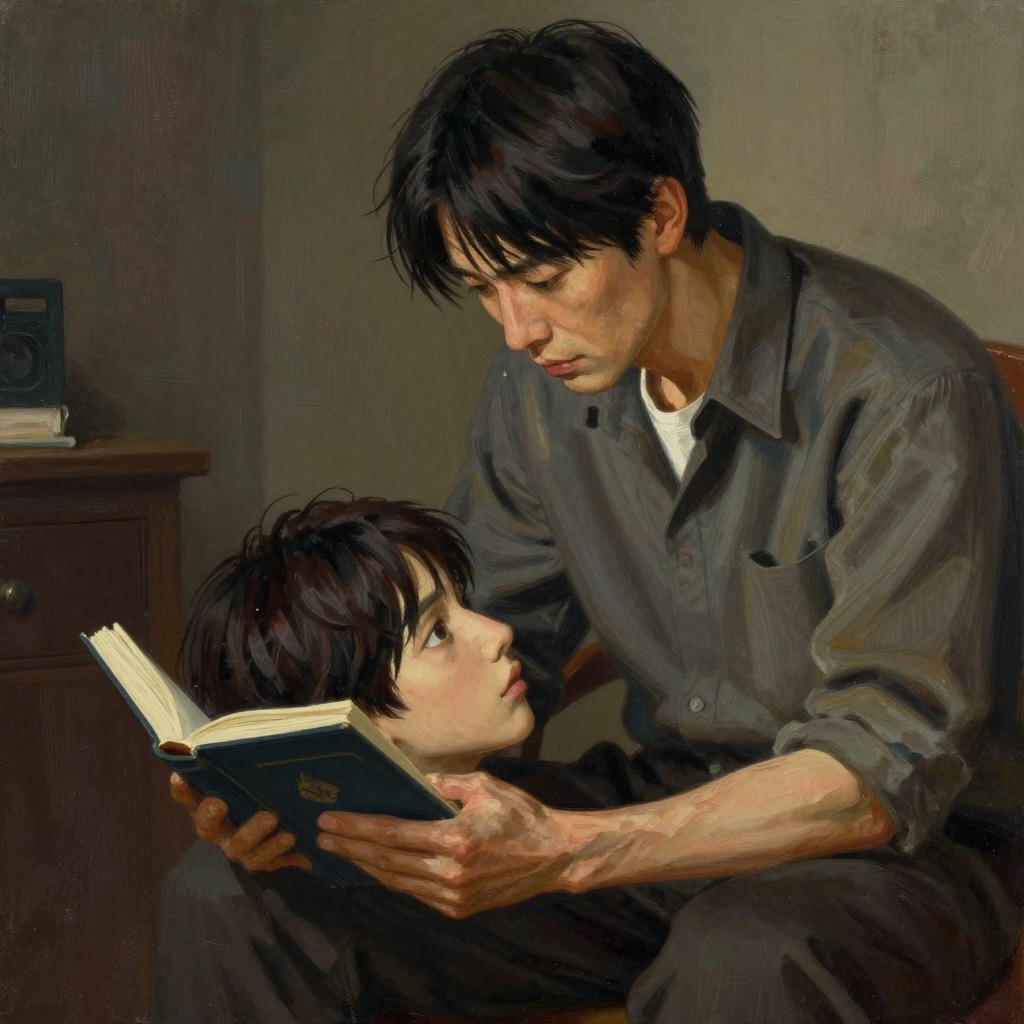
Yozo's father, who frequently traveled to Tokyo on business and always returned laden with presents for the family and relatives, once summoned all the children to the parlor the night before a departure. Smilingly, he asked each child what present they would like, carefully noting their replies in a little book. This display of affection was most unusual for him. When he turned to Yozo and asked, "How about you, Yozo?" the boy could only stammer uncertainly. Yozo's first impulse was always to answer "Nothing," driven by the thought that nothing would make him happy and by a congenital inability to refuse anything offered by another person, no matter how little it suited his tastes. When he hated something, he could not say "I don't like it"; when he liked something, he tasted it hesitantly, as though it were bitter. He had not the strength even to choose between two alternatives, a characteristic that would later develop into a major cause of his life of shame. As he remained silent and fidgeting, his father lost some of his good humor and suggested a book or a mask for the New Year lion dance, asking, "Wouldn't you like one?" The fatal phrase made it impossible for Yozo to answer; he could not even think of a suitably clownish response. His brother seriously suggested a book, and his father, the pleasure draining from his face, snapped his notebook shut without writing anything.
The Nocturnal Act of Appeasement
That night, lying shivering in bed, Yozo was consumed by the thought that he had angered his father and that his revenge would be something fearful. Desperate to redress the situation, he crept out of bed, tiptoed down to the parlor, and opened the drawer of the desk where his father had most likely put the notebook. Finding it, he riffled through the pages until he came to the place where the requests for presents were jotted down. He licked the notebook pencil and wrote in big letters "Lion Mask." He had not the faintest wish for a lion mask; he would actually have preferred a book. But it was obvious that his father wanted to buy him a mask, and his frantic desire to cater to his wishes and restore his good humor had emboldened him to this desperate expedient. This act was not born of a child's simple mischief but of a deep, terror-driven compulsion to please, a strategy of survival that bypassed any genuine expression of self.
The Success and Its Deeper Meaning
The desperate expedient was rewarded by the great success Yozo had hoped for. Some days later, when his father returned from Tokyo, Yozo overheard him say to his mother in a loud voice that he had found the words "lion mask" written in his notebook, not in his own handwriting. He realized it was some of Yozo's mischief, concluding that the boy must have wanted the mask so badly he couldn't stand it. "He's certainly a funny kid," his father laughed. "Pretends not to know what he wants and then goes and writes it." The incident was a triumph of Yozo's clowning, a performance that successfully manipulated his father's perception and restored familial harmony. Yet the victory was hollow. The incident perfectly illustrates the mechanism of Yozo's entire life: a surface of amusing eccentricity that conceals a core of paralyzing fear and a compulsive need to serve the expectations of others. It was a pattern that would repeat itself in his relationships with women, with friends like Masao Horiki, and in his desperate attempts to navigate a world he found terrifying and incomprehensible. The Lion Mask Incident is thus not merely a childhood memory but the prototype of Yozo's tragic strategy for survival, a strategy that ultimately leads to his complete disqualification as a human being.