Morphine
No Longer HumanMorphine enters Yozo's life as a seemingly benign substitute for alcohol, but it quickly becomes the instrument of his most complete degradation and the direct cause of his institutionalization. Offered by the crippled pharmacist woman as a medicine to be used "when you need a drink so badly you can't stand it," the drug initially promises liberation from the squalor of drunkenness. Instead, it delivers Yozo into a bondage far more absolute, erasing his remaining inhibitions, accelerating his physical ruin, and severing his last tenuous connections to a functional life. The morphine episode marks the point at which Yozo's self-destructive trajectory becomes irreversible, transforming him from a troubled alcoholic into a full-fledged addict whose existence is reduced to the single-minded pursuit of the next injection.
The Promise of Escape and the Onset of Addiction
The pharmacist woman, a widow who walks with crutches due to infantile paralysis, gives Yozo the morphine after he confesses to coughing blood and feeling unable to stop drinking. She explains that her husband, who had tuberculosis, shortened his life by claiming he killed the germs with liquor, and she urges Yozo to cut out the alcohol. Believing her when she says the morphine is no more harmful than liquor, Yozo injects the drug into his arm without hesitation. The effect is immediate and transformative: his insecurity, fretfulness, and timidity are swept away completely, replaced by an expansive optimism and fluent talk. He applies himself energetically to his cartoons, sometimes bursting out laughing even while drawing. The relief is so profound that what begins as a single daily shot quickly escalates to two, then three, and finally to four injections a day, at which point Yozo can no longer work unless he has had his shots.
The Spiral of Dependency and Degradation
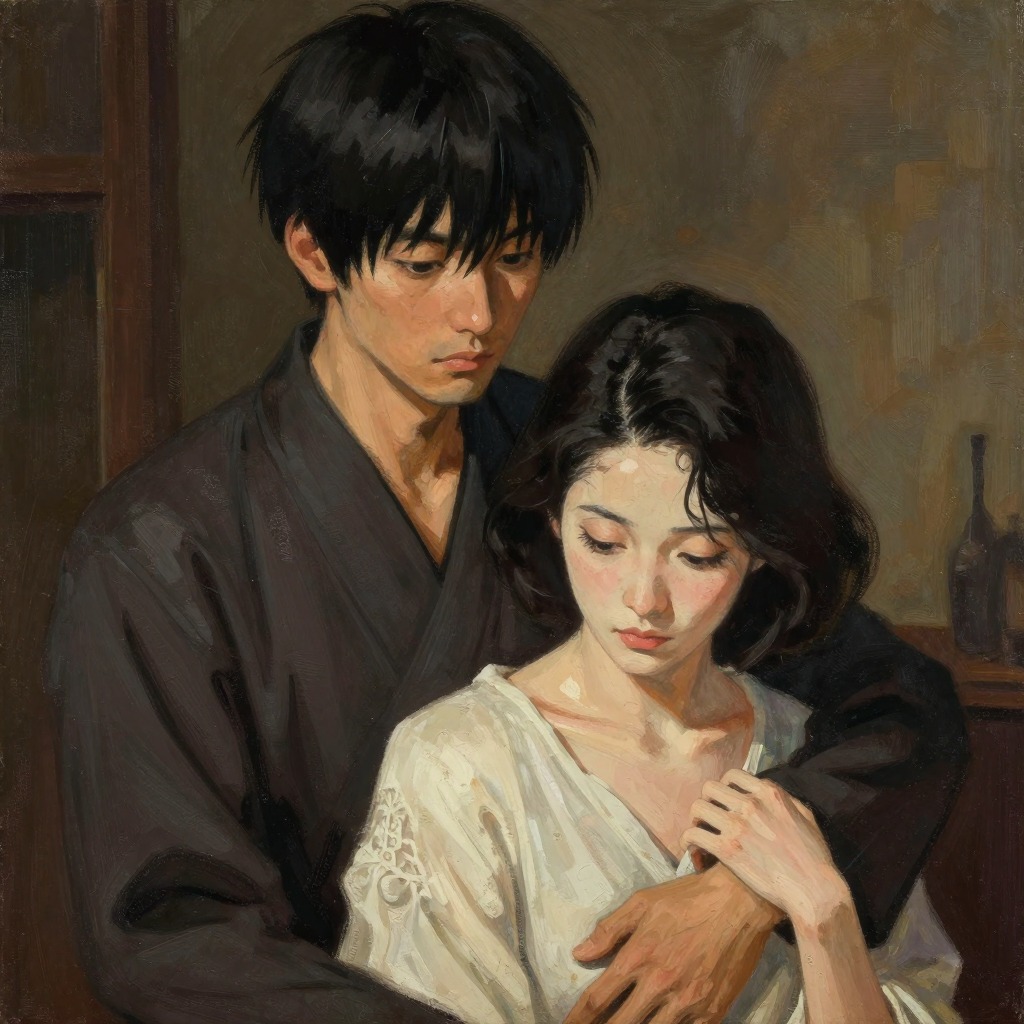
Yozo's susceptibility to suggestion accelerates his addiction. When the pharmacist woman admonishes him about the danger of becoming an addict, he immediately feels that he has already become a fairly confirmed one, and this uneasiness drives him to seek more of the drug. He begins to visit her late at night, once throwing his arms around her and pretending to weep in order to obtain a box of morphine. By the time he realizes that drugs are as abominable and foul—indeed, fouler—than gin, he has already become an out-and-out addict. He reaches what he calls the extreme of shamelessness: to obtain money for the drug, he resumes copying pornographic pictures, and he also has what he describes as a very ugly affair with the crippled woman from the pharmacy. The more he works, the more morphine he consumes, and his debt at the pharmacy reaches a frightening figure. Whenever the woman catches sight of his face, the tears come to her eyes, and Yozo weeps as well. He paces back and forth, half in a frenzy, between his apartment and the pharmacy, trapped in what he calls an inferno.
The Final Break and Institutionalization
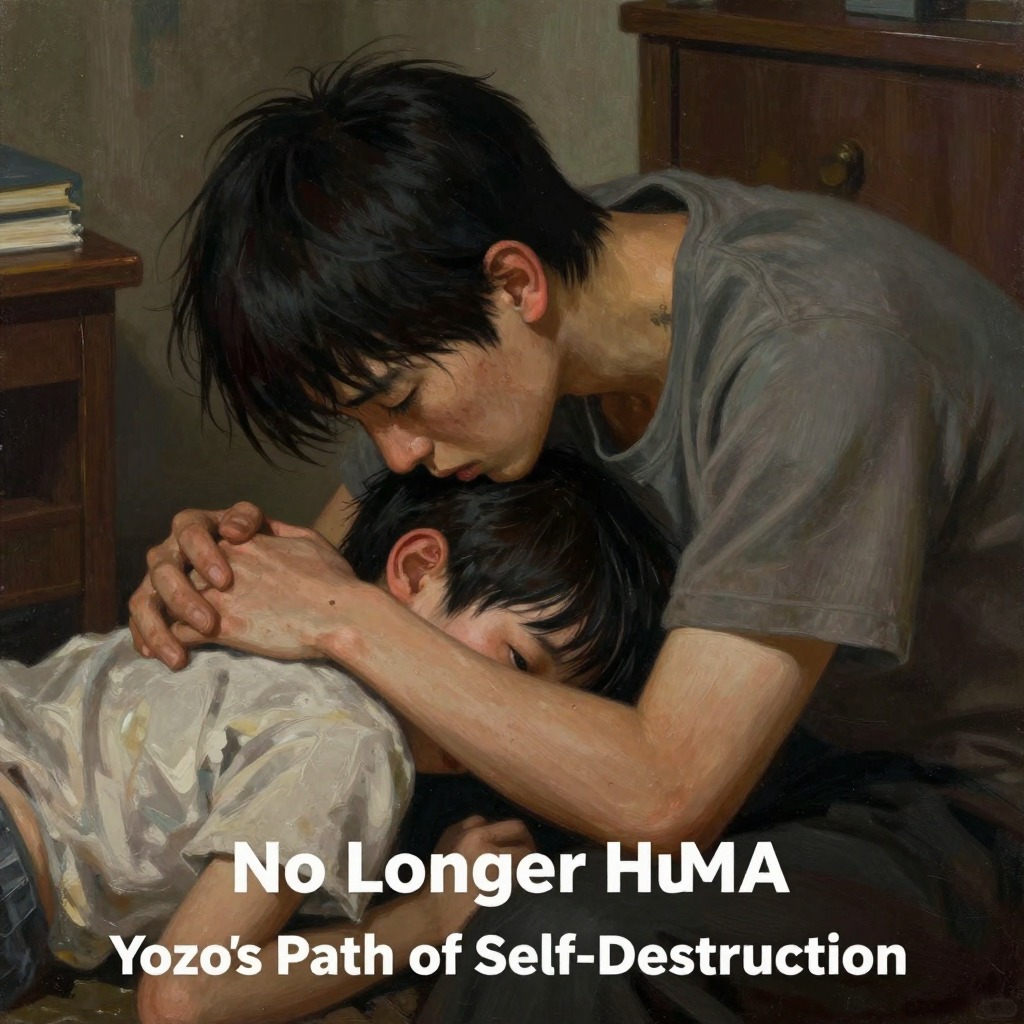
As a last resort, Yozo writes a long letter to his father confessing his circumstances fully, a gamble he equates with betting on the existence of God. The answer never comes, and his anxiety and dread cause him to increase the dosage further. He resolves to give himself ten shots in one night and throw himself into the river. On the afternoon of the chosen day, however, Flatfish and Horiki arrive, having seemingly sniffed out his plan. Horiki speaks to him with a gentle smile the like of which Yozo has never seen on his face, and Yozo is completely shattered by that one gentle smile. He weeps helplessly and obeys whatever the two men decree, like a man bereft of all will. They bundle him into an automobile and take him to a large hospital in the woods. There, a young doctor with a bashful smile examines him and pronounces that he needs to rest and recuperate. When Yoshiko silently offers him the hypodermic needle and the remaining medicine from her handbag, Yozo refuses them—a rare event, the one and only time in his life that he has refused something offered to him. The doctor then ushers him to a ward, and the key grates in the lock behind him. Yozo has been placed in a mental hospital. His delirious cry after swallowing the sleeping pills—that he would go where there were no women—has now materialized in a truly uncanny way: his ward holds only male lunatics, and the nurses are also men. There is not a single woman. Yozo concludes that he has now ceased utterly to be a human being, branded forever as a madman, a reject.