Photographs of Yozo
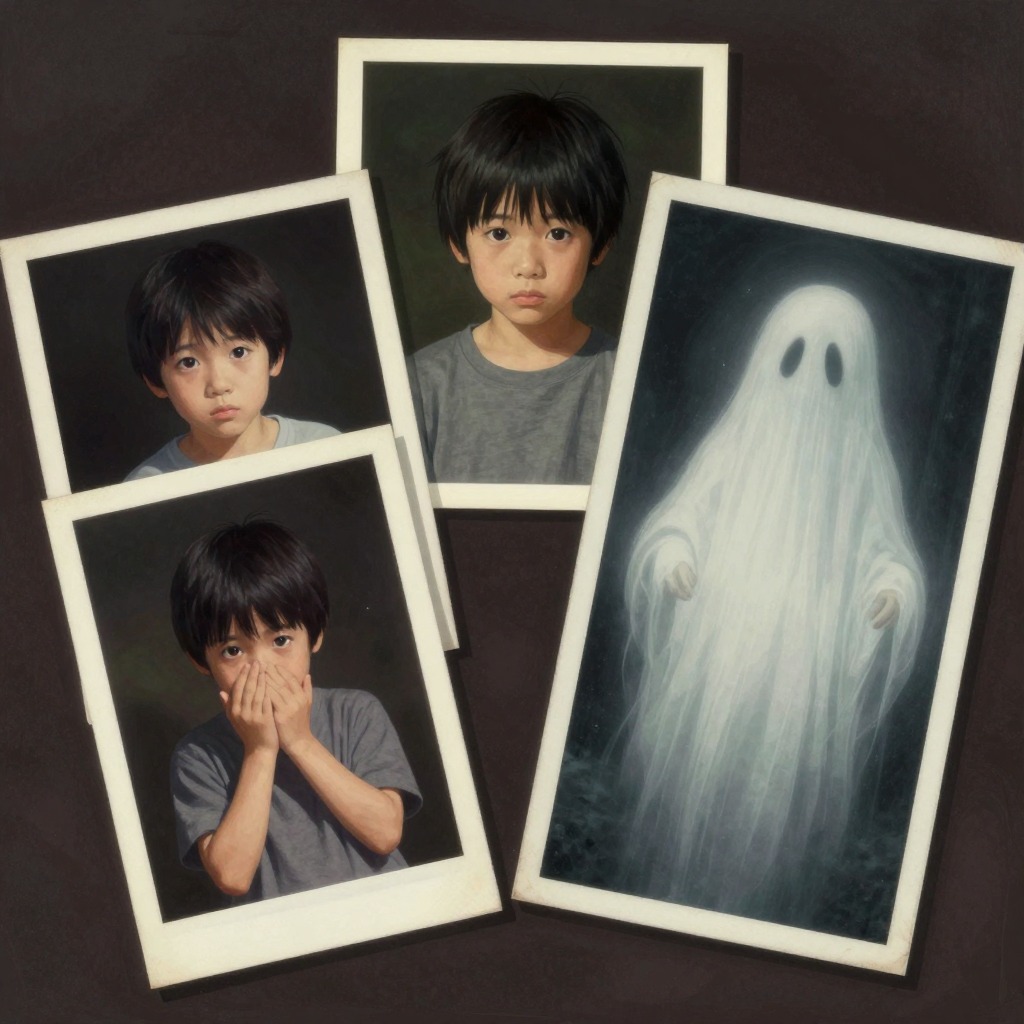
No Longer HumanThe three photographs of Yozo, described in the prologue of No Longer Human, function as a visual epitaph to his life of shame. They are not mere keepsakes but a triptych of alienation, each image capturing a different stage of his estrangement from humanity. The first, a childhood photograph, shows a boy of about ten, surrounded by women, his head tilted at a thirty-degree angle, his teeth bared in an ugly smirk. The narrator insists this is not a smile but a monkey's grimace, a freakish expression that inspires revulsion rather than affection. The boy's clenched fists betray the lie of his grin, and the image is so unsettling that the narrator compares it to brushing away a caterpillar. This photograph establishes Yozo's earliest performance: a desperate, unnatural clowning designed to placate others, a role born of a mortal dread of human beings that he already felt as a child.
The Student Photograph: A Mask of Artificiality
The second photograph, taken during Yozo's high school or college years, presents a startlingly handsome young man in a student uniform, a white handkerchief peeping from his breast pocket. He sits in a wicker chair with his legs crossed, wearing an adroit little smile. Yet this smile, too, fails to convey life. It lacks what the narrator calls the "heaviness of blood" or the "solidity of human life"; it is as light as a blank sheet of paper, a mere pretense. The image produces a sensation of complete artificiality, a baffling good looks that is strangely unpleasant. This photograph captures Yozo's perfected clowning, the mask he wore to navigate the world of human beings he feared. It is the face of the jester, the Harold Lloyd of Northeast Japan, a role that allowed him to survive but at the cost of any authentic self.
The Final Photograph: The Effacement of Self
The third and most monstrous photograph is the culmination of Yozo's disintegration. Taken in a corner of an extraordinarily dirty room, with crumbling walls, it shows a man whose hair is streaked with grey, his small hands held in front of him. He is not smiling; his face is utterly expressionless. The image has a chilling, foreboding quality, as if it caught him in the act of dying. The most shocking aspect is its lack of individuality: the forehead, wrinkles, eyebrows, eyes, nose, mouth, and chin are all average, and the face fails to leave a memory. The narrator cannot recall it even after looking at it a second time. It is like a human body with a horse's head attached, an effigy that suggests nothing so much as a death mask. This photograph represents the final stage of Yozo's life: the complete erasure of self, the point at which he has become a "reject," disqualified as a human being.
Narrative Function and Thematic Significance
The photographs are not merely a framing device; they are a key to understanding Yozo's entire narrative. They are introduced by an unnamed narrator in the prologue, who describes them before the reader encounters Yozo's own voice. This creates a tension between the external, objective view of Yozo's life and his own subjective, shame-ridden account. The photographs are later mentioned in the epilogue, when the madam of the Kyobashi bar gives them to the narrator along with Yozo's three notebooks. The narrator is fascinated by the photographs, and they persuade him to accept the notebooks. The photographs thus serve as a visual summary of Yozo's trajectory: from the grotesque clowning of childhood, through the artificial mask of youth, to the final, terrifying blankness of a man who has lost all connection to humanity. They are a testament to the novel's central theme: the impossibility of authentic selfhood in a world of performance and fear.