Pictures of Ghosts
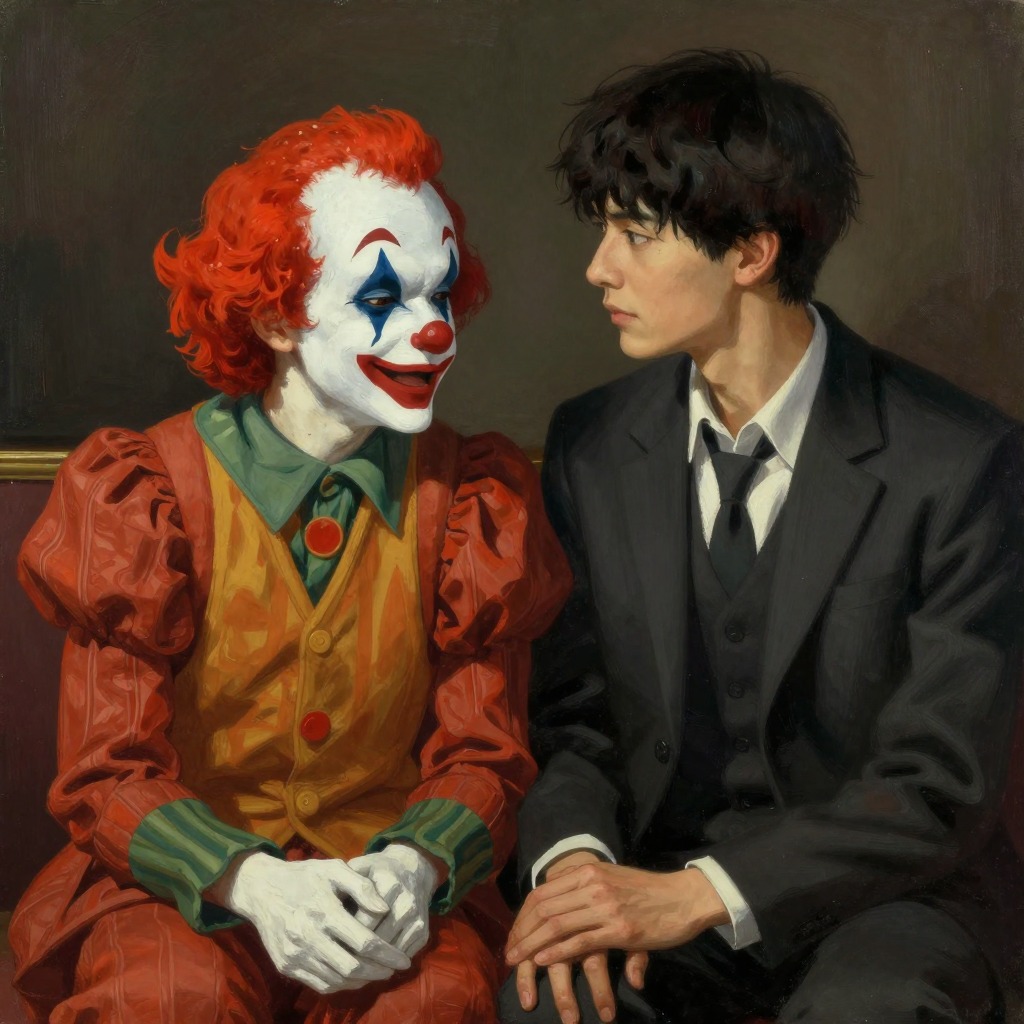
No Longer HumanPictures of Ghosts is the name Yozo gives to a series of self-portraits he painted in secret during his high school years, works that he considered his only genuine artistic achievement. Unlike the clowning and comic stories with which he entertained others, these pictures were a direct, harrowing depiction of his true self—the self he had desperately hidden behind a mask of cheerfulness. The pictures were so heart-rending that they stupefied even Yozo himself, and he kept them hidden in the back of his cupboard, showing them to no one except his schoolmate Takeichi. The loss of these pictures during one of his frequent changes of address became a source of permanent grief, and he later measured all his subsequent artistic efforts against the memory of these lost masterpieces, finding them all falling far short.
Origin and Inspiration
The concept of painting "ghosts" was first suggested to Yozo by Takeichi, the puniest boy in his class, who had detected that Yozo's clowning was deliberate. One day Takeichi came to Yozo's room proudly displaying a brightly colored picture he called a ghost. Yozo was startled to recognize it as a self-portrait by van Gogh. When Yozo showed Takeichi a volume of Modigliani reproductions, Takeichi widened his eyes in admiration and called one of the nudes "a horse out of hell." This exchange opened Yozo's eyes to a new understanding of art. He realized that the masters—van Gogh, Gauguin, Cézanne, Renoir—had not tried to depict things prettily; instead, through their subjective perceptions, they created beauty out of trivialities and soaked themselves in the pleasure of depicting even nauseatingly ugly things. They had dared to paint pictures of devils, and Yozo, trembling with excitement, declared to Takeichi that he too would paint ghosts and devils and horses out of hell.
The Self-Portraits as True Self
Before Takeichi's revelation, Yozo's paintings had remained flat as paper cutouts, offering no promise of development. But now he began to paint self-portraits in his new "ghost-style," taking care that they not be seen by his female visitors. The pictures he drew were so heart-rending as to stupefy even himself. Here was the true self he had so desperately hidden—the self behind the cheerful smile and the laughter he provoked in others. Yozo secretly affirmed this self, sure that there was no escape from it, but he was terrified that others might either detect the nightmarish reality under his clowning or, worse, mistake his true self for just another twist of his clowning and laugh at it. He therefore hid the pictures in the back of his cupboard and continued to paint in the conventional idiom of pretty things during school drawing classes. Only to Takeichi did he show his self-portraits, earning from him the prediction that Yozo would become a great painter someday.
Loss and Lingering Grief
The self-portraits, along with a picture of a ghost, disappeared during one of Yozo's frequent changes of address. Afterward, he painted pictures of every description, but they all fell far short of those splendid works as he remembered them. The loss plagued him with a heavy sense of loss, as if his heart had become empty. Whenever he spoke of painting, an "undrunk glass of absinthe" flickered before his eyes—a symbol of the unattainable standard set by those lost works. He was agonized by the frustrating thought that if only he could show those paintings to others, they would believe in his artistic talents. When Shizuko, the woman who took him in after his suicide attempt, dismissed his claims of artistic ability as a joke, Yozo wished he could show her those pictures but felt an empty chagrin that gave way to resignation. The lost masterpieces haunted him even as he drew cheap comic strips for a living, and he never recovered from the sense that his true artistic self had been irretrievably lost along with them.
Thematic Significance
The Pictures of Ghosts represent the only truthful expression Yozo ever achieved of his inner self—a self he otherwise concealed behind a lifetime of clowning and deception. They are the visual counterpart to the written notebooks that form the novel, both being attempts to record the harrowing reality of a man who feels disqualified from being human. The fact that Yozo kept them hidden, showed them only to the one person who had seen through his clowning, and then lost them forever, mirrors his inability to integrate his true self into the world of human beings. The pictures are also a measure of his failed artistic ambition: Takeichi's prophecy that Yozo would become a great painter never materialized, and Yozo ended his career as an unknown, second-rate cartoonist for the cheapest magazines. The lost ghost pictures thus stand as a symbol of everything Yozo might have been but never became—the authentic self that was hidden, lost, and ultimately unrecoverable.