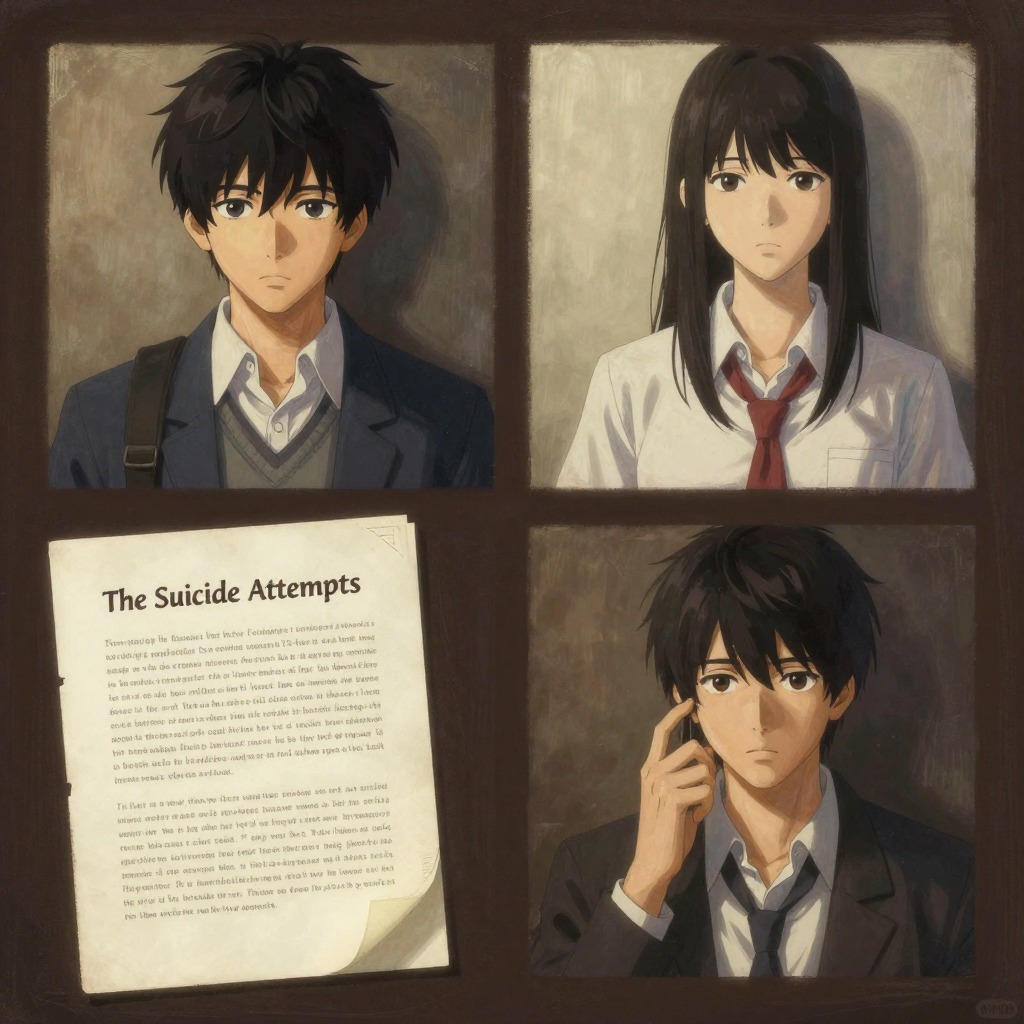
Second Suicide Attempt (Dial Overdose)
No Longer HumanThe Second Suicide Attempt (Dial Overdose) marks the decisive collapse of Yozo's already fragile existence, the moment when the last sustaining illusion—Yoshiko's immaculate trustfulness—is poisoned, and he turns to a calculated overdose as his only remaining action. Unlike the impulsive, shared leap into the sea with Tsuneko, this attempt is solitary, premeditated, and carried out in the dead of night within his own home, a direct response to a violation that has stripped him of his final hope. The event does not end his life but instead completes his social death, landing him in a mental hospital and crystallizing his identity as one who has been 'disqualified as a human being.'
Background and the Collapse of Trust
The attempt is the direct consequence of Yoshiko's rape by the shopkeeper, an event that Yozo witnesses through a window while standing paralyzed on the staircase. He does not feel fury or hatred but an 'overpowering fear,' a 'fierce ancestral dread' that splits him 'through the forehead between the eyebrows,' a wound that throbs whenever he encounters another human being. What destroys Yozo is not the physical act itself but the defilement of Yoshiko's 'immaculate trustfulness,' the one quality he had cherished as 'clean and pure, like a waterfall among green leaves.' After that night, the waters of that cascade turn 'yellow and muddy'; Yoshiko begins to tremble before him, and Yozo loses all comprehension of the world around him. His only resort is drink, and his face coarsens, his teeth fall out from the interminable drinking bouts. He begins copying pornographic pictures to sell secretly, needing money for gin. Doubt breeds fresh doubt: he wonders if Yoshiko has also been with Horiki or with someone else, but he lacks the courage to question her directly, writhing instead in his usual fears and drinking until he can inflict on her an 'abominable, hellish caressing' before falling into a dead sleep.
The Act of the Overdose
Towards the end of that year, Yozo comes home late one night blind drunk. Wanting a glass of sugar-water, he goes to the kitchen and opens the sugar bowl. Inside, instead of sugar, he finds a thin black cardboard box. He reads the label: most of the writing has been scratched off, but the Western letters 'Dial' remain legible. He recognizes it as a box of sleeping pills, the contents unquestionably sufficient to cause death, the seal still unbroken. He realizes he must have hidden it there himself at some past moment when he felt he might need it, after first scratching off the Japanese part of the label, confident that Yoshiko, who cannot read Western letters, would not understand. 'You have committed no sin,' he thinks. Very quietly, careful not to make the least noise, he fills a glass with water, deliberately breaks the seal, and pours the entire contents into his mouth. He calmly drains the glass in one gulp, switches off the light, and goes to bed at once. For three days and nights he lies as one dead. The doctor considers it an accident and kindly postpones reporting to the police. The first words Yozo murmurs as he begins to recover consciousness are, 'I'm going home'—though it is not clear even to himself what place he means by 'home'—and he is told he said this while weeping profusely.
Consequences: Confinement and the Label of Madness
When the fog clears, Yozo finds Flatfish sitting at his pillow with an unpleasant expression. Flatfish complains that Yozo always chooses the end of the year, when everybody is frantically busy, to do such things. The madam of the Kyobashi bar is also there. Yozo, still weeping, blurts out, 'Take me away from Yoshiko,' a confession that surprises even himself. Then, in an utterly unpremeditated slip of the tongue, he says, 'I'm going somewhere where there aren't any women.' Flatfish laughs loudly, the madam titters, and Yozo, amidst his tears, turns red and smiles despite himself. Flatfish declares it an excellent idea, saying everything goes wrong as soon as women are around. This delirious cry later materializes in a ghastly way. Not long after, Flatfish and Horiki appear, and Horiki, with a gentle smile Yozo has never seen before, says, 'I hear you've coughed blood.' Yozo is so overwhelmed by that one gentle smile that he averts his face and weeps, completely shattered. He is bundled into an automobile and taken to a large hospital in the woods. A young doctor with a bashful smile examines him and says he needs to rest. When Yoshiko silently offers him the hypodermic needle and remaining morphine from her handbag, Yozo refuses—a rare event, the only time in his life he has ever said no to something offered. The key grates in the lock behind him. He is in a mental hospital. His delirious cry has come true: his ward holds only male lunatics, and the nurses are also men. There is not a single woman. He realizes he is no longer a criminal but a lunatic, and that even if released, he will be forever branded on the forehead with the word 'madman' or 'reject.' He has now ceased utterly to be a human being.
Thematic Significance: The Final Disqualification
The Second Suicide Attempt is the terminal point of Yozo's long descent, the moment when his lifelong pattern of passive, non-resistant surrender—what he calls his inability to say no—finally delivers him into the hands of an institution that confirms his own verdict on himself. The attempt is not a cry for help or a dramatic gesture; it is a quiet, methodical act carried out in the dark, as if he were simply completing a piece of paperwork. The fact that it fails, and that he is saved only to be locked away, underscores the novel's central irony: Yozo's most decisive action—his choice to die—is the one that most thoroughly strips him of his humanity in the eyes of the world. The event also completes the arc of his relationship with Yoshiko: her trustfulness, which he once saw as a waterfall of pure virtue, becomes the source of his final undoing, and his refusal of the morphine she offers him at the hospital gate is the one and only time he ever says no, a belated assertion of will that comes too late to alter his fate. The 'Dial' label, with its Western letters that Yoshiko cannot read, becomes a symbol of the unbridgeable gap between Yozo's inner world and the world of others—a secret language of death that only he can decipher.