Society as an individual
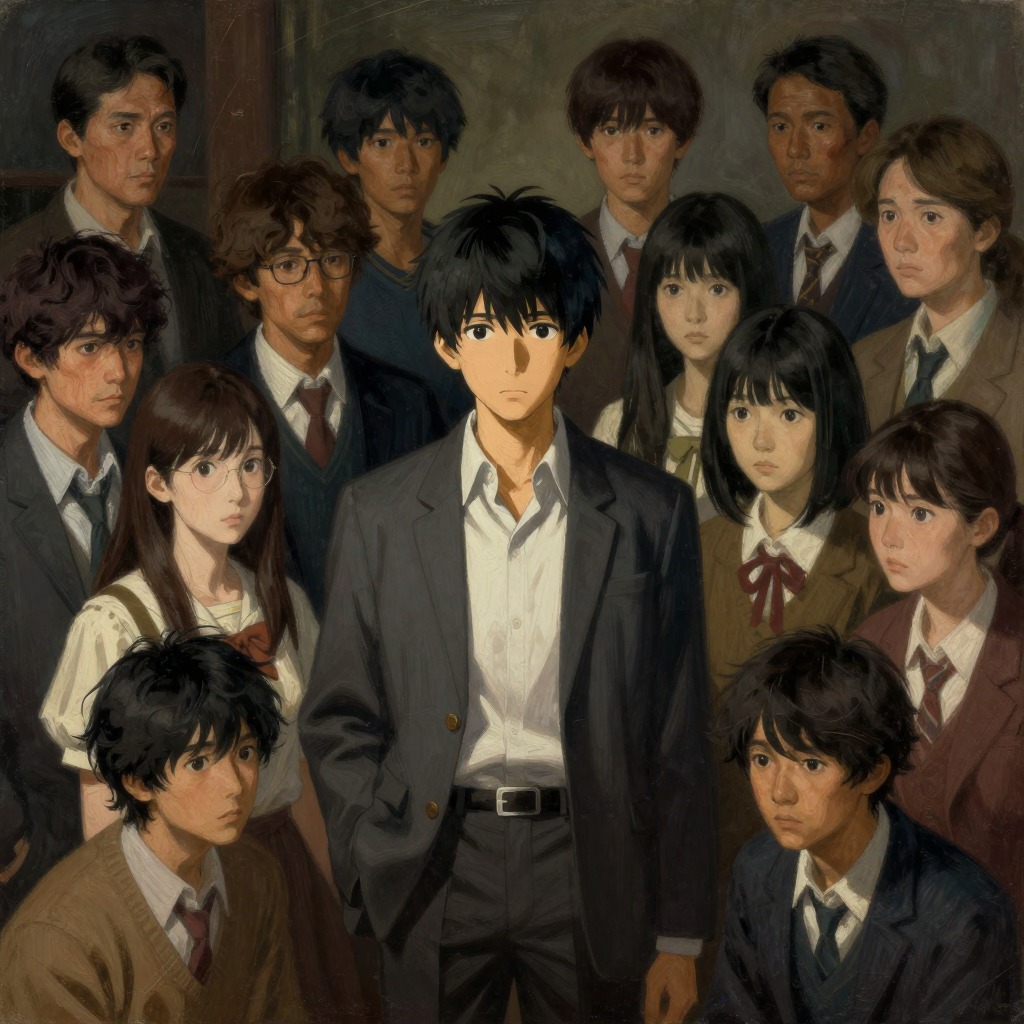
No Longer HumanSociety as an individual is the most decisive philosophical conviction that Yozo arrives at in No Longer Human, a redefinition of the terrifying abstraction called "society" as nothing more than a single human being. This insight, which he formulates almost as a creed, allows him to shed some of his paralyzing dread and to act with a new, aggressive self-will in the immediate struggles of daily life. Yet the same insight also reveals that the horror he once projected onto a vast, impersonal "society" is in fact the bottomless horror of individual human beings, a discovery that ultimately cannot save him from his descent into addiction, madness, and self-annihilation.
Origins in Fear and Clowning
Long before Yozo could articulate his conviction, his life was governed by a terror of human beings so profound that he could not conceive of himself as belonging to their species. He writes that his has been "a life of much shame" and that he cannot even guess what it must be to live the life of a human being. This dread drove him to invent his clowning, which he calls "the last quest for love I was to direct at human beings." He kept his melancholy and agitation hidden, feigning an innocent optimism and perfecting himself in the role of the farcical eccentric. His acting talents matured to the point where he could convulse a classroom with laughter, but the fear of human beings continued to writhe in his breast. This fundamental terror was the soil from which his later philosophical insight would grow.
The Formulation of the Conviction
The breakthrough comes during Yozo's period of living with Shizuko in Koenji, when Horiki begins to lecture him with warnings about what "society" will and will not tolerate. Horiki tells him, "You must stop your fooling around with women. You've gone far enough. Society won't stand for more." This triggers a cascade of unspoken thoughts in Yozo's mind. He wonders what Horiki means by "society" — is it the plural of human beings? Where is the substance of this thing called "society"? He has spent his whole life thinking that society must certainly be something powerful, harsh, and severe, but hearing Horiki talk makes the words "Don't you mean yourself?" come to the tip of his tongue. He holds the words back, reluctant to anger Horiki, but from that moment he comes to hold, almost as a philosophical conviction, the belief: "What is society but an individual?"
Consequences: A New Mode of Action
Once Yozo suspects that society might be an individual, he is able to act more in accordance with his own inclinations. Shizuko finds that he has become rather self-willed and not so timid as before. Horiki remarks that it is funny how stingy Yozo has become. Yozo himself reflects that he has gained a modicum of freedom from his terror at the illusion of the ocean called the world. He learns to behave rather aggressively, without the endless anxious worrying he knew before, responding as it were to the needs of the moment. When he leaves Shizuko's apartment, he simply tells the madam of the bar in Kyobashi, "I've left her and come to you," and that is enough. His single then-and-there contest has been decided, and "society," which by all rights should have been implacable, inflicts not a particle of harm on him. He gradually comes to relax his vigilance towards the world, thinking that it is not such a dreadful place.
The Limits of the Insight
Despite this new understanding, Yozo remains afraid of human beings. Before he can meet even the customers in the bar, he must fortify himself by gulping down a glass of liquor. The desire to see frightening things draws him every night to the bar, where he proclaims his drunken, bungling theories of art. His conviction that society is an individual does not free him from his fundamental dread; it only changes the terms on which he experiences it. The horror is no longer projected onto an abstract, oceanic "society" but is confronted in each individual encounter. This shift allows him to act, but it does not heal the wound that has been split through his forehead between the eyebrows — a wound that throbs with pain whenever he comes in contact with a human being.
The Tragic Irony
The ultimate irony of Yozo's conviction is that it both liberates him and condemns him. It liberates him from the paralyzing fear of an abstract, monolithic "society," enabling him to make decisions in the moment and to assert himself in ways he never could before. But it also condemns him because it reveals that the horror he once attributed to a vast, impersonal force is in fact the horror of individual human beings — and those individuals, one by one, prove to be more than he can bear. The shopkeeper who violates Yoshiko, Horiki who betrays him, the pharmacist woman who enables his morphine addiction — each is an individual, and each contributes to his destruction. His conviction that society is an individual becomes, in the end, not a source of strength but a confirmation of his utter isolation. He is left with the thought that "everything passes," the only thing he has ever found that resembles a truth in the society of human beings where he has dwelled as in a burning hell.