Sumida River
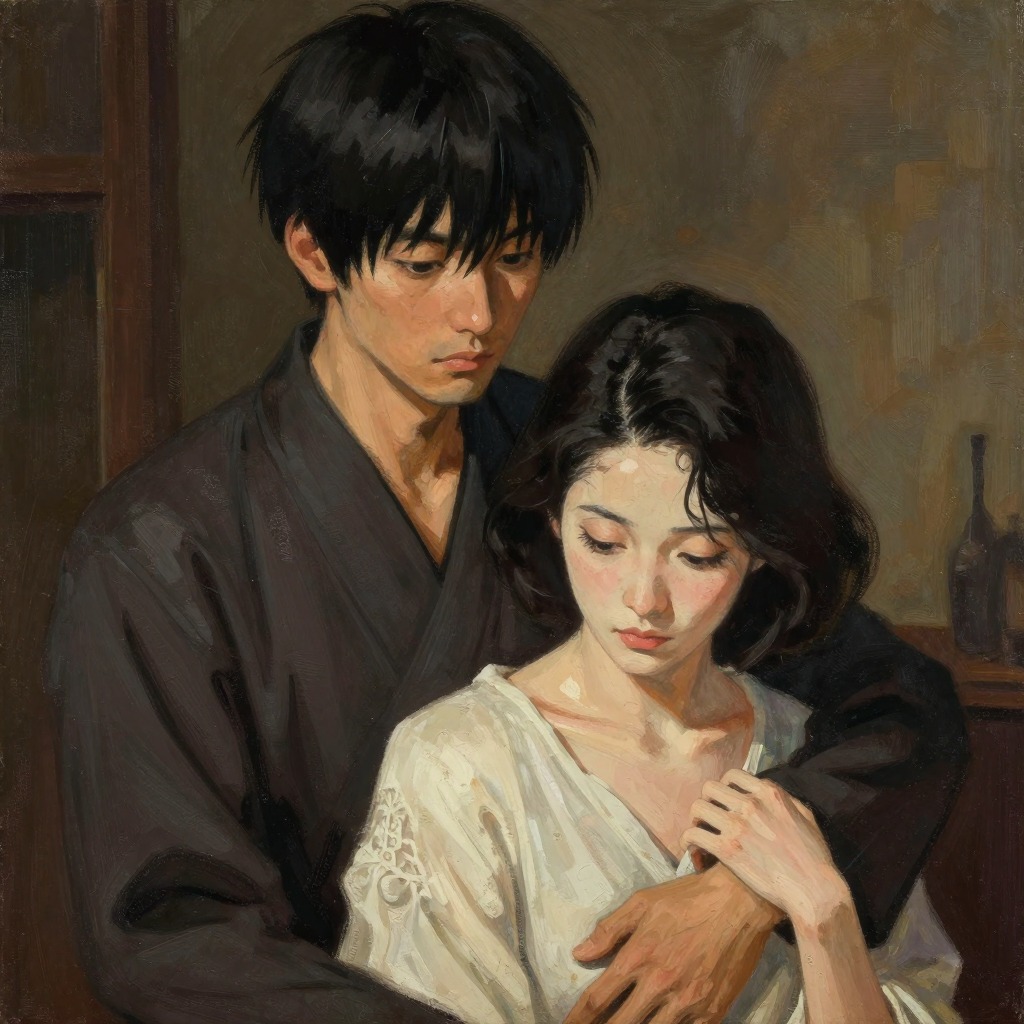
No Longer HumanThe Sumida River flows through eastern Tokyo, and it is on its banks that Yozo and Yoshiko rent a ground-floor apartment after their marriage, a home arranged with the help of the Madam of the Kyobashi bar. For a brief period the apartment by the Sumida River embodies the domestic tranquility Yozo has never known. He gives up drinking, devotes himself to drawing cartoons, and takes simple pleasure in evening walks with Yoshiko to see movies, stopping at milk bars or buying pots of flowers. More than any of these activities, it is the sight of his young bride, who trusts him with all her heart, that allows Yozo to entertain the faint hope that he might one day become a human being and be spared a horrible death.
The Return of Horiki and the Roof-Top Party
This fragile peace is shattered when Masao Horiki reappears, and the two old companions resume their rounds of bars. On a sticky hot summer night, Horiki visits the apartment wearing a tattered summer kimono, claiming an emergency has forced him to pawn his suit. Yozo, having no money, sends Yoshiko to pawn some of her own clothes, then uses the proceeds to lend Horiki what he needs and to buy gin. The two men go up onto the roof of the apartment house to drink, celebrating the evening cool with a dismal little party while faint miasmic gusts of wind blow in from the Sumida River. There they play Yozo's invented games of tragic and comic nouns and of antonyms, a diversion that degenerates into drunken insults. Horiki, revealing his true contempt, reminds Yozo that he has never been tied up like a common criminal, and the conversation turns to the antonym of crime, a debate that leaves Yozo shaken.
The Betrayal and the Decisive Wound
Horiki, drunk and belligerent, goes downstairs to fetch food from Yoshiko. He returns almost immediately, his voice and color changed, and beckons Yozo to follow. From the staircase, through a small window that opens over the ground-floor room, Yozo sees two animals inside: Yoshiko and the shopkeeper, a small, illiterate man who had commissioned cartoons from Yozo. The sight splits Yozo through the forehead between the eyebrows, a wound that will throb with pain whenever he comes into contact with a human being. He does not rush to help Yoshiko; instead, he runs back up to the roof and collapses, staring up at the summer night sky heavy with rain. The feeling that assails him is not fury, hatred, or even sadness, but an overpowering fear, a fierce ancestral dread like encountering a god in a sacred grove. His hair turns prematurely grey from that night. He has lost all confidence in himself, all hope for the things of this world, all joy, all sympathy, eternally. The apartment by the Sumida River, once a symbol of possible redemption, becomes the site of the decisive incident of his life.
Aftermath and Descent
In the aftermath, Yozo does not rage at Yoshiko. He recognizes that her defilement is less the physical act than the destruction of her immaculate trustfulness, a quality he had prized as clean and pure as a waterfall among green leaves. Now that trust is gone, and Yoshiko begins to fret over his every smile or frown, addressing him with excessive honorifics. Yozo's only resort is drink. His face coarsens, his teeth fall out, and his cartoons become pornographic. He secretly copies and peddles pornographic pictures to buy gin. The apartment becomes oppressive, and he spends his nights wandering the bars. The Sumida River, which had witnessed his brief happiness, now witnesses only his accelerating decline into alcoholism, morphine addiction, and finally confinement in a mental hospital. The river itself, a tragic noun in Yozo's invented game, flows on, indifferent to the human wreckage on its banks.