The antonym game
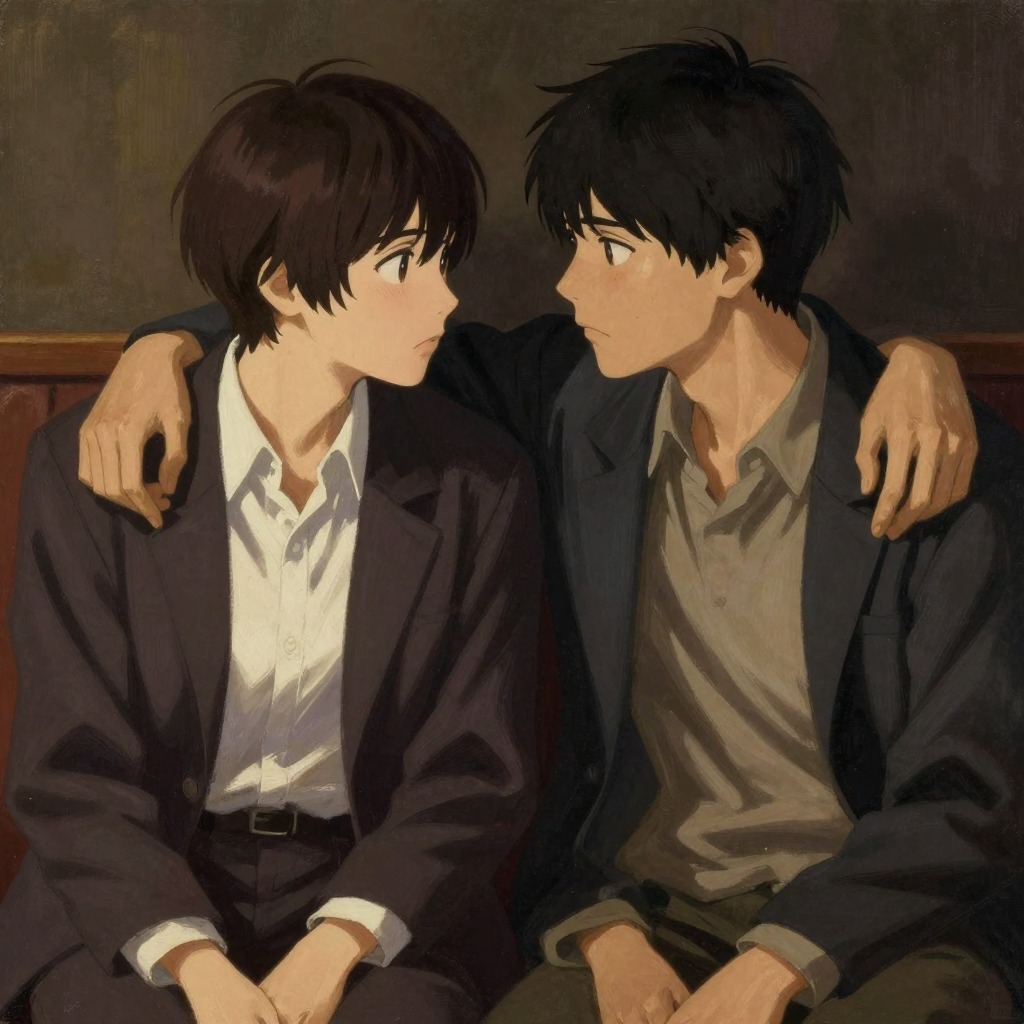
No Longer HumanThe antonym game is a private word game invented by Yozo and played with Masao Horiki on a sticky hot summer night on the roof of Yozo's apartment near the Sumida River. The game, which Yozo himself devised, is based on the proposition that just as nouns can be divided into masculine, feminine and neuter, so there is a distinction between tragic and comic nouns. Under this system, a steamship and a steam engine are both tragic nouns, while a streetcar and a bus are comic. Persons who fail to see why this is true, Yozo declares, are obviously unqualified to discuss art, and a playwright who includes even a single tragic noun in a comedy shows himself a failure if for no other reason. The same holds equally true of comic nouns in tragedies. The game is played as a guessing exchange: Yozo asks "What is tobacco?" and Horiki promptly answers "Tragic"; when Yozo asks about an injection, Horiki rules it tragic because of the needle, though Yozo briefly counters with the example of hormone injections. When Yozo asks about death, Horiki calls it comic, and adds that Christian ministers and Buddhist priests are comic too. Yozo then asks whether life must be tragic, but Horiki answers that it is comic as well. When Yozo asks about cartoonist, Horiki calls it an extremely tragic noun, and Yozo retorts that "extremely tragic" is a good description of Horiki himself. The game drops to the level of abysmal jokes, yet both are very proud of what they consider an extremely witty diversion never before known in the salons of the world.
The Antonym Game and Its Philosophical Turn
Yozo has invented another game of a rather similar character, a guessing game of antonyms. The antonym of black is white, but the antonym of white is red, and the antonym of red is black. When Yozo asks "What's the antonym of flower?" Horiki fumbles through several wrong answers—moon, bee, wind—before Yozo dismisses each. Horiki finally suggests "a woman," and when Yozo asks for a synonym of woman, Horiki answers "entrails." Yozo then asks for the antonym of entrails, and Horiki says "milk." Yozo calls this "pretty good" and then asks for the antonym of shame. Horiki answers "Shameless—a popular cartoonist I could name," and Yozo retorts "What about Masao Horiki?" By this point the two have gradually become incapable of laughter and are beginning to experience the particular oppressiveness, as if one's head were stuffed with broken glass, that comes from getting drunk on gin. Horiki then says, "Don't be cheeky now. I for one have never been tied up like a common criminal the way you have." Yozo is taken aback, realizing that Horiki at heart does not treat him like a full human being, only as the living corpse of a would-be suicide, a person dead to shame, an idiot ghost. Yozo feigns tranquillity and asks, "Crime. What's the antonym of crime? This is a hard one." Horiki answers flatly, "The law, of course." Yozo looks at his face again and sees, caught in the flashing red light of a neon sign on a nearby building, the somber dignity of the relentless prosecutor. Yozo feels shaken to the core.
Crime, Punishment, and the Failure of Language
Yozo protests that crime belongs in a different category, and reflects that perhaps everybody in "society" can go on living in self-satisfaction thanks to just such simple concepts as Horiki's—that crime hatches where there are no policemen. Horiki then suggests God as the antonym, adding that there is something about Yozo that smells a little of a Christian priest, which he finds offensive. Yozo insists they think about it more together, saying that you can tell everything about a man just from his answer to this one question. Horiki jokes that the antonym of crime is virtue, a virtuous citizen like himself. Yozo counters that virtue is the antonym of vice, not of crime, and that virtue and vice are concepts invented by human beings, words for a morality which human beings arbitrarily devised. Horiki, growing impatient, says, "What a nuisance. Well, I suppose it is God in that case. God. God. You can't go wrong if you leave everything at God . . . I'm hungry." Yozo says Yoshiko is cooking beans downstairs, and Horiki lies down on the floor, his hands tucked under his head. Yozo says, "You don't seem to be very interested in crime." Horiki replies, "That's right. I'm not a criminal like you. I may indulge myself with a little dissipation, but I don't cause women to die, and I don't lift money from them either." A voice of resistance weak but desperate speaks from somewhere in Yozo's heart, saying that he had not caused anyone to die and had not lifted money from anyone, but once again the ingrained habit of considering himself evil takes command. Yozo mutters almost to himself, "Actions punishable by jail sentences are not the only crimes. If we knew the antonym of crime, I think we would know its true nature. God . . . salvation . . . love . . . light. But for God there is the antonym Satan, for salvation there is perdition, for love there is hate, for light there is darkness, for good, evil. Crime and prayer? Crime and repentance? Crime and confession? Crime and . . . no, they're all synonymous. What is the opposite of crime?" Horiki, barely articulate from drink, says, "Well if you spell 'crime' backwards—no, that doesn't make sense. But the word does contain the letters r-i-c-e. Rice. I'm hungry. Bring me something to eat." Yozo's voice shakes with a rage he has almost never before betrayed as he tells Horiki to get it himself. Horiki then says he will go downstairs and commit a crime with Yoshiko, adding, "The antonym of crime is rice. No—it's beans!" Yozo tells him to get the hell out. Horiki mumbles, "Crime and an empty stomach. Empty stomach and beans. No. Those are synonyms."
The Dostoievski Connection and the Aftermath
The words "Crime and punishment. Dostoievski" graze over a corner of Yozo's mind, startling him. He wonders whether Dostoievski ranged 'crime' and 'punishment' side by side not as synonyms but as antonyms—absolutely incompatible ideas, irreconcilable as oil and water. Yozo feels he is beginning to understand what lies at the bottom of the scum-covered, turbid pond, that chaos of Dostoievski's mind, though he still does not quite see. These thoughts flash through his head like a revolving lantern when Horiki's voice calls out, "Extraordinary beans you've got here. Come have a look." Horiki's voice and color have changed. The two go down from the roof and halfway down the stairs to Yozo's room, where Horiki points through a small window. Inside, the light is lit and two animals are visible. Yozo's eyes swim, but he murmurs to himself through his violent breathing, "This is just another aspect of the behavior of human beings. There's nothing to be surprised at." He stands petrified on the staircase, not even thinking to help Yoshiko. Horiki noisily clears his throat, and Yozo runs back up to the roof to escape and collapses there. The feelings that assail him as he looks up at the summer night sky heavy with rain are not of fury or hatred, nor even of sadness, but of overpowering fear—not the terror the sight of ghosts in a graveyard might arouse, but rather a fierce ancestral dread that cannot be expressed in four or five words, something perhaps like encountering in the sacred grove of a Shinto shrine the white-clothed body of the god. Yozo's hair turns prematurely grey from that night. He has now lost all confidence in himself, doubted all men immeasurably, and abandoned all hopes for the things of this world, all joy, all sympathy, eternally. This is truly the decisive incident of his life. He has been split through the forehead between the eyebrows, a wound that will throb with pain whenever he comes in contact with a human being. Horiki says, "I sympathize, but I hope it's taught you a lesson. I won't be coming back. This place is a perfect hell . . . But you should forgive Yoshiko. After all, you're not much of a prize yourself. So long." Yozo gets up, pours himself a glass of gin, and weeps bitterly, crying aloud. The antonym game, which began as a witty diversion, ends in the shattering of Yozo's last hope for trust and the permanent wounding of his capacity to live among human beings.