Trustfulness
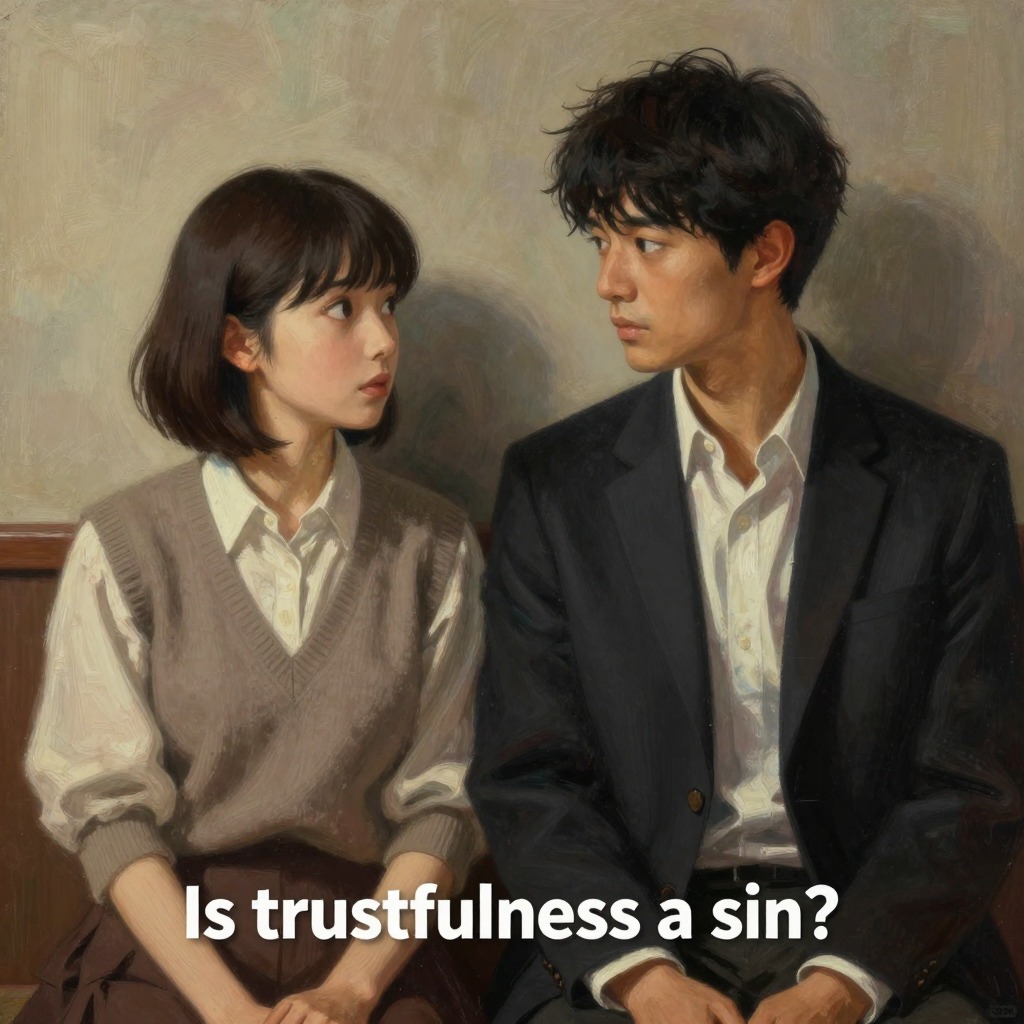
No Longer HumanTrustfulness, in Osamu Dazai's No Longer Human, is the rare virtue that Yozo both cherishes and ultimately cannot bear. It is personified in his wife Yoshiko, whose "immaculate trustfulness" he compares to a waterfall among green leaves—clean, pure, and utterly defenseless. This trust becomes the novel's central moral problem: Yozo, who has spent his life deceiving others and fearing their deception, finds in Yoshiko's faith a quality he can neither emulate nor protect. Her violation by a shopkeeper shatters this ideal, and the question "Is trustfulness a sin?" recurs with increasing anguish, driving Yozo to doubt the one thing he had depended on and to lose all comprehension of the world around him.
The Nature of Yoshiko's Trust
Yoshiko is introduced as a pale girl of seventeen with crooked teeth, working in a tobacco shop across from the bar where Yozo drinks. Her trust is not a conscious choice but an innate disposition: she "didn't know how to suspect anyone." Even after Yozo tells her about his suicide attempt with Tsuneko and his relations with the madam of the Kyobashi bar, she suspects nothing, taking his blunt confessions as jokes. Yozo calls her "a genius at trusting people," a phrase that carries both admiration and foreboding. Her trust is so complete that it becomes a kind of innocence that invites violation—a quality Yozo recognizes as both beautiful and dangerous.
The Violation and Its Aftermath
One summer night, while Yozo and Horiki are on the roof playing their invented game of tragic and comic nouns, Horiki discovers Yoshiko with a shopkeeper—an illiterate, undersized runt of about thirty who had commissioned cartoons from Yozo. Horiki returns to the roof and points out the scene through a small window. Yozo, standing petrified on the staircase, does not intervene; he murmurs to himself that this is "just another aspect of the behavior of human beings." The incident is less about sexual betrayal than about the defilement of trust itself. Yozo reflects that "it was less the fact of Yoshiko's defilement than the defilement of her trust in people which became so persistent a source of grief as almost to render my life insupportable." The waterfall of her purity turns yellow and muddy in a single night, and Yoshiko begins to fret over Yozo's every smile or frown, addressing him with excessive honorifics, trembling and afraid.
The Question of Sin
Yozo's anguish crystallizes into a repeated, almost liturgical question: "Is trustfulness a sin?" He searches novels about violated married women but finds none violated in so lamentable a manner as Yoshiko, because her story lacks even the consolation of love or desire—she was simply trusting. He concludes that any husband with authority could dispose of such a shock, but he is a husband without authority, and he feels that everything is his fault. The virtue he had prized, "the unbearably pitiful one called immaculate trustfulness," becomes the very cause of her violation. This paradox—that the purest quality leads to the deepest corruption—undermines Yozo's last foundation. He had begun to hope that with Yoshiko he might "turn one of these days into a human being," but now he loses all confidence, doubts all men immeasurably, and abandons all hope.
The Descent into Addiction and Madness
Doubt breeds fresh doubt: Yozo wonders if Yoshiko yielded only once, or also with Horiki, or with someone he didn't know. He lacks the courage to question her and instead drinks gin, his face coarsening and his teeth falling out. He begins copying pornographic pictures to sell for money to buy alcohol. The crisis culminates when he discovers a box of Dial sleeping pills hidden in the sugar bowl—pills he had apparently stored for a future suicide. He swallows the entire contents, lying as if dead for three days. When he regains consciousness, he cries out, "Take me away from Yoshiko," and then, in a slip of the tongue, "I'm going somewhere where there aren't any women." This delirious wish is later realized when he is committed to a mental hospital, a ward with only male lunatics and male nurses—a place without women, as he had unknowingly prophesied.
The Broader Significance
Trustfulness in No Longer Human is not merely a personal trait but a lens through which Yozo views the entire human condition. His own inability to trust others—rooted in childhood experiences of being deceived by servants and family—contrasts sharply with Yoshiko's absolute faith. He sees society as a place of mutual deception, where people "deceive one another without any wounds being inflicted," yet he cannot participate in that deception without feeling like a fraud. Yoshiko's trust represents an alternative, a possibility of genuine connection, but it proves too fragile to survive contact with the world. The novel's epilogue, in which the madam of the Kyobashi bar calls Yozo "a good boy, an angel," suggests that his failure was not malice but an excess of sensitivity—and that trust, in a world of bottomless horror, is both the highest virtue and the surest path to destruction.