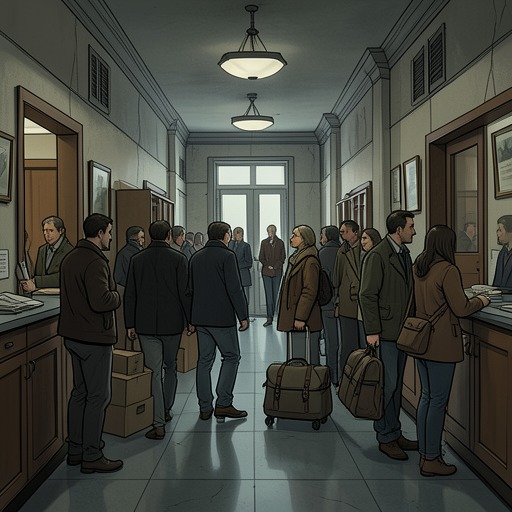
Connell invites Rachel Moran to the Debs
Normal PeopleConnell invites Rachel Moran to the Debs after his classmates’ teasing makes his private relationship with Marianne a source of social pressure. The choice is not merely a date for a school dance: it exposes the divide between Connell’s public life and his intimacy with Marianne, and its consequences help drive her out of school and end their contact for a time.
Background and Decision
At school, Connell’s classmates speculate about whether he has slept with Marianne and treat her as an object of gossip. Rachel says that everyone knows Marianne fancies him; Eric presses him to admit what happened, while Lisa objects to their cruelty. Connell denies having slept with Marianne, but the exchange leaves him visibly uncomfortable. Eric then turns the teasing into a suggestion that Connell should ask Marianne to the Debs, prompting laughter rather than a serious discussion of what she wants.
Connell withdraws to a bathroom cubicle, where the group’s attention gives way to his private fear. He remembers telling Marianne that he loves her, and imagines her going about her day without knowing what he has said. In the car with his mother, Lorraine, he eventually admits that he asked Rachel to the dance. His disclosure reveals the choice as a response to pressure and concealment, not as a decision made with Marianne’s knowledge.
On the walk back from lunch, Connell had deliberately hung behind the others because he knew Rachel would wait for him. He asked whether she already had a date; when she said no, he invited her. Rachel accepted, but remarked that she had hoped for something more romantic. Connell did not answer. The account presents his invitation as an awkward, deliberate act that he experiences as a plunge into a decision he cannot easily undo.
Lorraine’s Confrontation
Lorraine asks who Marianne will attend the Debs with. Connell says he does not know and suggests she may go with no one. When Lorraine asks whether Marianne knows he is taking someone else, he admits that he has not told her yet. He insists that his relationship with Marianne was agreed between them, but Lorraine challenges the secrecy and asks whether he feared what his classmates would say if they found out.
The argument is about more than the dance. Lorraine interprets Connell’s silence as a way of protecting his social position at Marianne’s expense, and tells him she is ashamed of him. He objects to her involvement, but she leaves the car rather than continue the argument. Connell stays behind, thinking of the years he spent working after school to buy the car he is sitting in. Instead of following Lorraine, he starts the engine. The scene makes his independence and his dependence on his mother visible at once: the car is his, but she has been driving with him because she does not have a licence.
Marianne Learns of the Invitation
In April, Connell tells Marianne that he is taking Rachel to the Debs. Marianne is sitting on the side of his bed and tries to keep her manner cold and humorous. Connell describes himself and Rachel as just friends, then distinguishes that arrangement from his relationship with Marianne. When Marianne asks whether he is sleeping with Rachel or wants to, he says he is not and does not particularly want to; he adds that he already has Marianne. She does not understand the joke he says he was making, and asks him to tell her if he ever wants to sleep with Rachel.
Marianne says that the issue is not simply whether Connell might have sex with Rachel. When she asks what the issue really is, he stares at her and does not answer. He neither apologises nor admits that asking Rachel has humiliated her. Marianne eventually laughs, but the laugh does not resolve the injury: she goes home and sleeps for thirteen hours. His silence leaves her to interpret the decision as evidence that he is willing to keep their relationship private while presenting himself differently to other people.
Consequences for Marianne
The next morning Marianne decides she cannot return to school. She had organised fundraisers and booked the Debs venue, yet sees no prospect of attending the event herself. She expects other students to know that she has no invitation, and believes that some will be glad while even sympathetic classmates will feel embarrassed for her. Rather than face the school’s attention and whispers, she stays home, studying and sleeping at irregular hours.
Her mother responds angrily: doors are slammed and Marianne’s dinners are thrown away. Marianne nevertheless maintains her decision. She has left the school’s uniform and its daily scrutiny behind, and sees herself as an adult who cannot be compelled to return. She later sits the exams, but never goes back to school as a student. Rumours circulate that she has been in a mental hospital, a further sign of how little control she has over the story others tell about her.
A week after Marianne leaves school, Lorraine visits and asks whether everything is all right. Marianne says she is not going back. When Lorraine mentions that Connell says Marianne is ignoring his calls, Marianne acknowledges that she is. Lorraine supports her, saying Connell does not deserve her and that he is barred from the house. Marianne asks that he not come inside if he has to collect Lorraine. Even while she minimises what he did in comparison with other students, Lorraine embraces her tightly, offering care in a moment when Marianne is withdrawing from school and from Connell.
Aftermath and Significance
Marianne’s account of the break is severe: she thinks Connell used their private relationship as an experiment and that she had mistaken his intimacy for evidence that he accepted her socially. Yet she also recognises that he did not pretend she was socially acceptable; she believes she had deceived herself. This retrospective judgment complicates the rupture without erasing its immediate consequence: she leaves school, stops answering his calls, and no longer sees him as someone she can rely on to acknowledge their relationship publicly.
The invitation reverberates beyond the school year. In a later conversation, Marianne recalls that she did not hold Rob’s bullying against him, and reflects on how cruelty can wound the person who inflicts it as well as its target. Her memories of school remain bound to the social world in which Connell’s choice took shape, though the account does not make his invitation the sole cause of everything that follows. As an event, it marks the point at which a private relationship’s secrecy becomes unsustainable: Connell’s attempt to manage how others see him leaves Marianne bearing the public and personal cost.