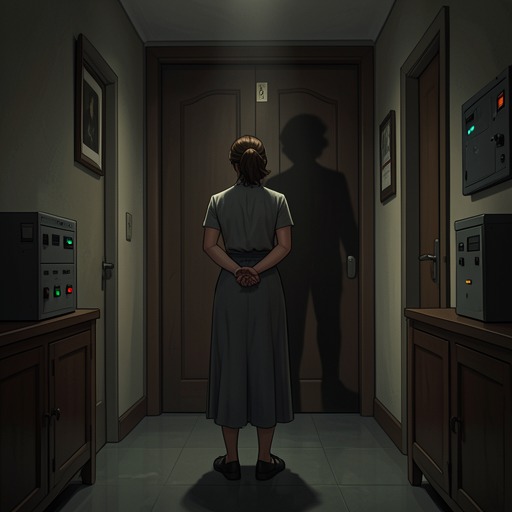
Connell tells Marianne “I love you”
Normal PeopleConnell tells Marianne that he loves her during the drive back to Carricklea after they attend a protest in Dublin. She says she loves him too, and he continues driving without further comment. The brief exchange makes their mutual love explicit without presenting it as a solution to grief, family strain, or the violence they have just protested against.
Background and Setting
By this point, Marianne is living at home again, with little to occupy her weekdays beyond household tasks and time in the garden. Her mother and brother are at work, and the home feels less welcoming in the absence of Lorraine, who has taken a full-time job at a hotel. Marianne’s return home leaves her in close proximity to her brother, whose repeated demands that she discuss their arguments make ordinary domestic life tense.
Her friendship with Joanna offers a different view of intimacy: Marianne is glad to see Joanna and Evelyn together, and their happiness gives her a glimpse of a kind of life she feels unable to reach herself. That sense of distance coexists with her continuing closeness to Connell, whose presence remains part of her daily life even as she faces isolation and uncertainty.
The Protest and the Drive
Marianne and Connell attend a protest against the war in Gaza with Niall and thousands of other people. The crowd carries signs, banners, and megaphones; the march crosses O’Connell Bridge, with drums and chanting making it loud and slow. The weather is hot, and Marianne’s shoulders become sunburned. In the crowd, she wants her life to mean something and hopes to oppose violence by the powerful against the weak. At the same time, she recognizes that she cannot end violence on a global scale and may be able to help only a few people. The modest scale of that possibility troubles her, though she understands that refusing to help anyone is not the answer.
That evening Connell drives Marianne back to Carricklea, although she had said she would take the train. They are both tired. As they pass through Longford, a White Lies song popular when they were at school plays on the radio. Without touching the dial or raising his voice, Connell tells Marianne that he loves her. She answers that she loves him too. He nods and keeps driving, as if nothing has changed; the scene’s restraint leaves the declaration at once decisive and unceremonious.
Meaning and Narrative Context
The exchange occurs against the continuing aftermath of Rob’s suicide. Connell has told a university counsellor that he feels guilty for not staying in touch with his school friend and for never replying to Rob’s last message. His anxiety has worsened into severe distress and panic attacks, and a Beck Depression Inventory score of forty-three leads the counsellor to identify a very serious depression. The declaration to Marianne does not erase this grief or make it a cure; its importance lies in the intimacy and steadiness it establishes within a period of emotional difficulty.
Marianne’s thoughts about Rob also complicate the scene’s emotional background. She remembers how he participated in bullying her at school, even as she reflects that cruelty can damage the person who inflicts it as well as the person who suffers it. After his death, she had struggled with other people’s public expressions of grief on his Facebook page, but later recognizes that they were grieving and wishes she could have forgiven him. The declaration takes place within a world where love and loss do not cancel one another: Connell and Marianne affirm their bond while grief, regret, and unresolved conflict remain present.
The scene’s form reinforces that distinction. A public protest gives Marianne a vast, difficult-to-measure cause; the return journey narrows attention to two people in a car, a familiar song, and a few direct words. Connell’s declaration is not accompanied by a plan or explanation, and Marianne’s answer is equally simple. Their mutual confession makes their love explicit, while the continued motion of the car preserves the ordinary life in which that love must exist.