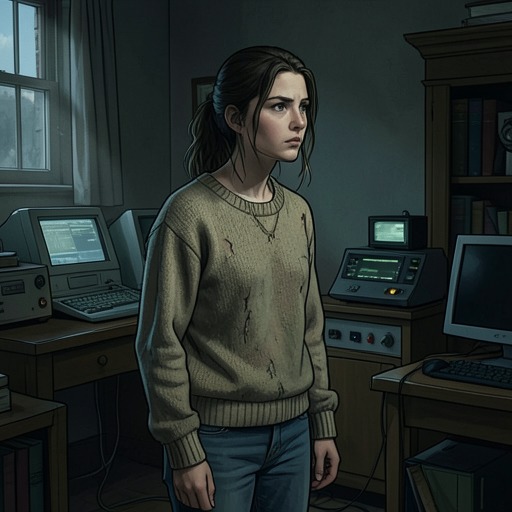
Joanna
Normal PeopleJoanna is Marianne’s close friend from their History and Politics course at Trinity, a thoughtful and often funny student who hopes to work in journalism. She becomes especially important when Marianne’s friendships with Peggy and Jamie unravel: while much of their shared social circle withdraws, Joanna keeps in touch, speaks frankly about what she thinks, and continues to make room for Marianne in her life. Their friendship is built less on social performance than on conversation, intellectual curiosity, and an unambiguous willingness to stay present.
Identity and Character
Joanna is serious about her studies and ideas, but that seriousness does not make her humourless. She is already planning a final-year thesis on James Connolly and the Irish Trades Union Congress, and she regularly recommends books and articles to Marianne, who reads them, half-reads them, or consults summaries. People see Joanna as a serious person, which she is, but she can also be very funny. Peggy does not always understand her humour; Peggy’s charisma, by contrast, is described as more intimidating and sexually charged than comic.
Joanna’s ambitions are practical as well as intellectual. She wants to work in journalism, and by the summer after their studies she has a job. Her working life becomes part of the contrast between the friends: Joanna talks about office personalities and workplace dramas, while Marianne, who is not working, regards paid employment with philosophical suspicion. Their disagreement does not dissolve their affection. Joanna can argue with Marianne about work and idleness while also reassuring her that she likes her as she is.
Friendship with Marianne
Joanna and Marianne keep in touch through conversation even when their routines diverge. Once Joanna is employed, most of their conversations take place over the phone, although both are living in Dublin. Marianne is home for a weekend while Joanna has only that time off work. Joanna’s accounts of the office can make paid employment seem to Marianne like a distant country, but the phone call also gives Marianne companionship during a weekend when she does not want to be in her family home.
Their exchange about work reveals both difference and trust. Marianne questions whether exchanging limited time for money is worthwhile and argues that some office work contributes little to human life. Joanna answers that she remains alive and has experiences while working, and points out that Marianne’s own time passes too. When Joanna asks whether Marianne thinks she judges her for being idle, Marianne admits that she suspects she does. Joanna distinguishes Marianne from Peggy, whose mind she calls idle, and says she does not want Marianne to become like Peggy: she likes Marianne as she is. Marianne responds by calling Joanna a good friend.
Joanna also tries to understand what happened between Marianne and Connell after he ends their relationship and moves home. She asks what each of them specifically said during the break-up, then falls quiet as if mentally reconstructing the scene. Her questions are not a demand that Marianne perform a simple account of her family or her relationship. When Joanna asks whether Connell understands what Marianne’s family are like, Marianne cannot give a confident answer: she feels she herself cannot describe them without either exaggerating their behaviour or minimizing it and feeling guilty. The conversation exposes how difficult it is for Marianne to make her experience legible even to someone close to her.
Social Rupture and Joanna’s Loyalty
After Marianne breaks up with Jamie, her social circle’s response becomes another source of isolation. Peggy tells Marianne that people are talking about her and are upset about the wider drama. When Marianne says she cares about Peggy but does not necessarily care about the same things Peggy does, Peggy worries about what position the breakup puts her in and says she does not want to take sides. She then suggests that Marianne consider seeing a therapist. Marianne finds the suggestion hard to dismiss, since people have told her throughout her life that she is mentally unwell and needs help, even though she does not understand why not being upset in the expected way should be treated as evidence against her.
Joanna is the only friend who continues to keep in touch. They talk on Skype about coursework, films, and articles Joanna is writing for the student paper. She has a girlfriend, Evelyn, a graduate student in International Peace Studies. When Marianne asks whether Joanna sees Peggy, Joanna briefly winces and explains that she does not see those people and that they know she was on Marianne’s side. Marianne apologizes for the cost of that loyalty, saying she did not want Joanna to fall out with anyone because of her. Joanna’s expression remains difficult to read, but she answers that she was never really friends with the others: they were more Marianne’s friends, and she was the only one she got on with.
Joanna is candid about Peggy and Jamie, whom she considers unkind and capable of taking pleasure in putting others down. Marianne agrees, then recognizes that she had been drawn into their social world because she liked how much they seemed to like her. Joanna says Marianne probably did understand, at some level, how obnoxious they were, but that the attraction of being accepted made it easier to overlook. The exchange complicates any simple division between the socially excluded and the socially powerful: Marianne sees that she, too, participated in a social world organized around status and mutual advantage, while Joanna had never been welcomed into it in the same way.
Work, Values, and Political Conversation
Joanna’s friendship with Marianne includes disagreements that are not treated as betrayals. When they discuss employment, Marianne frames time as more real than money and questions the value of office work; Joanna answers from her experience that working hours are still part of a life being lived. Their conversation shows that Joanna does not simply affirm Marianne’s ideas to maintain closeness. She responds on their merits, and then makes clear that Marianne’s present lack of employment does not diminish her affection.
The book also places Joanna among friends whose interests touch on politics and culture. Her planned thesis on James Connolly and Irish trade unionism sits alongside Marianne’s interest in politics and her later criticism of the people who treat friendship as a market in social capital. Joanna’s sustained contact with Marianne matters in that context: she is not shown joining the performance of popularity that Marianne comes to regret. Instead, she is a friend who can be direct about other people’s behaviour, admit where she stands, and remain in conversation after the social group has fractured.
Later Life and Narrative Significance
By the period when Marianne is back living at home in Carricklea, Joanna has a relationship with Evelyn and continues to make time for Marianne. The three women sometimes meet in Dublin, wandering around the Hugh Lane together. Evelyn is painstakingly kind to Marianne and interested in hearing about her life. Marianne feels happy for Joanna and Evelyn, and even hearing Joanna tell Evelyn that she loves her gives Marianne a window onto real happiness. It is a view she cherishes, though she cannot imagine stepping through it herself.
Joanna’s role is therefore not simply to provide advice or to confirm Marianne’s suspicions. She offers a durable form of friendship that survives work schedules, disagreements, and the collapse of Marianne’s college social life. Her loyalty helps Marianne see that exclusion by Peggy and Jamie is not proof that she has lost every possible connection; her frankness also prevents consolation from becoming flattery. In the novel’s account of belonging, Joanna stands for an intimacy that does not depend on being admitted to the most desirable circle and does not require pretending that its members are better than they are.