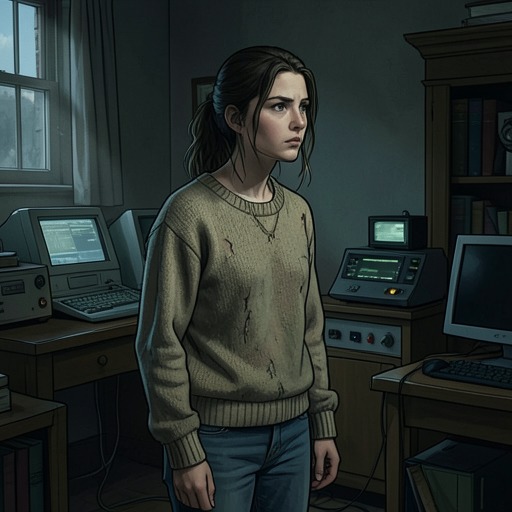
Lukas
Normal PeopleLukas is an artist in Lund whose relationship with Marianne develops into a coercive arrangement he calls “the game.” His meticulous attention to artistic appearance coexists with a disregard for right and wrong; when he carries their arrangement into photography and restraint, Marianne recognizes that she does not consent and leaves him.
Identity and Introduction
Marianne meets Lukas after arriving in Sweden for an exchange year. He lives near the station and works in a studio where he also sleeps. He dresses in black, and his exceptionally blond hair leaves fine strands on Marianne’s clothes. Their first conversation includes Marianne telling him she is a writer, though she is not; later she avoids discussing the lie with him. The gap between that claim and her developing sense of herself as a writer remains part of their relationship.
Lukas’s studio is arranged with tall windows, curtains and blinds, potted plants, atlases, and a bicycle wheel. Marianne is initially impressed by the assortment, but Lukas explains that he has gathered the objects for a photographic shoot, making the room’s apparent spontaneity seem staged. He is attentive to minute aesthetic failures across painting, cinema, novels, and television, sometimes dismissing a work by saying, “It fails for me.” Marianne eventually separates this sensitivity to form from moral judgment: his artistic discernment, she concludes, has not produced a corresponding sense of right and wrong.
The Arrangement
For several weeks, Lukas and Marianne have an arrangement he calls “the game.” Its rules prohibit Marianne from speaking or making eye contact while it is underway, and breaking them brings punishment later. The game continues beyond sex until she is allowed to shower. At times Lukas delays that point by talking to her and telling her degrading things about herself. Marianne feels drawn to hear them, but also recognizes that desire does not necessarily mean wanting what is happening. The relief she experiences is brief, followed by distress and emotional numbness.
The arrangement forms part of a broader period of detachment for Marianne in Sweden. People can seem unreal to her; moments of eye contact briefly remind her that she is visible to others, but the resulting desires—to eat, speak Swedish, swim, or dance—fade quickly. She is often not hungry and pours most of the water from the bottle she fills each morning back into the sink at night. This context does not make Lukas the source of all her distress, but it shows how the game takes place while her connection to her own needs and body is already weakened.
The Studio and Its Rules
When Marianne visits Lukas’s studio for a photographic session, she arrives through falling snow and finds him setting up a camera and tripod. He asks her to remove her sweater and later her bra while he takes photographs. The studio’s carefully arranged objects and the camera make the encounter feel like another constructed visual effect, but Marianne is not simply observing his art: she is the person being directed and photographed within it.
After the photographs, Lukas takes a length of coarse black fabric from a drawer and begins binding her wrists. Marianne complies at first, feeling too exhausted to resist. When he reaches for another length and she says she does not want to continue, he persists. He touches her throat and uses the fabric as a blindfold. The narrative marks a decisive change not through an argument about artistic intention but through Marianne’s reaction when Lukas tells her he loves her and claims she loves him. She recoils, demands to be untied, and threatens to call the police.
Break and Aftermath
Once Lukas loosens the binding, Marianne frees her arms, removes the blindfold, pulls on her sweater, and gathers her things. She tells him to get away from her and not speak to her that way again. When he asks what he has done, she asks whether his conduct is an artistic technique, then tells him plainly that she feels nothing for him. Lukas turns back to his camera rather than resolving the confrontation. Marianne leaves the apartment and goes down the stairs into the falling snow; the relationship ends with her departure, not with a negotiated change to the game.
The episode brings into focus a distinction Marianne has been trying to make: artistic sensitivity is not the same as care, and a person can frame an act as love without making it loving. Lukas’s claim that he loves her does not persuade her; it horrifies her because it collapses affection into behavior she experiences as abusive. Her refusal is therefore a break not only with Lukas but with the assumption that her participation in an arrangement obliges her to continue when its terms change.
Social Context and Narrative Significance
The novel places Lukas’s relationship with Marianne amid her estrangement from friends after she breaks up with Jamie. Jamie is unhappy about the breakup and tells others; Marianne senses that the social group’s attitude toward her turns, and that people who once admired her now avoid her. She has come to see a recurring pattern in which men’s attraction can resemble a desire to dominate her, whether through school cruelty or the sexual and social power of university life. The pattern helps explain why the game can feel familiar to her without making it harmless or inevitable.
The consequences of the breakup with Jamie persist after Marianne leaves for Sweden. She hears that people are discussing her, asks Joanna about the rumors, and eventually returns to Lukas to have him delete the photographs of her, though he had not posted them online. Shame initially makes the experience feel overwhelming, but it passes, and she recognizes the period as a chapter of her youth that has ended. Lukas’s part in the novel thus connects private coercion with Marianne’s vulnerability to social judgment, while her departure from his studio establishes a clear limit she can assert even in a period of numbness and isolation.