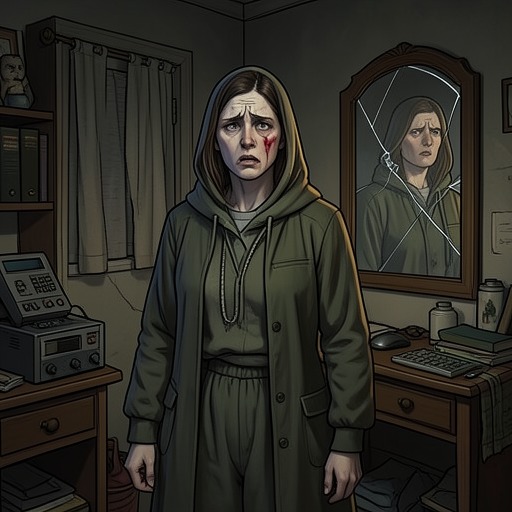
Marianne Sheridan–Alan Sheridan relationship
Normal PeopleThe relationship between Marianne Sheridan and Alan Sheridan is defined by a persistent imbalance of power: Alan uses insults, threats, and physical force to control and unsettle his sister, while Marianne often responds with silence, deflection, or emotional detachment. Their conflict is not presented as an isolated family quarrel. It recurs in ordinary domestic situations, and the absence of dependable protection from their mother helps make the house itself a place where Marianne’s freedom to refuse or seek help is constrained.
Identity and Family Setting
Marianne and Alan live in the same family home, where Alan can confront her at the door, follow her through the house, and interrupt private moments. Marianne’s social isolation beyond the family compounds this dependence: she describes having no friends, and her movements are limited. In one episode she knows the nearby town and surrounding area only vaguely, and her outings are largely confined to school, compulsory Mass, and visits to Connell when the house is empty. This restricted world gives Alan’s control over a doorway or a phone more than momentary force: he can interfere with the few routes by which she leaves home or connects with someone else.
The family’s responses do not offer a stable counterweight. Marianne understands that her mother has long accepted men’s aggression toward her as a way of expressing themselves, and that her own emotional withdrawal is treated as a defect rather than as a response to mistreatment. Alan’s conduct therefore unfolds within a household where Marianne cannot count on the adults around her to recognize the harm or intervene consistently.
Control of Marianne’s Movement and Contact
In February 2011, Marianne prepares to go out for a walk. Alan asks where she is going and blocks the front door, using her lack of friends to challenge her right to leave. When she tries another exit through the kitchen and garden, he follows and pulls her back. He warns her not to tell their mother; Marianne denies that she will, then leaves by the patio door. Only after reaching the street does she use her phone to send a message saying she is on her way. The scene links the small act of going for a walk with negotiation, evasion, and the need to reach someone outside the house.
A later confrontation shows Alan interfering with Marianne’s communication as well as her movement. When Connell calls to congratulate her on her exam results, Alan answers and announces that Connell wants to speak to her. Marianne refuses. Alan presses the phone against her and insists that she say hello; she takes it only to end the call. The incident makes her refusal unmistakable, but Alan responds with anger rather than accepting it. His claim that Connell wants to speak to her does not override her choice about whether to take the call.
Humiliation and Physical Aggression
Alan’s control also works through repeated belittlement. In the garden, he mocks Marianne’s lack of friends and interrogates her placid smile, mimicking it in a hostile way. At Christmas, after relatives have visited, he criticizes her for her exam results and calls her pathetic. When she answers without escalating the exchange, he repeats her words in a mocking voice and continues to insult her. These verbal attacks turn ordinary moments—getting ready to leave, speaking in the kitchen, washing teacups—into opportunities for him to challenge her and assert superiority.
The pattern includes physical aggression. In February, Alan grabs Marianne’s arm as she tries to get past him. At Christmas, he again pulls her away from the sink; after she laughs at one of his insults, he spits at her and leaves. She goes back to rinsing the dishes, though her hand trembles slightly. The contrast between the continuing household task and the tremor shows how the confrontation does not end simply because Alan walks away: its effect remains with her in the routine that follows.
Marianne’s Responses and the Family’s Complicity
Marianne often manages confrontation by withholding the reaction Alan seems to demand. She uses a placid smile when trying to get past him, answers some of his insults tersely, and sometimes refuses to explain herself. When Alan forces the phone on her, she states that she does not want to speak to Connell and ends the call. Her calmness should not be confused with consent or indifference to the situation; the narrative also shows her avoiding family contact and becoming accustomed to emotional isolation.
Marianne believes that telling her mother about Alan’s behavior would not make a meaningful difference. The story describes her as having resisted such treatment as a child but later detaching from it, while her mother interprets this detachment as evidence that Marianne lacks warmth. That judgment reverses the direction of responsibility: rather than addressing the aggression, the family treats Marianne’s difficulty in seeking affection as the problem. Alan’s warning not to tell their mother is thus part of a wider household dynamic in which his behavior is shielded from effective challenge.
Narrative Significance
The relationship gives domestic form to Marianne’s broader experience of social power. Outside the home, her isolation and vulnerability can make it difficult to find support; inside it, Alan exploits his access to her and her limited ability to avoid him. The recurring pattern of blocking, mocking, grabbing, and demanding compliance connects physical interference with humiliation and control, rather than presenting the incidents as unrelated sibling disputes.
The episodes also establish a contrast between Marianne’s outward restraint and the conditions producing it. She can state a refusal or return to washing dishes without displaying an overt reaction, but neither action ends the imbalance between them. By showing Alan’s conduct in everyday settings and the mother’s failure to protect Marianne, the narrative locates the relationship’s significance not only in individual confrontations but in the home’s repeated denial of Marianne’s autonomy and safety.