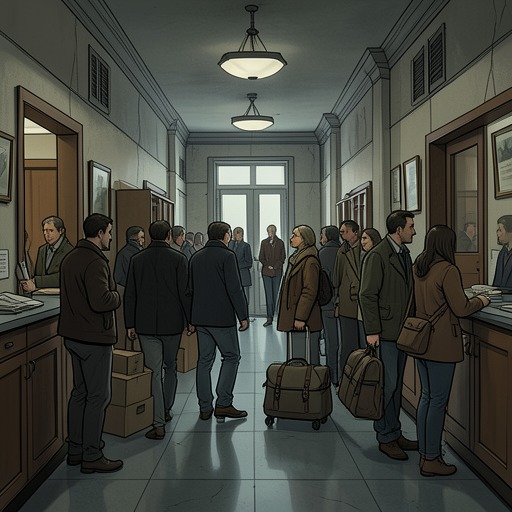
Marianne encourages Connell to go to New York
Normal PeopleMarianne encourages Connell to go to New York at the moment their shared future could divide into separate paths. Though he says he loves her and would stay if she asked, she tells him to accept the offer, affirming both the life he can pursue and the lasting importance of what they have given each other.
The Decision
The conversation follows a misunderstanding about Connell’s application. Marianne asks why he told Sadie he was applying but did not tell her, and whether he is in love with Sadie. Connell explains that Sadie had urged him to apply, that he does not like her as a friend, and that he had withheld the news because he felt embarrassed: he still looks up to Marianne and feared seeming deluded in her eyes. The disclosure makes plain that the obstacle is not a rival relationship but Connell’s anxiety about how Marianne sees him.
When Marianne tells him he should accept the New York offer, Connell initially refuses. He says he will not go without her and that he would not even be there without her. Marianne counters that he can go while she stays, and that the separation would last only a year. Her encouragement is not casual approval: she knowingly asks him to choose a future that may take him away from her.
What They Have Made Possible
Marianne understands Connell’s claim as true. Without their relationship, he might have been living somewhere else, with different aspirations and a different way of relating to women; she, too, would have become another person. The image of two little plants sharing one plot of soil gives their history a shape: each has grown around the other, contorting to make room, and their closeness has changed the possibilities available to them.
That recognition gives Marianne a source of meaning independent of whether Connell stays. She thinks she has helped make a new life possible for him and can feel good about that. The thought does not erase the cost of parting; it changes what the cost means. Her choice rests on the belief that their influence on each other has been real and valuable, even if it cannot secure a shared life on the terms they have known.
Love and Separation
Connell tells Marianne that he would miss her too much and would be sick without her, though she answers that the pain would ease at first and get better. While he speaks, she brushes her hair slowly, patiently working out its knots. The small, methodical action gives the scene its pace: instead of demanding an immediate answer or trying to force the future into certainty, she makes room for a difficult choice.
He tells her that he loves her and will never feel the same way for someone else. He also admits that he does not know what to do, and offers to stay if she asks him to. Marianne closes her eyes and thinks that he probably will not return, or that he will return changed. What they have now cannot be recovered unchanged. She nevertheless tells him to go, adding that she will always be there.
Significance
The exchange resolves the question of whether love requires Connell to remain beside Marianne: she does not treat his departure as proof that their relationship has failed. She releases him toward a new life while acknowledging the uncertainty and loneliness that may follow. Her conviction that loneliness is less painful than the unworthiness she once felt marks the distance she has travelled; the goodness Connell brought into her life now belongs to her, rather than depending on his continued presence.
The ending gives the pair’s relationship an open, unsentimental consequence. They have done good for each other, Marianne concludes, and people can really change one another. Her encouragement is therefore both a farewell and an affirmation: Connell’s future may open in many directions, while the change they made possible in each other remains part of them.