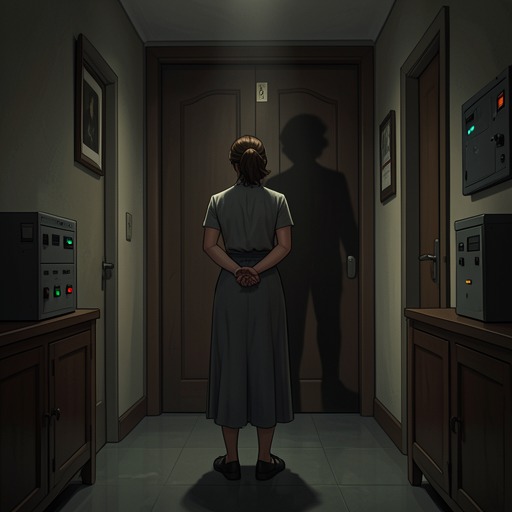
Marianne leaves home to meet Connell
Normal PeopleMarianne leaves home to meet Connell in February 2011, when an attempt to go for a walk becomes an encounter with her brother Alan’s control. She gets out through the patio door and texts that she is on her way; the brief exchange that follows turns departure into a quiet act of connection, set against her isolation at home and in Carricklea.
The Attempt to Leave
At her dressing table, Marianne studies her reflection and decides that wearing make-up would be embarrassing. Downstairs, as she takes her coat, Alan asks where she is going and then blocks the front door. She says she is going out for a walk. His challenge that she has no friends draws an unvarnished agreement from her, but does not settle the encounter: she offers a placid smile, hoping it will placate him, and he mocks her expression instead.
Alan follows Marianne toward the kitchen and stops her as she tries to leave through the garden. He warns her not to tell their mother. Marianne answers that she is only going for a walk, and he releases her. She goes out through the patio door rather than the front entrance, managing to leave without further argument. The route she takes registers the smallness of her available freedom: departure is possible, but only after she adapts to her brother’s obstruction and threat.
A Message and a Meeting
Outside, Marianne walks down the driveway and into the street. She takes out her phone and repeatedly mistypes a message before finally sending, “On my way.” The reply—“cool see you soon”—confirms that someone is expecting her. The scene does not name the recipient in the exchange itself, but its context identifies Connell as the person she is going to meet. The text offers a practical counterpoint to the silence she has used inside the house: once out of Alan’s reach, she can make contact directly.
Isolation and Limited Horizons
Marianne’s departure takes place within an unusually narrow map of everyday life. She knows Carricklea poorly: she does not go to its pubs or nightclub, has not visited the sports centre, and knows nearby towns mostly as names. Her usual destinations are school, compulsory Sunday Mass, and Connell’s house when no one is home. Even the unoccupied Mountain View housing estate is unfamiliar to her until Connell explains what it is and where people go there.
Her sense of exclusion is not only geographical. At a school football match, Marianne watches Connell play while the others know the chants and share the experience around her. She thinks of her “real life” as something happening somewhere far away, without her. That earlier feeling illuminates the choice to leave home: the walk is modest, but it leads away from a household where Alan controls her exit and toward a relationship that gives her an opening beyond her habitual isolation.
Family and Social Power
The contrast between the Sheridans and the Waldrons shapes how Marianne understands the town around her. Her mother and father are solicitors, while Connell’s family is regarded as socially disreputable; Marianne knows fragments of the Waldron family’s history, but not the town’s wider social geography. Connell, meanwhile, is popular and admired at school. The difference between their public positions does not erase the separation between them: Marianne’s established family status coexists with her lack of friends and dependence on secret opportunities to see him.
The scene also sits within a wider pattern of Marianne being exposed to other people’s control. At a school fundraiser, a man ignores her refusal and touches her without consent while those nearby laugh; she leaves the room, and Karen comes out to support her. Later, after breaking up with Jamie, Marianne finds that her social circle turns away from her, and shame makes the episode feel, for a time, as if her life were over. These events are distinct from her departure in February, but together they show how limited and conditional her safety and belonging can be—in her family, among peers, and in relationships.
Significance
The departure is neither a dramatic escape nor a declaration of independence. Marianne goes out under the pretext of a walk, accepts Alan’s release only after he has obstructed her, and sends a short message once she is outside. Its importance lies in that scale: she creates a path to another person from within a life shaped by exclusion and control. The message’s plain certainty—she is on her way—contrasts with her hesitation at the door and with the larger uncertainty she feels about where her own life is happening.