Mental distress and anxiety
Normal PeopleMental distress and anxiety are recurring conditions in the lives of Connell Waldron and Marianne Sheridan, expressed through shame, confusion, withdrawal, and difficulty communicating. The novel connects private suffering to social pressures: Connell doubts his own feelings when others define them for him, while Marianne’s isolation and the judgment surrounding her relationships shape how she experiences distress. Their experiences are not identical, but each reveals how loneliness and strained relationships can make it harder to understand or voice a need for support.
Connell’s uncertainty and shame
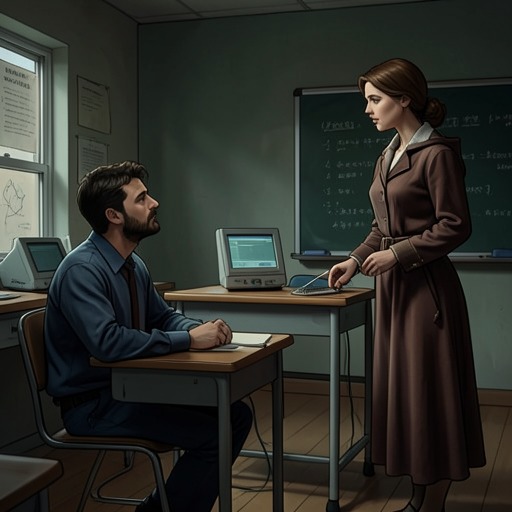
At school, Connell is troubled by the attention Paula Neary gives him, but classmates interpret it as evidence that he is attracted to her. Their assumption unsettles his trust in his own responses. Because he has found sex stressful and unpleasant, he is unsure what desire is supposed to feel like and wonders whether his discomfort is being misread, even by himself. The episode presents anxiety not simply as fear of an encounter, but as confusion sharpened by the pressure of other people’s interpretations. Connell does not want the matter reported to a teacher, and Marianne’s reassurance that he is not responsible for Paula’s behavior offers support without resolving his embarrassment or uncertainty.
That difficulty in speaking plainly extends to his relationship with Marianne. After his classmates joke about whether the two have had sex and suggest he take her to the Debs, Connell leaves the room, locks himself in a bathroom cubicle, and vomits. The immediate trigger is social teasing, but his thoughts turn to his private declaration of love and the fear that Marianne will never know what he feels. The scene binds emotional distress to secrecy: what he cannot say to her becomes physically overwhelming, while the surrounding group treats their intimacy as material for jokes.
Separation and persistent loneliness
When Marianne leaves school, Connell enters a period of low spirits that others notice. He struggles to act normally, disengages from conversation at lunch, and sometimes fails to respond when friends call to him. He misses Marianne’s company and the way he felt with her, but his attempts to reach her—frequent calls and daily messages—receive no reply. Her absence therefore becomes both a loss of companionship and a reminder of the harm between them.
Connell tries to blunt the loneliness by drinking and having sex with other girls, but these encounters bring further distress rather than relief. After one encounter, he feels so bad that he vomits and gives an explanation that does not reflect the whole situation. He has no one he feels able to talk to about it. Dreams of being with Marianne again briefly offer an image of ease and closeness, only for waking to restore the separation; at times he feels so depressed that moving seems impossible.
His conversation with Lorraine shows how differently he understands Marianne’s silence from how she does. He calls her lack of response an overreaction, while Lorraine tells him that Marianne is vulnerable and that his conduct was exploitative and hurt her. Connell resists acknowledging that he feels bad, but the exchange makes clear that his distress cannot be separated from his choices or their consequences. Loneliness is not presented as proof that he has been wronged: it coexists with responsibility for having hurt someone.
Anxiety in intimacy and grief
Even after Connell and Marianne reconnect, closeness does not remove his anxiety. In one moment of intimacy, he suddenly imagines that he could strike Marianne and is frightened by the thought. He backs away, his hands shaking, and struggles to breathe normally. He cannot explain the reaction or identify a clear cause; Marianne checks on him, but he can only say that a strange feeling has come over him. The episode distinguishes an involuntary, alarming thought from an action: Connell is disturbed by the possibility he imagines and withdraws from it. The suddenness of the fear also shows that tenderness and distress can occupy the same relationship without either cancelling the other.
Grief brings another pattern of acute distress. At the anniversary Mass for Marianne’s father, Connell finds looking at her intensely painful and reflexively imagines ways of causing himself severe injury. The text describes this imagining as briefly interrupting his thoughts, but says he feels worse afterward. Later that night, he drinks heavily and becomes less engaged with the people around him, concentrating instead on drinking. The sequence links grief with attempts to escape awareness, while showing that the attempted escape deepens rather than resolves his suffering.
Social and material pressures
The novel places distress within environments that restrict ordinary forms of belonging. Although Carricklea is the only place Marianne has lived, she knows little of its social and physical geography: she rarely goes beyond school, Mass, and Connell’s house, and she has never visited several familiar local spaces. Her limited access is not a passing detail; it gives material shape to her isolation. She also understands that the Waldrons are treated as a bad family while Connell is nevertheless admired at school, illustrating the town’s class judgments and the uneven ways reputation attaches to people.
Economic insecurity compounds Connell’s difficulty asking for help. When his employer cuts his hours, he cannot cover both rent and living costs, and he decides he must leave his Dublin accommodation for the summer. Though he believes Marianne would let him stay, he delays telling her because asking feels too much like asking her for money. He is especially uncomfortable with the unspoken financial relationship between their families: Marianne’s mother pays his mother for domestic work, and money then reaches Connell indirectly. Marianne often pays for shared expenses without emphasizing them, but Connell’s reluctance reveals how material dependence can become a barrier to candor even in an intimate relationship.
Reputation, withdrawal, and unequal judgment
Marianne’s distress also arises in the aftermath of social conflict. After she breaks up with Jamie, their circle begins to turn against her, and she senses people avoiding her or falling silent when she enters a room. The loss of admiration and belonging is unsettling, but she gradually becomes accustomed to it. Peggy’s insistence that Marianne’s situation places her in a difficult position makes the social cost explicit: Peggy does not want to take sides, while Marianne distinguishes caring about Peggy from sharing the same priorities.
The circulation of gossip about Marianne’s sexuality makes that isolation more acute. She asks Joanna repeatedly who has been talking and what was said; Joanna declines to provide details and argues that people’s fixation is more revealing of their attitudes than of Marianne herself. Marianne also asks Lukas to delete photographs he had taken of her, although they had not been put online. For a time, shame makes her feel as if her life is over; then the intensity subsides, and the episode becomes a painful chapter that has concluded. Connell later acknowledges hearing that Jamie spoke badly about her, but he had not understood how much people cared. Their conversation exposes a gendered imbalance: Marianne identifies the reputational harm, while Connell recognizes that Jamie’s conduct is judged differently because he is a man.
Across these episodes, distress is conveyed through recurring acts of silence, withdrawal, and failed relief: Connell cannot tell his classmates what Paula’s behavior is like, cannot initially disclose his feelings to Marianne, and delays discussing money; Marianne remains cut off from much of her community and tries to avoid social spaces where she cannot be inconspicuous. The novel treats mental distress as lived experience with interpersonal and material causes, not as an isolated label. Its recurring emphasis on what the characters cannot say shows how anxiety and loneliness can persist even when affection is present, and how honest recognition of harm can begin without immediately repairing it.