2009 Clearwater boating accident
Not Without HopeThe 2009 Clearwater boating accident was the March 1, 2009 capsizing of Marquis Cooper’s 21-foot Everglades fishing boat in the Gulf of Mexico, an accident that killed Marquis Cooper, Corey Smith, and Will Bleakley and left Nick Schuyler stranded at sea for roughly forty-three hours. Its decisive significance lies in the chain linking an improvised attempt to free a stuck anchor to the boat’s rapid overturning, the men’s lack of immediate flotation and distress equipment, the difficulty of locating them offshore, and the extraordinary but limited protection created by the capsized hull. The event is remembered not simply as a story of individual endurance, but as a convergence of mechanical error, environmental exposure, incomplete information, delayed rescue, and collective effort.
Causes and Background
The men left before dawn on February 28, 2009, traveling to the Seminole Boat Ramp in Clearwater and intending to fish at a wreck roughly fifty nautical miles west of Clearwater Pass. A cold front was approaching, and Marquis Cooper had monitored the weather closely. He warned that the water might become rough and said they might turn back before reaching their destination. By late afternoon, however, the sea had deteriorated into seven-foot swells. Nick Schuyler was severely seasick, unable to keep down food or water, while the group was already dressed in soaked or inadequate cold-weather clothing for the worsening conditions.
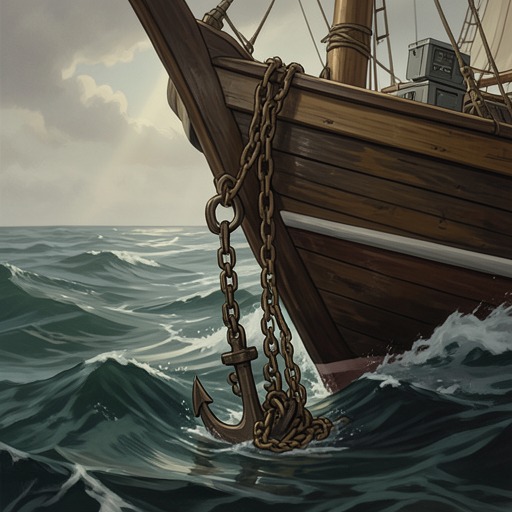
The immediate mechanical problem was the anchor. Marquis Cooper maneuvered the boat over it while Will Bleakley and Corey Smith pulled at the line, but the anchor remained fixed to the bottom despite repeated changes of position and the strength of the two men. The same problem had occurred on the previous trip, when a friend had eventually cut the line and Marquis Cooper had paid two hundred dollars for a replacement anchor and rope. Determined not to lose another anchor, the group accepted Will Bleakley’s proposal to move the one-inch anchor line from the bow to a cleat at the stern and use the engine to wrench the anchor free.
The later investigation by the Florida Fish and Wildlife Conservation Commission identified three connected causes: the line had been tied improperly to an eye bracket on the port side of the transom, the engine had been throttled forward in an attempt to pull the anchor loose, and insufficient slack had been left in the line. Together, these conditions drew the stern down into the water. The accident therefore did not arise from a single mysterious failure; it followed a clear physical sequence in which the anchor’s resistance was transferred to the vulnerable rear of the boat.
Capsizing and Immediate Survival Crisis
As the boat rocked, Corey Smith stood near the center console holding the canopy, while Will Bleakley remained at the stern beside the relocated anchor line. Marquis Cooper tightened the line and gunned the engine. The motor first made a high, rising sound and then a low rumble. When the anchor blades dug in more deeply instead of releasing, the stern squatted and water poured aboard. The bow rose toward the sky, and the boat listed to port. Marquis Cooper shouted for everyone to get to the top, but the movement was too fast for a Mayday call. Nick Schuyler grabbed the starboard railing and was thrown into the water as the vessel rolled.
All four men surfaced within a few feet of one another, but none was wearing a life jacket. The boat lay completely upside down, its white hull and propeller projecting above the water while thousands of bubbles escaped from beneath it. Their first response was to try to right the vessel. Will Bleakley and Marquis Cooper cut the still-tight anchor line from the propeller, hoping that freeing the boat would allow it to roll back. Instead, the men discovered that the overturned hull offered no useful leverage. Nick Schuyler and Corey Smith lay across the stern and kicked downward, while Marquis Cooper and Will Bleakley pushed from the front and starboard side. The submerged center console acted like a resistant rudder, and the deeper the two men pushed, the farther underwater they were driven. The boat never came close to being righted.
The failed attempts consumed time and strength as daylight faded. With the boat drifting away after the line was cut, the men realized that rescue would not come before dark. Will Bleakley began asking practical questions about an emergency beacon, flares, a functioning radio, drinking water, and the location of the life jackets. Marquis Cooper had no emergency position-indicating radio beacon, and the men had no immediate Mayday transmission. Their wet wind jackets, wind pants, sweatpants, and other clothing offered little protection as shivering began. The crisis had shifted from a brief capsize to an open-ended struggle against cold, exhaustion, darkness, and separation.
Search, Rescue, and the Role of the Overturned Hull
The Coast Guard did not receive notification until 1:27 a.m. on March 1, when Brian Miller reported that the 21-foot Everglades boat was overdue. The report contained errors about the number and experience of the passengers, and the boat was beyond the range of the Coast Guard’s communications towers. A later call supplied a handheld GPS position—27°58'09" N and 083°42'01" W—about ten miles south of the plotted wreck site, enlarging an already uncertain search area. Captain Timothy Close emphasized that the missing men might have been in the water for hours, a delay that substantially reduced their chances of survival.
The absence of an EPIRB was especially consequential. Such a device could transmit a unique satellite signal and, in some circumstances, activate automatically when a boat overturned. Because the vessel sent no distress signal, searchers had to estimate where wind, waves, and currents might carry a drifting boat, while also allowing for the different movement of human bodies in the water. A capsized vessel was difficult to see: searchers might encounter only a narrow glimpse of white hull amid immense fields of whitecaps, storm clouds, and darkness. The Everglades boat’s RAMCAP construction meant that its bonded, closed-cell core could keep it afloat even after overturning, but buoyancy did not make it easy to locate.
The USCGC Tornado was diverted from routine patrol in the Florida Straits, 230 miles northward, to assist the search off Tampa and St. Petersburg. Its crew normally used several lookouts and systematic scanning methods because waves, debris, shifting light, and the vessel’s own motion could hide a person or hull even at close range. On the morning of March 2, Michael Briner saw an orange speck and a white wave about five hundred yards off the starboard side, west of Tampa. The apparent wave did not break and disappear like the surrounding water. The bridge crew confirmed that the object was a living person.
Twelve minutes passed between the sighting and the survivor’s arrival aboard the rescue boat. David Earles reached Nick Schuyler, gave him a flotation device, and told him to float on his back while the crew reeled them in. Schuyler’s bright clothing and his position sitting on the rear of the boat helped make him visible. The rescue was therefore the result of both persistence and a narrow visual distinction: one patch of orange and one persistent white shape separated from the constantly moving sea.
Medical Consequences and Survival
When Nick Schuyler reached Tampa General Hospital, his temperature had risen to 95 degrees, although he remained somewhat confused. His temperature when found had been measured between 88.8 and 89.5 degrees, a range described as moderate hypothermia. Doctors were concerned about cold injury and trauma to his legs, which had been repeatedly battered against the boat, and his platelet count was low. The lower limbs were described as one extensive bruise, and vascular specialists checked that swelling had not compromised circulation. Compression devices were applied to support blood flow and prevent clots.
Dr. Mark Rumbak judged that Schuyler might have survived another six to twelve hours in the Gulf. His temperature had risen steadily after he changed out of wet clothes aboard the cutter and was wrapped in wool blankets, so the hospital did not need to warm him with injected fluids. His platelet count later returned to normal, and the bruising healed. Yet the medical outcome remained difficult to explain because the four men were close in age, size, and physical fitness. Schuyler had little body fat, which offered limited insulation, but his exceptional fitness as a personal trainer may have helped him endure the ordeal. His survival could not be reduced to a simple formula of strength or willpower; the treating physician called it, in effect, a miracle.
Responsibility, Memory, and Significance
In retrospect, the accident exposed several layers of insufficient preparation. The men were not wearing life jackets, lacked a reliable means of transmitting their exact position, had no EPIRB, and were poorly equipped with flares and flashlights. The Coast Guard’s later assessment also underscored the danger of taking a single-engine boat far offshore without appreciating how isolated the crew could become. These failures mattered not as abstract safety rules but because each removed a possible protective layer once the stern began to submerge.
At the same time, Nick Schuyler’s account refuses to portray the men as passive or careless throughout the crisis. After the capsizing, they stayed together, retrieved life jackets from beneath the boat, tried to keep anyone who slipped from falling away, communicated, attempted to right the vessel, and used their phones where possible. Their decisions were made under severe cold, illness, darkness, and incomplete information: they even debated whether a distant shape might be land and attempted a short swim while tying themselves together with cable so they would not be separated. The Florida Fish and Wildlife Conservation Commission’s causal findings identify the unsafe anchor maneuver, but the survivors’ later memory also records sustained cooperation after the error had become irreversible.
The accident permanently altered the meaning of Schuyler’s physical training. Afterward, he returned to weightlifting to manage stress and anger, but the workouts no longer had the same intensity as the sessions with Marquis Cooper and Corey Smith. The gym became both a way to continue and a reminder of the friends whose competitive energy had once made exertion pleasurable. His retrospective questions—whether a jacket, an earlier discovery of the steering cable, or a different decision might have prolonged Will Bleakley’s life—show how the accident continued as a moral and emotional event after the physical danger ended.
The dead men were commemorated in public as well as privately. Three weeks after the accident, the Detroit Lions announced that Corey Smith’s number 93 would not be worn during the 2009 season, honoring the relentless way he had played. Later, during an Oakland Raiders victory over the Philadelphia Eagles, a pigeon flew in formation with the kickoff team; several Raiders players and Marquis Cooper’s mother interpreted it as a sign representing his spirit. Such gestures could not resolve the accident’s unanswered questions, but they carried the three men from the unstable world of the overturned boat into lasting communal memory.