Airlift of Nick Schuyler to Tampa General Hospital
Not Without HopeThe Airlift of Nick Schuyler to Tampa General Hospital was the decisive medical evacuation that followed Nick Schuyler’s rescue from the Gulf of Mexico. It began aboard the USCGC Tornado, where he was cold, weak, and physiologically unstable, and ended at Tampa General Hospital after a Coast Guard helicopter hoisted him in a rescue basket and carried him ashore. The movement from overturned boat to cutter to helicopter to hospital was not a clean victory lap: it was a succession of emergency thresholds in which survival depended on warming, hydration, monitoring, and rapid transport, even as Nick remained preoccupied with the three friends who had not been found.
Medical Emergency Aboard the Cutter
Nick reached the cutter in a condition shaped by prolonged cold-water immersion and exposure to seawater. The book’s medical account explains that immersion could produce hypothermia as body temperature fell below 95 degrees, while swallowed salt water could create a dangerous sodium imbalance, draw water from cells, and progress toward delirium, seizures, cardiac failure, and death from dehydration. The rescuers therefore treated his arrival not as the end of the crisis but as the beginning of a tightly controlled medical response.
Adam Best, the USCGC Tornado’s emergency medical technician, and David Earles, the rescue swimmer, guided Nick to the executive officer’s bathroom. They dried him, removed his wet clothing, put him in Coast Guard coveralls, wrapped him in wool blankets, and supplied sandals because his feet were too large for the biggest pair aboard: he wore size fifteen, while the largest available sandals were size twelve. The details make the rescue physical and improvised. Basic objects—dry clothing, blankets, footwear, and a sheltered room—became immediate instruments of survival.
Nick’s temperature was 89.5 degrees, far below the normal 98.6. His breathing was somewhat labored, his lips were turning blue, and his skin was cool and clammy. He complained of cold and pain in his legs, which had minor cuts aggravated by salt water. His condition appeared to be entering the early stages of shock, though he remained mostly coherent. When Best questioned him, Nick knew his name, location, and the month, but could not remember who was president of the United States. The combination of lucidity and impairment showed why evacuation could not wait for a more complete recovery aboard the cutter.
The Hoist into the Helicopter
The decision to airlift Nick created a new danger. He was told that a helicopter was coming and that he would be lifted in a basket, while a crew member repeatedly insisted that his temperature had to be raised immediately and could not be allowed to fall further. The crew continued adding dry blankets, but Nick could barely stand and was still intensely thirsty. The cutter’s treatment had stabilized him enough for transfer, not made him safe.
The rescue basket looked impossibly small to Nick. It was approximately four feet long, with a bar looped across its middle and attached to the helicopter cable. Water sprayed into the air as the basket descended, and the cold made it difficult for him to endure the exposure. Coast Guard personnel held up his feet, helped him into the basket, and absorbed the pain of the landing as he struck his injured backside. He had many things he wanted to say or scream but held them in, concentrating on enduring the lift.
As the basket rose, people aboard the USCGC Tornado stared up at him, waved, and gave him thumbs-up signs. Nick returned the gesture with his right hand. That small exchange marked a visible change in the rescue: he was no longer an unidentified survivor being hauled from the sea but a living man whose recovery the crew could briefly acknowledge. Yet the gesture did not erase the loss surrounding him. He still wished that his best friend and Marquis Cooper and Corey Smith were aboard the ship with him.
Coast Guard Coordination and Flight
Kevin Lajeunesse, a Coast Guard petty officer second class, had been conducting a shoreline search with his helicopter crew for twenty or thirty minutes when they received word that the USCGC Tornado had found one of the missing boaters. The helicopter redirected thirty-five miles west of St. Petersburg. A HC-130 Hercules aircraft was operating in the area and had spotted several objects of interest, but a low flyover revealed no signs of movement before the helicopter proceeded to the cutter.
The coordination reflects the wider difficulty of the search. The boat had not transmitted a distress signal because it apparently lacked an Emergency position-indicating radio beacon, and an overturned hull would present only a small white fragment amid vast numbers of whitecaps. Coast Guard personnel had to work without an immediate electronic position and under conditions of darkness, cloud, wind, and rough seas. Nick’s evacuation was therefore the recovery point of an uncertain search system, not an isolated act of transport.
Lajeunesse initially asked whether the survivor was Will Bleakley, having learned the missing boaters’ identities from friends. Nick explained that hypothermia had taken hold, that Corey Smith had removed his life jacket, and that Corey had appeared traumatized, with abnormal eyes, before sinking. Nick also reported that Will may have seen a light on the horizon. These statements made the flight a medical evacuation and an intelligence-gathering operation at once: while his body was being warmed, Nick was being questioned for information that might direct the continuing search.
Stabilization in Flight and Arrival
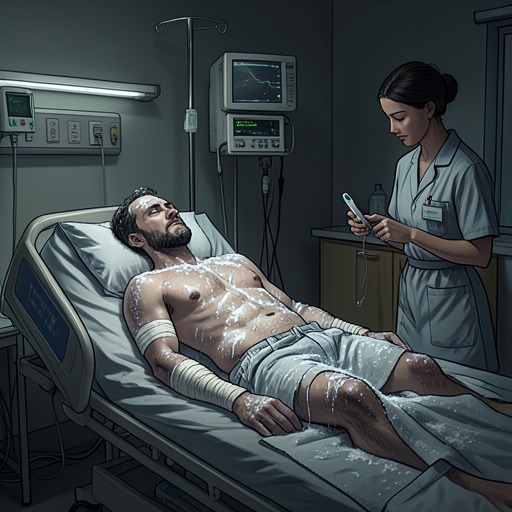
Nick’s temperature was rising in the helicopter, but at 93 degrees it remained dangerously low. His skin was scabbed and covered with dry salt, and he looked exhausted and beaten up. Lajeunesse gave him water, which he gulped down, while he remained under a thick wool blanket. The crew directed heat from the helicopter engine—called bleed air—toward his head and feet. The treatment addressed the immediate physiological threats in sequence: heat loss, dehydration, weakness, and the risk that renewed exposure would reverse the limited improvement achieved aboard the cutter.
The crew repeated questions about how many people were missing, where they might be, where the boat had departed from, and how far offshore it had traveled. Nick was too weak to lift the water bottles himself. He tipped his head back and let water fall into his mouth from three large bottles. His thirst was not incidental discomfort; it was the continuing expression of the dehydration that had accompanied cold, salt-water exposure, and prolonged deprivation.
The helicopter reached Tampa General Hospital roughly twenty or thirty minutes after leaving the cutter. Nick tried to rise from the basket, but a Coast Guard crew member had to help lift him. A stretcher team ran out to meet him. He was warmer than he had been on the boat, yet still extremely cold, and he shifted his body to relieve the pressure on his injured backside. The transition to land did not immediately restore ordinary movement or comfort; the emergency had changed location, not ended.
Hospital Treatment and Emotional Consequence
At the hospital entrance, reporters, microphones, and cameras surrounded Nick. Their questions—especially about the other boaters—collided with his physical confusion and exhaustion. Inside the emergency room, staff cut off his blue jumpsuit, inserted intravenous lines in both arms, checked his pulse, and connected him to a heart monitor. Machines beeped around him while he remained focused on elementary needs: water, warmth, sleep, and seeing his family, who were waiting nearby.
The airlift thus carries a double meaning in the larger account. Medically, it was a successful recovery barrier: Coast Guard personnel removed Nick from the cutter, supplied heat and fluids, monitored his condition, and delivered him to hospital care while his temperature remained dangerously low. Narratively, however, the arrival exposed the cost of being the sole survivor. Nick was alive and able to answer questions, but the very questions that established his identity also forced him to recount that Marquis Cooper, Corey Smith, and Will Bleakley were not with him.
Later medical interpretation rejected the idea that the three men had simply chosen to give up. Hypothermia could cause delirium, falling potassium levels, and breakdown of the heart’s cell membranes until the heart could no longer contract. Their confusion and physical deterioration were consequences of the cold, not evidence of a straightforward moral failure. That explanation also frames Nick’s evacuation differently: saving him did not mean that he had defeated the same conditions through willpower alone. His survival resulted from a narrow convergence of endurance, clothing, physical circumstance, rescue timing, and medical intervention, while the others’ bodies crossed the lethal threshold sooner.