Coast Guard maritime search-and-rescue lookout protocol
Not Without HopeThe Coast Guard maritime search-and-rescue lookout protocol is the visual discipline used to search moving water for people, debris, and vessels that may disappear among waves. Its decisive significance in the search for Marquis Cooper’s boat lies in its insistence that rescue depends not only on aircraft, radios, and computerized drift calculations, but on trained human eyes repeatedly examining an environment designed to conceal what they are seeking.
Purpose and Operating Conditions
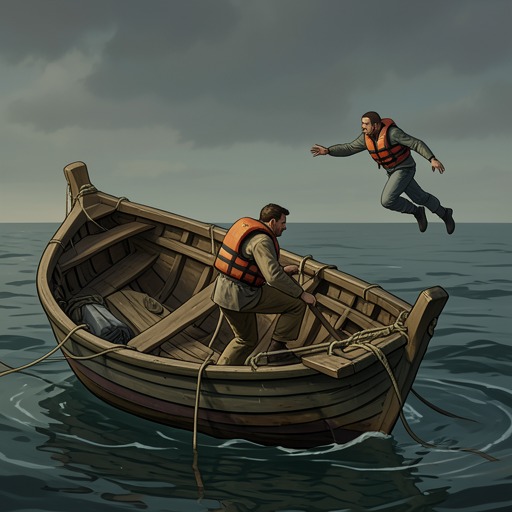
The protocol was applied under unusually difficult conditions. The missing boat was a twenty-one-foot Everglades fishing boat, and the Coast Guard had to consider whether it remained upright, had capsized, was still carrying the fishermen, or had left them in the water. If overturned but afloat, it would present only a small portion of its white hull among hundreds of thousands of whitecaps. The search took place under cloud cover associated with a cold front, with little moonlight and rough seas, making the target difficult to distinguish even before fatigue and distance were considered.
The sea also defeated ordinary assumptions about visibility. A beach ball could be visible from miles away on a calm, flat day yet vanish at one hundred yards when it dropped into a wave trough, met harsh or flat light, or became indistinguishable from the color of the water. A lookout therefore could not simply stare toward the horizon and expect a recognizable object to announce itself. The search demanded repeated, methodical coverage of a moving field in which both observer and terrain were bucking and shifting.
Scanning Method
Lookouts were trained to move their eyes in a repeating S shape, sweeping over and down, over and down, while using binoculars. Without binoculars, they moved their gaze back and forth like the carriage of a typewriter. They generally began at the horizon and worked toward the vessel, but varied the direction by sometimes starting near the bow and scanning outward, reducing eye strain and preventing attention from settling into one exhausted pattern.
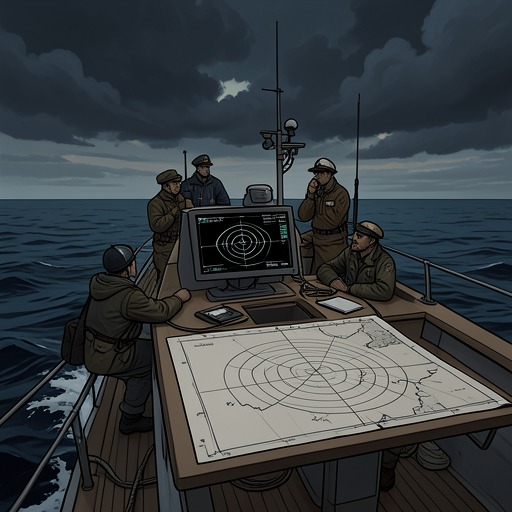
The protocol divided the visual field into manageable portions rather than treating the sea as a single vista. Michael Briner used the Tornado’s dozen bridge windows to frame separate areas, beginning at the waterline or just above or below it and sweeping each window from left to right. The method acknowledged that sophisticated technology could not replace observation. Briner’s training held that electronics might fail when most needed, while people positioned at the scene could still detect a fleeting contrast, an unbroken wave, or an object that did not behave like surrounding debris.
Peripheral vision was also treated as valuable. Briner knew from sixteen years in the Coast Guard that objects were often located more quickly through peripheral vision than by direct staring. That principle made the search less like looking for a large, obvious boat and more like isolating a tiny irregularity inside a field of moving visual noise.
Deployment During the Search
The Tornado began its initial search at 7:45 on Monday morning after passing through the storm. Swells still reached six feet. The cutter searched west for eight to ten miles, turned north in increments ranging from a quarter mile to a mile to create spacing, and then proceeded east in a straight-line creep. The pattern was compared to moving across a football field in successive strips: advance, cross, edge forward, and return in the opposite direction. This geometry converted a vast and uncertain ocean into a series of overlapping search lanes.
Normally, three lookouts stood on the bridge, each responsible for scanning forward, starboard, or port. Yet the protocol extended beyond formal watch assignments. Coast Guardsmen were expected to look through the bridge windows whenever they were on the bridge, even during a cigarette break. Every additional pair of eyes mattered because the target might be visible for only a moment before disappearing behind a wave.
The method was used alongside, not instead of, technological and organizational tools. The Coast Guard had already used drift calculations, radio calls, an Urgent Marine Information Broadcast, a Jayhawk helicopter, and a motor lifeboat. But the search area had remained uncertain because the original report gave incomplete and partly mistaken information, the boat was outside the communications towers’ effective range, and no Emergency position-indicating radio beacon had transmitted a precise signal. The protocol was therefore a recovery layer in a chain whose other layers had been weakened by missing information, darkness, weather, and equipment limitations.
Detection and Rescue Significance
At 11:43 Monday morning, roughly thirty-eight miles west of Tampa, Briner was looking through the bridge windows when he saw a speck of orange and a white wave that did not break and disappear. The water was rough, and ordinary waves repeatedly rose and vanished; this one persisted. He first thought it was an oddly placed buoy, then recognized that no buoys were located that far offshore. He alerted the bridge by saying, “I’ve got something.” The disciplined search had transformed an ambiguous color and an unusually persistent wave into the first decisive visual lead.
The protocol’s importance is sharpened by the contrast between the apparent simplicity of the discovery and the difficulty of producing it. The Tornado’s crew was searching for a capsized twenty-one-foot boat whose hull could resemble a whitecap, amid floating objects ranging from milk jugs to old rafts and refrigerators. The RAMCAP construction of the Everglades model made the boat likely to remain afloat even if overturned, but buoyancy did not make it conspicuous. Survival therefore depended on the searchers’ ability to notice a small, stable anomaly rather than merely a large structure.
Broader Context and Limits
The protocol does not eliminate the consequences of poor preparation or delayed notification. The boat had been reported overdue at 1:27, and the Coast Guard recognized that the fishermen might already have spent hours in the water. Captain Timothy Close emphasized that an immediate notification could have preserved one or two hours of daylight and that the absence of an EPIRB meant a search rather than a direct rescue. The lookout system could improve the probability of discovery, but it could not restore time already lost or supply coordinates that had never been transmitted.
The rule also reveals a central tension in maritime rescue: the more advanced the search system becomes, the more clearly its dependence on embodied attention is exposed. Computerized models estimate drift, aircraft extend the search range, and radios distribute warnings, yet the final breakthrough came when a tired observer noticed that one wave behaved unlike the others. In this account, the human eye is not presented as a romantic substitute for technology. It is a trained, procedural component of the rescue infrastructure—one that makes the difference when the sea turns a boat, a person, or a piece of hope into a nearly invisible branch among moving water.