Coast Guard search for the four missing boaters
Not Without HopeThe Coast Guard search for the four missing boaters was the central recovery effort following the capsizing of Marquis Cooper’s fishing boat in the Gulf of Mexico on March 1, 2009. It began with an overdue-vessel report and developed into a technically difficult search for a nearly invisible overturned hull and four men scattered by cold, waves, and currents. The operation exposed how a chain of ordinary vulnerabilities—an improperly secured anchor line, inadequate emergency equipment, uncertain coordinates, delayed notification, and severe weather—could turn a recreational fishing trip into a maritime disaster, while disciplined lookout work eventually found Nick Schuyler alive.
Causes and Initial Alarm
The crisis began when Marquis Cooper, Corey Smith, Will Bleakley, and Nick Schuyler tried to retrieve the anchor in worsening conditions. Cooper drove Marquis Cooper’s twenty-one-foot Everglades boat while Will Bleakley and Corey Smith pulled on the anchor line. The anchor remained fixed to the bottom despite the efforts of two exceptionally strong men and repeated repositioning of the boat. Frustrated by the failure and unwilling to lose another anchor, Cooper pulled the line tight and throttled forward.
The anchor blades appear to have dug in more deeply. The stern squatted, water poured into the boat, the bow rose, and the vessel listed toward port before rolling over. The men escaped into seven-foot swells without even having time to transmit a Mayday call. They later cut the line from the propeller and tried repeatedly to right the boat, but the submerged center console acted like a resistant rudder and gave them no leverage. Their strength made almost no difference: the overturned boat did not come within five percent of being flipped back.
The later investigation by the Florida Fish and Wildlife Conservation Commission identified three linked causes: the anchor line had been tied improperly to an eye bracket on the port side of the transom; the crew had attempted to use forward throttle to free the anchor; and there had not been enough slack in the line, allowing the stern to submerge and the boat to capsize. The search therefore followed an accident whose decisive mechanism was not a single dramatic failure but the alignment of several preventable weaknesses.
Notification and Search Problems
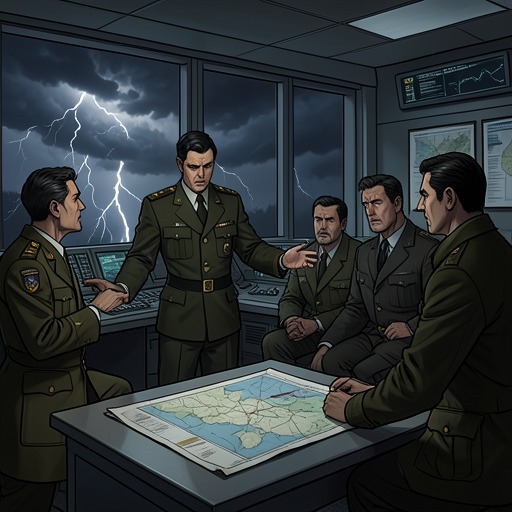
At 1:27 a.m., the Coast Guard station in St. Petersburg, Florida, received notice that the twenty-one-foot Everglades boat was overdue. Brian Miller, a friend of Marquis Cooper, reported that the boat had left the Seminole Boat Ramp in Clearwater and was apparently headed toward a dive wreck fifty nautical miles west of Clearwater Pass. The initial report contained errors: it said there were only two other passengers and described the men as having little maritime experience. Cooper’s truck, trailer, recently rebuilt motor, and limited boating experience became part of the information used to define the search.
The station called repeatedly on VHF Channel Sixteen, the international distress frequency, but received no response. The boat was far enough offshore to lie beyond the range of the Coast Guard’s communications towers. The absence of a signal was made more consequential by the boat’s lack of an Emergency position-indicating radio beacon. An EPIRB could have transmitted a unique satellite signal, identifying both the craft and its location; without one, searchers had to infer the men’s position from uncertain reports and drift calculations.
At 2:38 a.m., Miller reported that a handheld GPS device belonging to Marquis Cooper had been found and might contain the coordinates of Cooper’s usual fishing location. At 2:53, he supplied a position of 27°58'09" N and 083°42'01" W, approximately ten miles south of the plotted wreck site. Instead of narrowing the problem decisively, the new information enlarged and complicated the search area. The Coast Guard had to consider whether the boat was upright or capsized, whether the men remained aboard, whether they had entered the water, and whether they had stayed with the drifting hull.
The delay mattered because the four men might already have been in the water for hours. Captain Timothy Close emphasized that an immediate report could have preserved an hour or two of daylight, while the actual notification came after that advantage had largely disappeared. At 2:47, the Coast Guard issued an Urgent Marine Information Broadcast, asking other vessels to report any Mayday signal or information about a boat in distress. At 6:38, dispatchers advised relatives to check credit-card activity, search closer to shore rather than assume the boat had reached its intended offshore destination, establish the departure point, determine the amount of fuel, and alert the media so that more people on land and water could watch for the missing boat.
Search in Darkness and Heavy Seas
The first Jayhawk helicopter launched at 7:09 a.m. and reached the search area at 7:45. A forty-seven-foot motor lifeboat arrived at the supplied GPS coordinates at 7:10, where seas ran eight to ten feet and sometimes rose to twelve feet, with thirty-mile-per-hour winds and visibility of only half a mile. Captain Timothy Close compared the lifeboat’s passage through the conditions to an E-ticket ride at Disney World. The search was not simply a matter of reaching a point on a map; wind affected the drifting boat differently from the people in the water, whose movement was more directly shaped by currents.
An overturned boat was especially difficult to see. Searchers might encounter only a small white edge of hull among hundreds of thousands of whitecaps. The moon provided little illumination, and cloud cover from a storm-churning cold front further darkened the sea. A capsized twenty-one-foot boat could resemble a wave, while floating debris—milk jugs, old rafts, refrigerators, and other objects—could create false possibilities. The moving vessel, unstable horizon, changing light, and constantly shifting water made the operation unlike searching from land or from a car on a highway.
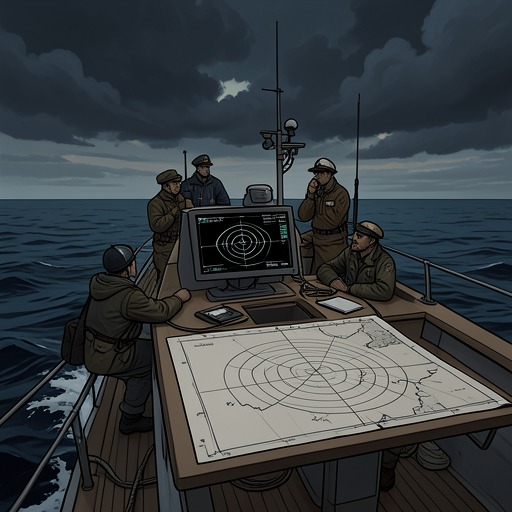
The Coast Guard’s search pattern depended on method as much as endurance. On Monday morning, after the cutter had passed through the worst of the storm, USCGC Tornado began its initial search at 7:45 with swells still reaching six feet. The vessel moved eight to ten miles west, turned north for spacing intervals of a quarter mile to a mile, and then advanced east in a straight-line creep. The pattern resembled a football-field exercise: across, edge upward, and return in the opposite direction, turning open water into a systematic grid.
Three lookouts normally scanned from the bridge toward the forward, starboard, and port sectors. The procedure recognized that peripheral vision could locate an object more effectively than direct staring. Even Coast Guardsmen who were not formally on watch were expected to look out the windows and contribute another set of eyes. Yet the physical conditions remained punishing. A beach ball visible for miles on calm water could vanish one hundred yards from a ship if it dropped into a wave trough, became masked by flat light, or blended with the sea’s color.
Discovery and Rescue
At 11:43 Monday morning, about thirty-eight miles west of Tampa, Chief Boatswain’s Mate Michael Briner saw a small orange speck beside a white wave. The wave did not break and disappear like the surrounding water. The object seemed to be an oddly placed buoy, but there were no buoys in that part of the Gulf of Mexico. Briner announced, “I’ve got something,” and fixed his attention on the object roughly five hundred yards off the starboard side. His recognition transformed an indistinct mark in the water into the possible location of the missing boaters.
The discovery was made possible by persistence within a search system that had been operating under severe uncertainty. USCGC Tornado had survived waves powerful enough to tear an ammunition box from twelve half-inch bolts and damage metal fittings, yet its crew continued the methodical scan after the weather improved. The search’s decisive moment did not come from a dramatic electronic signal. It came when a trained lookout noticed that one patch of orange and white behaved differently from a wave.
The operation ultimately found the overturned boat and rescued Nick Schuyler. The search did not recover Marquis Cooper, Corey Smith, or Will Bleakley alive. When Kristen Schuyler saw Nick in the hospital, he was bleeding, pale, thin, dehydrated, and struggling to keep his eyes open; when asked about the other men, he indicated that they were gone. A television report then circulated an unconfirmed claim that Marquis Cooper had also been found. Kristen briefly wondered whether Nick’s denial might be hallucination, but Nick answered that Marquis had not been found.
Consequences and Aftermath
The search became inseparable from questions about preparation. The boaters had not been equipped with an EPIRB, had not sent a distress signal, and had not clearly communicated their exact destination. In retrospect, Nick Schuyler identified the absence of flares and flashlights, the failure to wear or properly locate life jackets, and the lack of a reliable emergency plan as additional weaknesses. These omissions did not make the search unnecessary; they made the search harder, slower, and more dependent on weather, chance, and individual observation.
The public story also changed as information moved among relatives, Coast Guard dispatchers, television reports, and online commentators. The original notification miscounted the passengers, and the eventual confirmation that four men were missing—including two NFL players—was expected to generate high media interest. Afterward, Nick Schuyler’s decision not to speak publicly was criticized by bloggers, some of whom made brutal and racist accusations about his survival and his tattoo. The search thus continued in another form: families and survivors had to navigate competing versions of what had happened, while official findings supplied a more precise account of the accident.
For Schuyler, the Coast Guard search ended with rescue but not with closure. He later memorialized Marquis Cooper, Will Bleakley, and Corey Smith in a Celtic-cross tattoo incorporating their initials, a rope, an anchor, and the date March 1, 2009. At a memorial service for Cooper attended by about seventy people, Schuyler said that Cooper had taught him never to give up and never to quit. The same principle that sustained the search—continuing to scan despite darkness, whitecaps, false objects, and exhaustion—became the emotional language through which the survivors remembered the men who were not found alive.
The search therefore stands as both a rescue operation and an anatomy of uncertainty. Its outcome depended on the interaction of accident mechanics, equipment, communication, family information, weather, search doctrine, and trained perception. The overturned boat was nearly indistinguishable from the sea, but the Coast Guard’s repeated effort eventually made one crucial distinction: a wave disappeared, while the orange-and-white object seen by Michael Briner did not.