Detroit Lions
Not Without HopeDetroit Lions is significant in the book because it links Corey Smith’s professional identity to both the trajectory of his football career and the public memorialization that followed his death. Smith’s connection with the team gives the tragedy a national sporting dimension, but the team’s remembrance also insists on the particular qualities of the man and player his teammates knew: durability, relentlessness, and an unwillingness to stop working.
Corey Smith and the Team
Corey Smith had gone undrafted out of North Carolina State in 2002 before joining the Tampa Bay Buccaneers as a free agent. He appeared in six of the team’s first nine games that season, then finished the year on injured reserve and could not play in the Super Bowl, when the Buccaneers defeated the Oakland Raiders. His career therefore began with both improbable achievement and frustration: he was part of a Super Bowl team as a rookie, yet could not participate in its defining game.
Smith’s professional identity was built less around celebrity than dependable labor. After his early Tampa Bay seasons, he became known as a durable, reliable backup. He and Marquis Cooper briefly played together with the Buccaneers in 2004, although they apparently did not know each other well at that time. Their later friendship developed through training rather than through their shared professional employer, with the gym becoming the place where they pushed one another and established the intense physical partnership that shaped their connection.
The Detroit Season
Smith’s career also contained a sharp reversal. He had played on a Super Bowl team as a rookie, but in 2008 he was with the Detroit Lions, a team that lost all sixteen of its games. The contrast places his work in a larger pattern of professional football in which individual toughness persists even when collective results collapse. The book does not present Smith’s value as dependent on the Lions’ record; instead, his reputation rests on the consistency with which he performed under difficult circumstances.
That reputation was visible in the story the Lions continued to tell about him. During the 2007 season, Smith had a strained hamstring, and Detroit’s coaches tried to replace him on the kickoff-return team during a game against Chicago. The account emphasizes that his instinct was to remain involved despite injury, a detail that helps explain why teammates remembered him as relentless rather than merely talented. His football body was a working instrument, repeatedly offered to the demands of the team.
Public Recognition After His Death
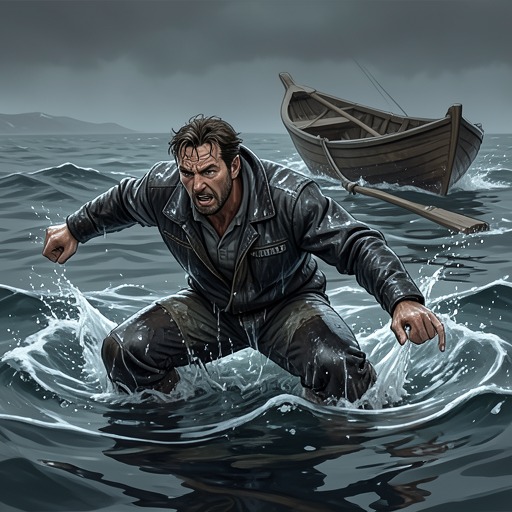
Smith was one of the four men aboard Marquis Cooper’s 21-foot Everglades fishing boat when it capsized in the Gulf of Mexico on March 1, 2009. Nick Schuyler was the only person recovered alive. The football identities of Smith and Cooper intensified public attention to the disappearance: when the Coast Guard confirmed that four men were missing, it also confirmed that two of them were NFL players. In that sense, Detroit Lions was not only part of Smith’s biography but also part of the machinery through which the accident became a highly visible national story.
The team’s most direct memorial came three weeks after the accident, when the Detroit Lions announced that no player would wear number 93 during the 2009 season, the number Smith had worn for Detroit. Retiring or setting aside the number for that season transformed a private loss into a visible team practice. The gesture preserved Smith’s place within the roster’s history while allowing the number itself to stand for absence.
The memorial was reinforced by testimony about how Smith worked. Galen Duncan, the Lions’ player development director, told the Associated Press, “If you could see the way this man worked,” invoking effort as the essential fact through which Smith should be remembered. The tribute did not reduce him to the circumstances of his death; it returned attention to the discipline and persistence that had defined his professional life.
Institutional Memory and the Book’s Wider Meaning
Detroit Lions belongs to a network of institutions and rituals through which the three dead boaters were remembered. Smith’s family and friends carried the intimate burden of his loss, while the team supplied a public language of number, uniform, effort, and collective respect. That division matters because Nick Schuyler’s account repeatedly resists the idea that the victims should be understood only as names in a disaster report. Smith’s athletic history provides evidence of the physical strength and competitive culture the four men brought into the boat, but the accident also exposes the limits of that identity against cold water, rough seas, inadequate signaling equipment, and a capsizing chain caused by the anchor arrangement.
The Detroit Lions’ tribute therefore carries a double significance. It honors Smith’s professional life and the work ethic associated with him, while also marking the boundary between sporting endurance and survival at sea. The team could preserve his number and his reputation, but it could not undo the loss. Its remembrance becomes one of the book’s clearest examples of how an individual tragedy moves from the realm of family grief into collective memory without ceasing to be personal.