Dry Tortugas
Not Without HopeDry Tortugas appears in the rescue narrative not as the site of the capsizing, but as the point near which the USCGC Tornado was operating when the cutter was redirected toward the search for the missing fishermen. Its mention widens the scale of the disaster: the men were lost far offshore in the Gulf of Mexico, while the rescuers themselves had to cross a deteriorating sea before they could reach them.
Position in the Rescue Narrative
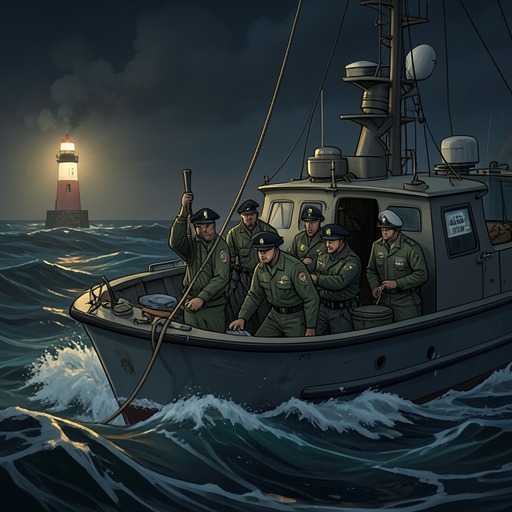
Dry Tortugas enters the account when the USCGC Tornado, with three of its four engines operational, increased speed to twenty-three or twenty-four knots while heading east of the islands. The cutter’s crew learned of the new assignment through the Internet and understood that the mission concerned four missing football players. From that remote position, the ship became part of the expanding response to the overdue twenty-one-foot Everglades fishing boat that had departed the Seminole Boat Ramp in Clearwater for a destination about fifty nautical miles offshore.
The geographic distance mattered because the boaters’ exact position was initially uncertain. The Coast Guard had received an overdue-vessel report at 1:27 A.M., but the caller had misstated the number of passengers, and the boat was beyond the range of the station’s communications towers. A handheld GPS later supplied coordinates, yet those coordinates were about ten miles south of the plotted shipwreck site, enlarging an already imprecise search area. Dry Tortugas therefore functions as a marker of the rescue system’s reach: the responding cutter was not waiting beside the casualty, but had to be diverted from elsewhere and sent toward a location still being reconstructed through incomplete information.
A Remote Starting Point for a Difficult Transit
The passage from Dry Tortugas toward the search area unfolded under worsening weather. Lieutenant Commander Patrick Peschka knew that a storm was moving through the Gulf of Mexico. After roughly ninety minutes, the wind rose from ten to fifteen miles an hour; by late Sunday afternoon it had reached twenty to twenty-five miles an hour, and swells increased from three feet to eight feet. The USCGC Tornado reduced speed to ten or twelve knots. Between midnight and two on Monday morning, winds reached thirty-five miles an hour and swells reached twelve feet, forcing the cutter to slow further even though it was 179 feet long.
The conditions aboard the cutter reveal that distance was not merely a number on a chart. Michael Briner reported that crew members had to hold on to avoid being thrown around, and some became seasick despite the ship’s size. Others placed boots beneath their mattresses to create an incline in their narrow bunks, allowing their bodies to roll toward the walls while they tried to sleep. The rescue vessel was substantially larger and better equipped than the capsized fishing boat, yet it remained subject to the same wind, waves, and darkness that had made the missing men so difficult to locate.
Contrast with the Capsizing Site
The men aboard Marquis Cooper’s fishing boat had also been operating at a considerable remove from shore when the accident occurred. After fishing for hours, they attempted to free an anchor that had remained fixed to the bottom. The anchor line was tied at the stern, and when the engine was throttled forward, the anchor blades dug in more deeply. The stern submerged, water poured into the boat, the bow rose, and the vessel rolled toward its port side before the men could make a Mayday call.
Their subsequent attempts to right the vessel failed because the overturned boat offered no useful leverage. Corey Smith and Nick Schuyler lay across the stern and kicked downward, while Marquis Cooper and Will Bleakley tried to pull or push from the front and starboard side. The submerged center console acted as a resistant rudder, and the physical strength of the four men could not overcome the boat’s position in the water. The Florida Fish and Wildlife Conservation Commission later attributed the accident to the improper attachment of the anchor line to an eye bracket on the port side of the transom, the attempt to throttle forward against the stuck anchor, and the failure to leave sufficient slack in the line.
The contrast between Dry Tortugas and the capsizing site is consequently structural as well as geographic. At sea, a 3,400-pound boat could be transformed from a fishing platform into a nearly invisible object. The Coast Guard warned that an overturned vessel would present little more than a small section of white hull amid hundreds of thousands of whitecaps. The search took place under cloud cover, with little moonlight, rough seas, and no Emergency position-indicating radio beacon to transmit an automatic or manual location.
Significance in the Book’s Maritime Scale
Dry Tortugas helps keep the rescue from becoming a single, isolated scene. The narrative moves between the fishermen struggling around the overturned hull, relatives trying to establish who was aboard, Coast Guard personnel calculating how wind and current might carry a boat or a person, and crews crossing open water under increasingly severe conditions. The islands’ brief appearance anchors one end of that system, while the missing boat and its survivors occupy another.
The location also sharpens the book’s distinction between response and rescue. The Coast Guard did not immediately dispatch a craft when the boat was first reported overdue; personnel first had to determine the vessel’s identity, route, occupants, fuel, equipment, and likely position. They issued an Urgent Marine Information Broadcast at 2:47 A.M., obtained GPS coordinates at 2:53, launched the first Jayhawk helicopter after sunrise, and sent a motor lifeboat toward the reported position. Meanwhile, the missing fishermen might already have been in the water for hours, a delay that Captain Timothy Close identified as decisive for survivability.
In the aftermath, public accounts continued to reshape the event. A television report briefly claimed that a second fisherman, Marquis Cooper, had been found, though the report was unconfirmed; Schuyler rejected the claim when Kristen Schuyler repeated it to him. Later, after Schuyler’s tattoo honoring Cooper, Bleakley, and Corey Smith became his Facebook profile photo, online commentators criticized both his silence and his appearance of memorialization, including vile accusations that he had caused the deaths. Against these competing versions, Dry Tortugas remains a quiet but important geographical fact: it signifies how far the rescue effort had to travel, how exposed the responders were to the Gulf’s force, and how the scale of the ocean could turn uncertainty into lost time.