February 28, 2009
Not Without HopeFebruary 28, 2009 was the day a recreational fishing trip became the initiating disaster of the book: Nick Schuyler, Marquis Cooper, Corey Smith, and Will Bleakley left Clearwater for an offshore wreck site, and a failed attempt to free the anchor caused Marquis Cooper’s 21-foot Everglades boat to take on water and overturn. The date therefore marks both a final ordinary morning—breakfast, beer, fishing gear, and a farewell outing—and the beginning of the men’s 43-hour struggle in cold, rough water.
Departure and Purpose
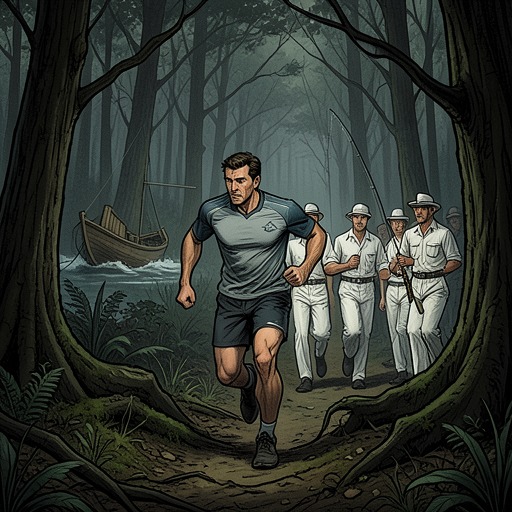
Before sunrise, at about 6:30 on Saturday morning, the group launched from the Seminole Boat Ramp in Clearwater, Florida. Nearly a dozen boats were already on the water, their navigation lights shining against the residential towers along the Intracoastal Waterway and the Causeway Bridge leading toward Clearwater Beach. A cold front was expected later, but the morning still belonged to routine preparations and anticipation.
The trip was intended as a going-away celebration for Marquis Cooper. He was preparing to leave Tampa for an off-season training camp with the Oakland Raiders, after selling his house and arranging to travel first to Seattle, where he had attended the University of Washington. Although he planned to keep a residence in the Tampa area, he was unsure when he would next have time to fish. The outing thus carried a quiet farewell quality even before the danger appeared: it was connected to Cooper’s football career, his family life with Rebekah Cooper and their three-year-old daughter, Delaney Cooper, and his attachment to his boat and the Gulf.
The men traveled roughly sixty-five or seventy miles west of Clearwater Pass toward a shipwreck that was one of Cooper’s favorite fishing areas. They had packed for a cool late-winter morning, wearing jackets, hats, windbreakers, and wind pants. Cooper had carefully selected ten fishing rods from a garage containing about fifty. Two twenty-gallon coolers were secured aboard: one held beer, drinking water, and ice, while the other contained water, Gatorade, sandwiches, and protein bars. A storage compartment held additional food and supplies, and a backpack containing phones and wallets was placed with the life jackets.
Warnings and Offshore Conditions
Cooper had been monitoring the weather for several days and had warned that the approaching cold front might make the water rough. On the morning of departure, he again expressed uncertainty about whether the party would travel all the way to the fishing site. The warning was not ignored so much as absorbed into the ordinary logic of the trip: the men proceeded while keeping open the possibility of turning back.
The boat was fueled before reaching the ramp, and by 6:21 the group was at the Seminole Boat Ramp. A few minutes after setting out, the men opened their first beers. The scene still carried the loose atmosphere of a social excursion, but the weather and distance made the outing dependent on decisions that would become increasingly difficult as the day progressed. The boat was a 21-foot, single-engine vessel, and its limited size and propulsion would later matter sharply once the sea deteriorated.
By late afternoon, the sea had become dangerous. Seven-foot swells were striking the boat, the men were sick and exhausted, and they had decided to return after fishing. At about 4:15, Cooper told Will Bleakley to reel in his line because the conditions were worsening and the trip back would take a long time. The danger at that point was not an abstract possibility: the men were already cold, battered by the sea, and operating far from shore.
The Anchor and Capsizing
The immediate crisis began when the anchor would not come free. Cooper maneuvered the boat over the anchor while Bleakley pulled on the line, and Corey Smith joined him at the bow. Even two exceptionally strong men could not move it. Cooper had faced the same problem on the previous week’s trip, when a friend had ultimately cut the anchor line and Cooper had spent two hundred dollars replacing the anchor and rope. Determined not to lose another anchor, he rejected cutting the line.
Bleakley proposed moving the one-inch anchor line from the bow to the stern and using the engine to pull the anchor loose. The suggestion seemed practical because nobody had a better alternative. The anchor might come free, the line might snap, or the boat might drag whatever held it until the obstruction released. The men did not know whether the anchor was caught on the wreck, a cable, debris, or the bottom itself, possibly deep in the muck.
With Cooper driving, Bleakley stood at the back of the boat beside the reattached line, while Smith held near the center console. Cooper tightened the line and gunned the motor. Instead of freeing the anchor, the force drove its blades more firmly into whatever held them. The stern squatted and began taking on water, the bow rose toward the sky, and the boat listed toward port. Cooper shouted for everyone to get to the top, but the turn happened too quickly for a Mayday call. Schuyler grabbed the starboard railing and was thrown into the sea as the 3,400-pound boat rolled.
The men initially believed that the taut line was still holding the vessel down. After drifting to create a small amount of slack, Bleakley and Cooper cut the rope around the propeller, a process that took about five minutes. The stern lifted slightly, but the boat immediately began drifting. They then tried to right it by pulling across the stern, kicking downward, and pushing from the starboard side. The effort failed because no one could gain leverage, while the submerged center console acted like a large resistant rudder. The boat did not come close to flipping upright; its mass and position made further strength almost irrelevant.
Consequences and Retrospective Meaning
The capsizing transformed a fishing trip into a maritime-distress emergency. The overturned hull became difficult to see in the rough Gulf, appearing to searchers as little more than a white fragment among hundreds of thousands of whitecaps. The storm-darkened sky and limited moonlight further reduced visibility, and the boat apparently lacked an emergency position-indicating radio beacon. As a result, the Coast Guard had no automatic satellite signal giving the vessel’s position and had to reconstruct its likely drift area from incomplete information.
At 1:27 on March 1, the Coast Guard station in St. Petersburg, Florida, received notice that the boat was overdue. The initial report contained errors about the number and experience of the passengers, while radio calls on VHF Channel 16 produced no response because the boat was beyond the range of the Coast Guard’s communications towers. The case was upgraded from alert to distress at 2:37, after the worsening weather, unusual lateness, distance offshore, and cold water made the possibility of immersion increasingly grave.
The physical consequences of the February 28 decision chain were compounded by the environment. Saltwater ingestion could produce a dangerous sodium imbalance, cellular dehydration, delirium, seizures, heart failure, and death. Cold-water immersion threatened hypothermia, with younger and fitter men not necessarily protected by their strength; at approximately 65 degrees, a typical twenty-five-year-old man was expected to remain functional for about 9.9 hours and survive for about 15 hours. Muscle could reduce flotation and increase the effort required to tread water, while greater body fat could provide insulation.
The later Florida Fish and Wildlife Conservation Commission investigation identified three causal factors: the anchor line had been tied improperly to an eye bracket on the port side of the transom; the engine had been throttled forward in an attempt to pull the anchor free; and insufficient slack allowed the stern to submerge and the boat to capsize. Schuyler’s retrospective account adds the human dimension to that conclusion. He wished the men had handled the anchor differently, prepared better for a distress signal, specified their exact destination, carried more flares and flashlights, and worn their life jackets or known more clearly where they were stored. February 28 thus remains both a date in the men’s personal lives and the precise starting point of an avoidable chain in which weather, distance, equipment deficiencies, and a single improvised maneuver aligned with catastrophic force.