Florida Fish and Wildlife Conservation Commission
Not Without HopeThe Florida Fish and Wildlife Conservation Commission is the state agency that appears after the 2009 Clearwater boating accident as both an investigative body and an important intermediary between the survivors’ account and the public record. Its role is consequential because the accident was not explained only by rough water or human endurance: the Commission’s investigation identified a specific sequence involving the anchor line, engine power, and the submerged stern, while an early statement attributed to the agency helped generate claims that the survivors had been drunk, fighting, or had simply given up.
Role in the Immediate Investigation
The Commission entered the narrative after Nick Schuyler had been rescued and taken to Tampa General Hospital. Two agency investigators came to his room, where he recounted the ordeal over approximately forty-five minutes. The interview was physically and emotionally difficult: Schuyler was weak, in severe pain, and still suffering the effects of prolonged exposure and immersion. Even so, he understood that he was the only person able to give Will Bleakley’s parents a coherent account of what had happened to their son.
Schuyler later described speaking with Bleakley’s parents and explaining that the men had been drinking, but that alcohol was not the reason the boat overturned. He identified the decision to move the anchor line to the stern as the central questionable choice. Bleakley’s father responded that Will had taken boating-safety classes and knew better, a reaction that showed how the investigation immediately intersected with grief, disbelief, and the search for responsibility. Schuyler also emphasized that Bleakley had worked to keep him alive, including going beneath the overturned boat to retrieve life jackets, Gatorade, and pretzels.
Public Information and Disputed Accounts
The agency also became connected with the first public explanations of the disaster. After Schuyler’s rescue, the Florida Fish and Wildlife Conservation Commission issued a brief statement. Schuyler believed that his words had been misunderstood, distorted, or delivered while he was still incoherent. Reports circulated that Marquis Cooper had simply given up and died, that the men had been drunk and that drinking had caused the accident, that Corey Smith had attacked the others, and that Bleakley had removed his life jacket and swum toward a light.
Schuyler directly disputed those versions. He said that he—not Bleakley—had seen the light and nearly swum toward it. He regarded the rumors as disrespectful to Cooper, Smith, and Bleakley, whose survival under the conditions had already required extraordinary effort. The episode illustrates the gap between an unstable early account, a public statement, and the more complete reconstruction that became possible only after Schuyler had recovered enough to describe the event accurately.
Findings on the Capsizing
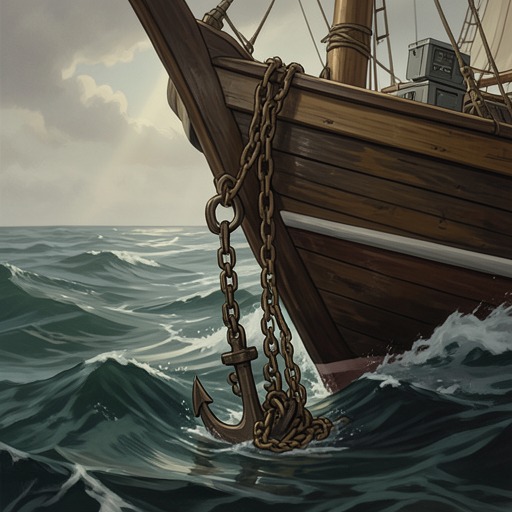
The Commission’s later investigation concluded that the accident resulted from three interacting factors. First, the anchor line had been tied improperly to an eye bracket on the port side of the boat’s transom. Second, the crew attempted to use forward throttle to pull the anchor free. Third, there was not enough slack in the line. Together, those conditions caused the stern to submerge and the boat to capsize.
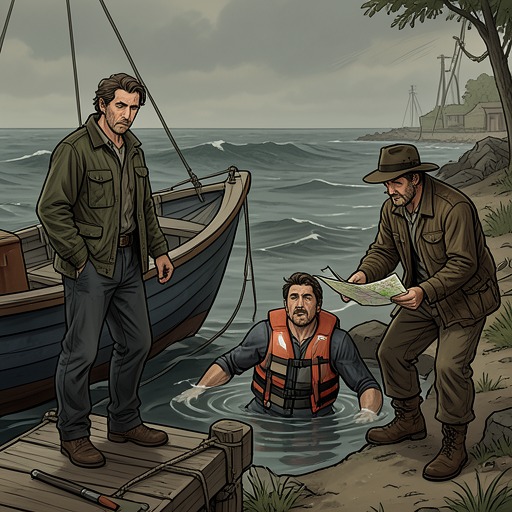
The narrative supplies the physical sequence behind that conclusion. Marquis Cooper was driving while Schuyler sat beside him on the captain’s bench. The boat was about one hundred yards downwind from the anchor, which would not budge despite efforts by Bleakley and Smith and repeated repositioning by Cooper. Bleakley then moved the one-inch line from the bow and tied it to a stern cleat. When Cooper tightened the line and gunned the motor, the stern squatted, water poured into the boat, the bow rose, and the hull listed toward port. The men had no time to make a Mayday call before the boat rolled.
The Commission’s finding therefore transformed a seemingly overwhelming natural disaster into an identifiable accident chain. The seven-foot swells and the cold Gulf of Mexico formed the dangerous environment, but the immediate mechanical trigger was the interaction between a fixed anchor, a stern-tied line, engine thrust, and insufficient slack. After the line was eventually cut, the boat still could not be righted: the center console lay beneath the surface like a resistant rudder, and the men could not obtain leverage against the hull.
Equipment, Preparation, and Consequences
The agency’s findings sit within a broader pattern of inadequate preparation. The boat had no emergency position-indicating radio beacon, which could have transmitted a distinctive satellite signal and the vessel’s location when manually or automatically activated. The Coast Guard later noted that, with such a device, the operation might have been a rescue rather than a search. The men also had not established a reliable distress procedure, had not clearly communicated their exact fishing location, and had not been wearing life jackets when the boat overturned.
The evidence does not support treating those omissions as a single personal failing. The men were college-educated and physically strong, and the account rejects the claim that they had been incapacitated by drinking: Schuyler had consumed only about one and a half beers and vomited them, Smith did not drink, Bleakley had seven or eight beers, and Cooper five or six over ten hours. At the same time, they were inexperienced boaters operating far offshore in deteriorating weather. The Coast Guard’s search difficulties—darkness, cloud cover, whitecaps, uncertain drift, and the absence of an emergency beacon—show how preparation failures multiplied the consequences of the capsize.
Investigative and Narrative Significance
The Florida Fish and Wildlife Conservation Commission’s significance lies in the tension between its different appearances in the story. Through its investigators, it preserved Schuyler’s testimony during the fragile period immediately after rescue. Through its public statement, or through the way that statement was understood and reported, it became part of the confusion surrounding the men’s conduct and deaths. Through its final investigation, it supplied the clearest causal account of the accident.
That progression matters because the book repeatedly resists explanations based on rumor, moral simplification, or hindsight. The Commission’s conclusion confirms that the disaster arose from a chain of choices and conditions rather than from a claim that one man panicked, attacked another, or voluntarily abandoned the group. Schuyler’s later reflections remain haunted by counterfactuals—whether he should have recognized the danger of the stern line, whether different equipment or clothing might have prolonged Bleakley’s life—but the official finding gives those questions a concrete framework. It identifies what happened without erasing the rough sea, the cold, the missing equipment, the men’s limited information, or the human cost that followed.