Hallucination
Not Without HopeHallucination is the perceptual and cognitive breakdown that accompanies the men’s prolonged exposure after Marquis Cooper’s fishing boat overturns in the Gulf of Mexico. In Nick Schuyler’s account, hallucination is both a symptom of bodily collapse and a narrative measure of how far the survivors have moved from ordinary reality. The sea remains physically present—cold, rough, and indifferent—while the mind repeatedly supplies beaches, cities, companions, water, and rescue. These visions create false possibilities at the precise moments when the men most need reliable judgment.
Definition and Physiological Setting
Hallucination develops within a chain of mutually reinforcing dangers rather than appearing as an isolated mental event. Boaters thrown into the Gulf could swallow large quantities of seawater, producing a poisonous sodium imbalance, cellular dehydration, delirium, seizures, cardiac failure, and death from dehydration. Hypothermia added another form of neurological disruption: as body temperature fell below 95 degrees, shivering could progress to clumsiness, rapid shallow breathing, blue lips, confusion, slurred speech, and irrational or confrontational behavior.
The survival circumstances made the younger, fitter men especially vulnerable in ways that contradicted ordinary assumptions about physical strength. A military survival guide estimated that an average twenty-five-year-old immersed in 65-degree water might remain functional for 9.9 hours and survive for 15 hours, while a fifty-year-old might remain functional for 11.6 hours and survive for 17.6 hours because greater body fat offered insulation and flotation. The Coast Guard also noted that muscular football players could be disadvantaged by their reduced flotation and by the difference between short bursts of athletic exertion and the stamina required to tread water for hours. Hallucination therefore emerges as part of a physiological process in which strength, endurance, cold, salt, and exhaustion no longer operate in the ways the men understood from ordinary life.
Imagined Land and Unreliable Distance
Nick’s clearest early visual hallucination appears during the night after the capsizing. Looking to his left, he saw what seemed to be the brightest city, with a glow extending for several miles above buildings near a beach. He considered whether the lights might belong to Cuba, the Bahamas, or Puerto Rico. Reflections on the water formed shapes like stars or crosses, but salt water in his eyes made the scene difficult to interpret. The image turned the featureless Gulf into a possible geography, giving Nick something more definite than the overturned hull to look toward.
The Coast Guard later suggested that Nick may have seen a cruise ship or cargo ship, or that the apparent city resulted from salt water in his eyes. Yet uncertainty was itself part of the danger. Nick questioned whether the lights marked land, whether he was approaching or receding from it, and whether swimming toward them represented his last chance. The imagined shore became an impossible calculation: distance could not be measured, direction could not be trusted, and waiting for rescue had already failed repeatedly. Hallucination thus did not merely distort perception; it converted uncertainty into an apparent decision.
The Hallucinations of the Other Men
Before Nick fully recognized the same process in himself, he watched it transform Marquis Cooper and Corey Smith. Around two-thirty, Marquis’s responses to repeated calls grew slow; he slurred and rambled, had swallowed substantial salt water, gagged, dry-heaved, and shivered continuously. Later, Corey floated at the back of the boat, moaning and rambling, answering only after Nick and Will Bleakley shouted his name several times. Then Corey suddenly displayed desperate energy, pulling on Marquis’s legs and trying repeatedly to climb onto the hull, with an angry and threatening expression.
Nick understood that Corey’s behavior was not an expression of his ordinary character. Corey, normally the easiest man to get along with, seemed mentally absent, becoming physically aggressive for ten or fifteen seconds before going lifeless and trying again. Nick and Will told him to stop because there was nowhere else to go. The episode shows how neurological impairment could produce actions that appeared purposeful while being fundamentally detached from the actual conditions of survival. Later medical interpretation confirmed that hypothermia could cause delirium and confusion; Marquis, Corey, and Will Bleakley had not simply chosen to give up, and tying them to the boat would not necessarily have saved them because their hearts might have stopped before discovery.
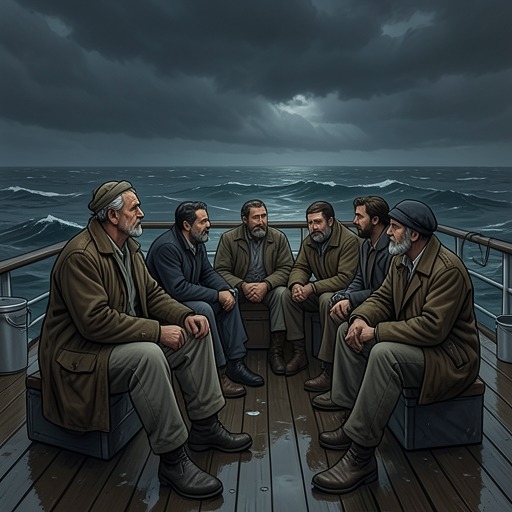
The four men’s huddling on the hull provides the physical counterpoint to this mental separation. Freezing and exhausted, they pressed their bodies together around the motor, with Nick’s cheek against Marquis’s back, Will’s chest against Nick’s back, and Corey leaning in from the stern. They shivered and heard one another’s teeth chatter, attempting to conserve body heat while the waves tossed the overturned boat. Around nine o’clock, Corey’s illuminated waterproof Nike watch helped them keep track of time, and they recited the Lord’s Prayer. These concrete instruments of shared reality—bodies touching, a watch marking the hour, and a prayer spoken together—stood against the later collapse in which each man’s mind could no longer reliably locate the others.
Nick’s Delirium at Sunrise
By sunrise on Monday, March 2, Nick knew that his own perceptions were failing. He was still moving in and out of the water, resting his head on his hands at the motor, when he heard someone yelling and realized the voice was his own. He then imagined Marquis, Corey, and Will standing about ten feet behind him beneath the canopy, on a version of the boat that appeared right side up while his side remained upside down. In the vision, they were driving the boat and facing him. Nick demanded a gallon of water, shouted repeatedly for it, and believed the men were deliberately ignoring him and playing a cruel game.
The hallucination became tactile and nearly interactive. Nick reached backward while holding the motor with his other hand, imagining that the others were extending a clear plastic jug toward him but refusing to hand it over. Then his awareness abruptly returned. He realized that he was losing control, feared that he was becoming “cuckoo,” and recognized the pattern as the same one that had overtaken Marquis, Corey, and Will. This recognition is crucial: hallucination does not erase Nick’s capacity for observation all at once. For a brief interval, he becomes both its participant and its diagnostician, using the earlier behavior of his friends to understand that dehydration and hypothermia are shutting down his own mind.
Rescue, Memory, and Meaning
Near the end of the ordeal, hallucination mingled with memory, grief, and the desire for rescue. Nick pictured his family and Paula Oliveira at his funeral, crying before his coffin. He also imagined Nate Milstead, a friend from Ohio and an Akron police officer, standing on shore at Shephard’s Beach Resort on Clearwater Beach, near the place where the men had caught bait fish on Saturday morning. Nick called to Nate to come get him, believing that he was close to shore or perhaps already swimming toward it. The imagined shoreline compressed past familiarity, present danger, and anticipated death into one scene.
These visions occurred alongside a shrinking ability to regulate the body. Nick’s temperature eventually measured 89.5 degrees after rescue; his breathing was labored, his lips were blue, his skin cool and clammy, and he appeared to be entering the early stages of shock. He remained mostly coherent and knew his name, location, and the month, but could not remember who was president. Before that, his heart rate had slowed dramatically, his head had sagged onto his hands, and he had struggled to draw breath. He prayed for his family and Paula, imagining the words that might remain if he died. Hallucination therefore marks the threshold at which prayer, memory, imagined conversation, and physiological failure begin to occupy the same mental space.
The episode is ultimately interpreted by the book as evidence of injury rather than culpability. Dr. Mark Rumbak argues that hypothermia caused confusion, potassium loss, and damage to the heart’s cell membranes; the men who disappeared had not consciously abandoned one another. Nick’s hallucinations make that medical explanation experiential. They allow the reader to see how a person can appear angry, irrational, or absent while the underlying cause is a body losing the capacity to think clearly. The visions also explain why Nick’s survival cannot be reduced to simple willpower. His mind repeatedly drifted toward false shores and impossible companions, yet he continued trying to remain awake, signal a helicopter with his camera phone, and resist giving up.
After rescue, the hallucinations remained part of the meaning Nick assigned to the disaster. He understood that his friends had worked together to keep him alive, and he honored them with a tattoo bearing their initials, the date of their deaths, a Celtic cross, an intertwined rope, and an anchor. The Persian proverb he chose for its background—“In the hour of adversity, be not without hope.”—opposed the apparent surrender that outsiders might mistakenly read into the men’s final behavior. Hallucination is consequently both a medical state and a boundary in the narrative: it records the mind’s loss of dependable reality while preserving the evidence that the men’s deaths resulted from cold, dehydration, and confusion, not from a failure of friendship or effort.