Hypothermia
Not Without HopeHypothermia is the life-threatening loss of core body heat that governs the later stages of the four men’s ordeal in the Gulf of Mexico. In the overturned boat, cold water, wind, exhaustion, wet clothing, and repeated physical exertion gradually turned strong, clearheaded athletes into men who shivered uncontrollably, slurred their speech, lost coordination, became confused, and eventually slipped beyond purposeful control. The book’s medical interpretation is decisive: Marquis Cooper, Corey Smith, and Will Bleakley did not simply surrender, and Nick Schuyler’s survival was not proof that the others lacked determination. Their bodies were following different trajectories through the same physiological crisis.
Definition and Physical Progression
Hypothermia began as an environmental threat before it became an obvious medical condition. The men were stranded in rough water whose temperature was in the low sixties; the Coast Guard estimated it at roughly sixty-four degrees. They had no life jackets at first, and the wind and repeated immersion continually removed heat. The immediate signs were bodily and unmistakable: darkness, constant chattering teeth, nausea, fatigue, and the effort required merely to remain attached to the overturned boat. As the night continued, shivering became the visible rhythm of the crisis.
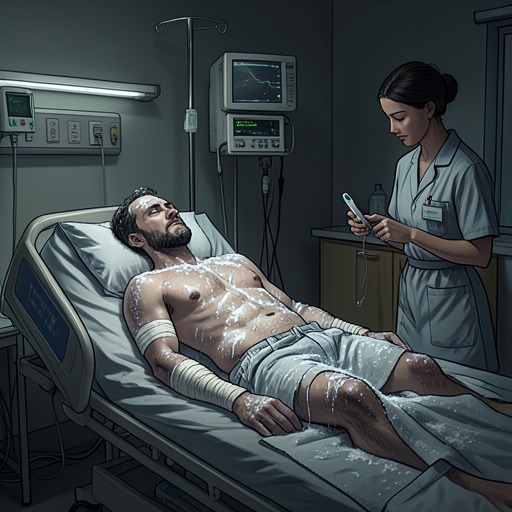
The progression described by the book is systematic. Once body temperature falls below 95 degrees, blood vessels in the arms and legs constrict, redirecting blood toward the core to protect the heart, lungs, and brain. Continued cooling produces clumsiness, rapid shallow breathing, blue lips, confusion, slurred speech, and irrational or confrontational behavior. In a person immersed in water near 65 degrees, a military survival guide estimated that a typical twenty-five-year-old man might remain functional for about 9.9 hours and survive for about 15 hours. Those figures distinguish the ability to act from mere biological survival: a person may still be alive after losing the capacity to make coherent decisions or control the body.
Cold was compounded by the possibility of seawater ingestion and dehydration. A person thrown into the Gulf could swallow large quantities of salt water, creating a dangerous sodium imbalance, drawing water out of cells, and progressing toward delirium, seizures, cardiac failure, and death from dehydration. Hypothermia therefore operated alongside salt-water exposure, exhaustion, and starvation rather than as an isolated condition. The men’s physical decline was the combined result of a hostile environment and diminishing physiological reserves.
Symptoms Among the Boatmen
Marquis Cooper’s decline provided the clearest early demonstration of hypothermia’s effects. He had almost no body fat despite extraordinary muscular conditioning, so he had little insulation against the cold. While attempting to secure the cooler on the boat’s hull, he repeatedly slid toward the water and required the others to pull him back. He insisted that he was fine, but his fatigue was increasingly visible. Later, his responses became slow, he slurred and rambled, and he dry-heaved after taking in salt water. The deterioration was not a sudden change of personality; it was a bodily process that progressively impaired his ability to understand the danger around him.
Marquis then began acting on a confused conviction that he had to retrieve the anchor. He mumbled that he needed to get under the boat and repeatedly tried to move around the hull. His arms became wild, his head lolled, his eyes moved erratically, and his mouth foamed as he dry-heaved. He also repeatedly tried to remove his life jacket, pulling it halfway off even as the others tightened it and put it back. The men slapped him and called his name in an attempt to restore his awareness, but the person responding to them no longer seemed like the calm, powerful athlete they knew.
Corey Smith developed similar symptoms later. He had earlier stood out of the water on a trim tab, but gradually sank lower off the stern while still holding the boat. He became quieter, shivered, muttered, and occasionally released a loud, random scream. Around five on Sunday morning, after approximately twelve hours in the water, he suddenly summoned desperate energy and tried to climb onto the hull by pulling on Marquis’s legs. His expression appeared angry and threatening, and his behavior became physical and repetitive: he would struggle for ten or fifteen seconds, go lifeless, and then try again. Nick Schuyler recognized that Corey’s conduct was not the character of the ordinarily easygoing man; the cold had begun to take control of him.
Will Bleakley’s later decline showed that even the man who had repeatedly helped rescue the others remained vulnerable. After the weather improved, he still could not climb back onto the boat. His face was frightened, sad, and extremely pale. Once he finally reached the hull, he began mumbling and slurring, speaking in a deeper tone and producing words that Nick could scarcely understand. The pattern recalled Marquis and Corey, though without the earlier aggression. Nick’s determination to keep Will alive became an intimate counterpoint to the medical explanation: affection could produce effort and resistance, but it could not cancel the effects of prolonged cold-water immersion.
Fitness, Body Composition, and Unequal Survival
The men’s athleticism offered both an advantage and a liability. Marquis was an exceptionally strong professional football player, listed at six feet three inches and 215 pounds, with an unusually lean, muscular body. Yet the same lack of body fat that made him appear so physically formidable reduced his insulation. The Coast Guard’s medical discussion emphasized that younger, fitter people could be more exposed to hypothermia because muscle adds weight without necessarily providing the buoyancy or insulation supplied by additional body fat.
Muscle also increased the effort required to remain afloat. Lieutenant Bruno Baltazar explained that a heavily muscled person might have less flotation and therefore need to tread water harder, while an older person might possess more insulation and float somewhat more easily. Football conditioning was not identical to endurance in cold water: football develops repeated bursts of rapid movement followed by rest, whereas survival in the sea demands sustained exertion and the ability to conserve heat over many hours. The physical ideal celebrated on land thus became an imperfect tool in the water.
Nick’s survival reflected a different combination of factors rather than a simple superiority of will. He also had little body fat, but he was exceptionally fit as a personal trainer and had an athlete’s habit of pushing through pain. He had put on a sweatshirt and winter jacket after becoming seasick, giving him somewhat more protection than the others. Dr. Mark Rumbak also considered whether growing up in Ohio, where Nick had worn shorts in severe cold, might have contributed to his acclimatization, though the doctor remained surprised by the length of his survival. Nick’s physical conditioning helped him continue, but the narrative presents that endurance as one variable among clothing, body composition, behavior, and circumstance.
Medical Interpretation and Meaning
The book explicitly rejects the interpretation that Marquis Cooper, Corey Smith, and Will Bleakley simply gave up. Dr. Rumbak explained that hypothermia can cause delirium, disrupt potassium levels, and damage the heart’s cell membranes until the heart can no longer contract. The men’s confusion and erratic actions were therefore symptoms of a failing system, not evidence that they had chosen death or abandoned their companions. Even tying them to the boat might not have saved them; their hearts could have stopped before rescuers found them.
That interpretation changes the moral shape of the survival story. In the boat’s darkest hours, the men huddled together for warmth, prayed, spoke about their families, and admitted things they wished they had done differently. Their words and gestures express loyalty and love, but the later scenes show the limits of conscious intention. Marquis’s attempts to remove his life jacket, Corey’s violent efforts to climb aboard, and Will’s incomprehensible speech can look like betrayal or surrender when viewed only from the surface. Through the medical framework, they become the visible language of cooling brains and failing bodies.
Nick’s own struggle with survivor’s guilt is likewise placed against physiology rather than blame. Rumbak said that Nick had no reason to believe he had caused the others’ deaths: he had not killed them, and their lives had become shorter because they cooled more quickly or otherwise lost physiological function sooner. The doctor recognized that Nick might still carry demons and might not be able to accept that explanation immediately. Hypothermia thus remains both a medical concept and a narrative correction, replacing moral judgment with an account of unequal bodily decline while leaving the emotional burden of survival intact.