Maritime distress
Not Without HopeMaritime distress in the book is not a single instant but a cascading condition: a fishing trip moves beyond ordinary discomfort into an emergency in which the boaters lose control of their vessel, cannot summon help, and must manage exposure, exhaustion, and failing judgment while the Coast Guard searches through darkness and heavy seas. Its decisive significance lies in the way a preventable equipment and decision failure becomes a test of survival, rescue infrastructure, and the moral meaning later attached to the deaths of Marquis Cooper, Corey Smith, and Will Bleakley.
From Return Decision to Capsizing
Marquis Cooper was driving when the men decided to return. At approximately four o’clock, the chop had grown into seven-foot swells, the group was soaked, sick, and exhausted, and the trip back promised to take longer than the four hours required to reach the fishing site. At 4:15, Marquis told Will Bleakley to reel in his line because the weather was worsening and the last fish had been caught. The decision to leave therefore arose from an explicit recognition that the conditions had deteriorated, not from an attempt to prolong the outing.
The immediate crisis began when the anchor would not come free. Marquis maneuvered the boat over the anchor while Will pulled the line, and Corey Smith joined him at the bow. Even with two exceptionally strong men pulling from changing positions, the anchor remained fixed to the bottom. The same problem had occurred on the previous week’s trip, when a companion had ultimately cut the line and Marquis had paid two hundred dollars for a replacement anchor and rope. This earlier loss sharpened Marquis’s determination not to abandon another anchor, but the effort also placed the line and the force of the engine in a dangerous configuration.
With the line tight at the stern, Marquis gunned the single-engine outboard motor while Will warned him not to apply too much throttle. The anchor’s blades apparently dug in more deeply. The stern squatted, water poured into the boat, and the bow rose toward the sky as the vessel listed to port. The men had no time to make a Mayday call. Nick Schuyler, seated beside Marquis on the captain’s bench, seized a railing on the starboard side and was thrown into the water as the boat rolled. The four men had been in the Gulf of Mexico in seven-foot swells, and the 3,400-pound vessel had become the center of an emergency almost instantaneously.
The Overturned Boat as a Failing Refuge
After the capsizing, the men initially believed that the taut anchor line was holding the boat down. They drifted until they created a small amount of slack, then Will and Marquis cut the rope against the exposed propeller. The stern rose slightly once the line was severed, encouraging the hope that the boat could still be righted. That hope failed when the men tried repeatedly to turn the vessel over. Corey and Nick lay across the stern, kicking downward and pulling with their arms, while Marquis and Will worked from the bow and later pushed upward from the starboard side.
The physical arrangement made their strength almost irrelevant. The men could not gain leverage; the more Marquis and Will pushed, the farther they sank beneath the surface, and the submerged center console acted as a resistant rudder. The boat did not come close to being righted. The contrast between the men’s athletic power and the boat’s mechanical resistance becomes central to the meaning of maritime distress: strength that was decisive in football and training could not overcome an unfavorable structure, an anchored mass, and the leverage imposed by water.
As daylight diminished, the overturned hull became both their only visible refuge and an increasingly inadequate one. Nearly two hours of sunlight remained when the boat first turned over, but by about 5:30 sunset was an hour away, the seas were growing rougher, and waves repeatedly crashed over their backs. Will recognized that rescue would not come before dark and began organizing the immediate problem. He asked about an emergency beacon, flares, a working radio, drinking water, and the location of the life jackets, insisting that they needed as many supplies as possible.
The men recovered limited equipment from beneath the inverted canopy. Will retrieved a Ziploc bag containing phones, keys, and Marquis’s camera, as well as several flares. The flares were tucked into Marquis’s swimsuit so they would not float away. Nick used Marquis’s dry BlackBerry to dial 9-1-1, but the call never connected; there were no reception bars and no cellular towers within range. Calls to Rebekah Cooper and Paula Oliveira failed in the same way. The inability of an apparently functioning phone to produce assistance exposed the distance between having a device and having a usable maritime distress system.
Exposure, Injury, and the Progression of Distress
The men’s clothing offered little protection once it became saturated. After roughly forty-five minutes in the water, their wind jackets, wind pants, sweatpants, and jackets were soaked through, and all four were shivering. The danger was not merely discomfort. Salt-water ingestion could produce a poisonous sodium imbalance, draw water out of cells, and lead to delirium, seizures, cardiac failure, and death through dehydration. Cold-water immersion posed a separate and compounding threat as body temperature fell, reducing coordination, narrowing blood vessels, and progressing toward confusion, slurred speech, and irrational behavior.
The book emphasizes that physical fitness did not guarantee safety. An average twenty-five-year-old man immersed in water at roughly sixty-five degrees might remain functional for about 9.9 hours and survive for about fifteen, while a fifty-year-old man might remain functional for 11.6 hours and survive for 17.6. Younger, more muscular men could be disadvantaged because they carried less insulating body fat, had less flotation, and had to expend more effort to remain above water. Football conditioning, built around short bursts rather than sustained treading, was not equivalent to endurance in cold seas.
The men’s changing behavior showed the progression of hypothermia and exhaustion rather than a simple decision to surrender. Around 2:30, Marquis Cooper’s responses became delayed, his speech slurred and rambling, and after swallowing salt water and gagging he began dry heaving while his teeth chattered constantly. Later, during a period of repeated large waves, the men were thrown away from the boat and had to scramble back within reach. The sea repeatedly separated them from the fragile point of safety, making every recovery an expenditure of energy they could not replace.
At about five the next morning, Corey developed similar symptoms. After twelve hours in the water, he suddenly displayed desperate energy and tried to climb onto the hull, pulling at Marquis’s legs and grabbing at anything that might lift him out. His behavior became aggressive and physically forceful, unlike the easygoing person Nick had known. He would struggle for ten or fifteen seconds, become lifeless, and then try again. The scene demonstrates how hypothermia can distort conduct until a familiar person appears mentally absent, while the body continues sporadic efforts to survive.
Search, Delay, and the Limits of Rescue
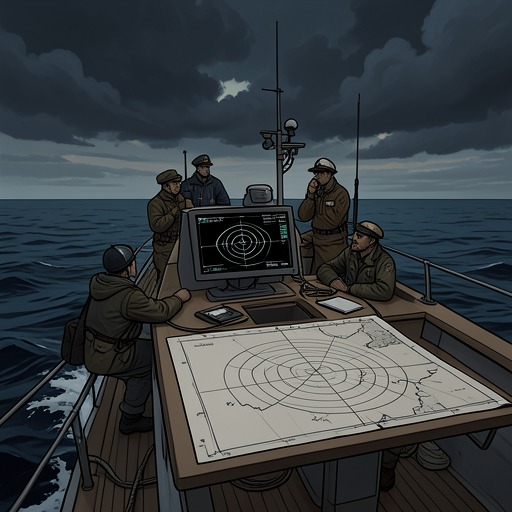
The Coast Guard’s response developed under severe uncertainty. At 2:37, seventy minutes after the Everglades boat had been declared overdue, the case was upgraded from alert to distress. The worsening weather, the men’s unprecedented lateness, their distance from shore, rough seas, and water temperatures around sixty-four degrees made the delay especially consequential. A C-130 Hercules aircraft was requested to search parallel tracks across an area twenty miles by thirty miles, while a forty-seven-foot self-righting motor lifeboat was recommended for the waters west of Clearwater Pass.
The search problem was not simply to find a missing boat but to predict the different movements of a vessel and human bodies. Wind could move an overturned boat differently from current-driven swimmers, and the Coast Guard had to calculate probabilities from incomplete information. An overturned hull would present only a small portion of white surface among hundreds of thousands of whitecaps. A storm-churning cold front obscured the limited moonlight, and the boat had transmitted no distress signal because it apparently lacked an Emergency position-indicating radio beacon.
At 2:47, the Coast Guard issued an Urgent Marine Information Broadcast asking other vessels to report any Mayday signal. A family friend later supplied a GPS position—27°58'09" N and 083°42'01" W—roughly ten miles south of the supposed shipwreck destination, enlarging the search area while making it less precise. The first available C-130 developed engine trouble and failed to launch; the second eventually departed at 3:00 a.m., flying at 1,000 feet and 140 miles per hour, but encountered technical problems and could not operate its radar effectively in eight-foot seas.
The absent beacon became a crucial missed protective layer. An EPIRB could have transmitted a unique satellite signal identifying both the vessel and its position, potentially converting a search into a rescue. The later account does not reduce the disaster to one foolish act, however. Weather, inexperienced boating, anchor placement, missing or inaccessible safety equipment, failed phone coverage, and the time required to recognize the emergency compounded one another. Maritime distress here is therefore represented as a system of aligned vulnerabilities rather than as an isolated failure of courage.
Aftermath and Meaning
The Florida Fish and Wildlife Conservation Commission attributed the accident to three connected factors: the anchor line had been improperly tied to an eye bracket on the port side of the transom; the motor had been throttled forward in an attempt to free the anchor; and insufficient slack allowed the stern to submerge and the boat to capsize. Nick later looked back on the decision with painful precision, wondering whether his sickness had prevented him from recognizing the danger of placing the anchor line at the back of the boat. He also wished the men had been better prepared to send a distress signal, had told others their exact destination, had carried more flares and flashlights, and had worn life jackets or known where they were stored.
The consequences continued after the immediate danger. Nick was rescued with a temperature of 89.5 degrees, labored breathing, blue lips, clammy skin, leg pain, and signs of early shock. He was mostly coherent but temporarily unable to remember who was president of the United States. Medical interpretation later rejected the idea that Marquis, Corey, and Will had simply given up. Hypothermia could produce delirium, falling potassium levels, and damage to the heart’s cell membranes; tying the men to the boat might not have saved them and could have caused their hearts to stop before discovery.
Maritime distress also became a psychological state that survived the rescue. Nick’s survivor guilt centered on counterfactual questions: whether he should have given Will his winter jacket, whether a different choice might have prolonged another man’s life, and whether that alternative might instead have killed him as well. Dr. Mark Rumbak argued that Nick had not caused the deaths and that the men’s lives had ended because they became colder more quickly, not because Nick chose to survive. Yet the persistence of those questions shows how an emergency continues to operate in memory, turning practical decisions made in freezing water into permanent moral trials.
The book finally presents the accident as a warning against treating maritime danger as an abstraction. A twenty-one-foot boat, weighing more than three thousand pounds and carrying four powerful men, could be pulled under by the interaction of an anchor, a taut rope, throttle force, and an unforgiving sea. Once the vessel overturned, the absence of a beacon, the failure of cellular communication, the worsening darkness, and the physiological limits of cold-water survival narrowed the available choices hour by hour. Maritime distress thus names both the physical emergency and the larger chain of preparation, infrastructure, bodily vulnerability, rescue delay, and remembrance that determines what follows it.