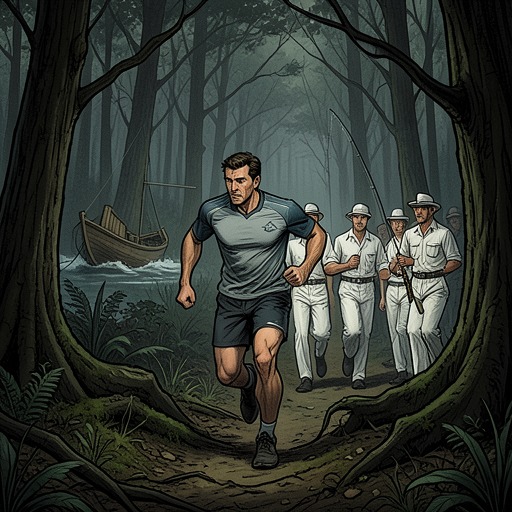
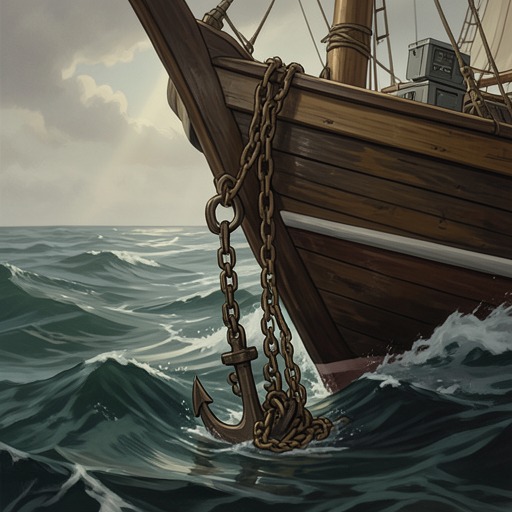
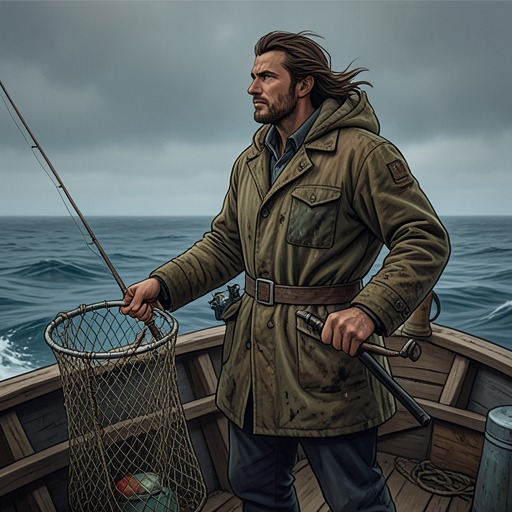
Marquis Cooper's fishing boat
Not Without HopeMarquis Cooper's fishing boat is the central physical object in the offshore journey: a 21-foot Everglades boat that carries four large men 75 miles west of Clearwater, turns over in seven-foot swells when its anchor line is used in a dangerous configuration, and remains afloat long enough to become the survivors’ only shelter. Its importance is practical rather than symbolic alone. The boat’s size, engine, storage, flotation system, anchor, and visibility in rough water shape every stage of the accident, from the decision to fish far offshore to the prolonged wait for rescue.
Design and Preparation
Marquis Cooper's fishing boat had a rated capacity of ten people, but Marquis Cooper preferred to take no more than four, particularly when the passengers were as large as the four men aboard and the trip would extend far into the Gulf of Mexico. The boat measured 21 feet and had a center-console helm beneath a small canopy. A 200-horsepower single-engine outboard motor supplied its propulsion, while a 66-gallon fuel tank and five additional five-gallon cans of gasoline bungeed at the stern provided fuel for the long run offshore.
The morning of the trip showed how the boat served as both transportation and carefully arranged storage space. Marquis Cooper towed it behind a Chevy Silverado pickup, selected ten fishing rods from an unusually large collection, and loaded two 20-gallon coolers. One cooler, positioned ahead of the center console, held mostly beer, drinking water, and ice; the other, beneath the bench-shaped captain’s chair, contained water, Gatorade, sandwiches, and protein bars. Both were secured with bungee cords. The center-console storage area held a case of beer, paper towels, toilet paper, chips, and pretzels, while a backpack containing wallets and cell phones was placed in the compartment where the life jackets were stored.
The boat entered the Gulf of Mexico at about 7:30 in the morning, after the men had reached Seminole Boat Ramp in Clearwater. Marquis Cooper had monitored a cold front and warned that the water might become rough enough to force an early return. The warning mattered because the boat was being taken into an environment whose scale exceeded the men’s ordinary experience: the Gulf reaches more than 14,000 feet at its deepest point and supports major commercial and recreational fisheries. The vessel was therefore a recreational craft operating within a vast resource landscape that could quickly become a hazardous maritime setting.
Offshore Use and the Anchor Problem
The boat’s first function was recreational. A week earlier, Nick Schuyler and Corey Smith had accompanied Marquis Cooper to the same general area, where Marquis Cooper caught red snapper, grouper, lemon sharks, and amberjacks at a rapid pace. On the accident trip, the men stopped repeatedly because of the choppy conditions, the five- to six-foot seas, the need to fish or eat, and the physical punishment of the ride. The anchor repeatedly failed to catch properly, allowing the boat to drift downwind and making it difficult for Marquis Cooper to position the vessel over schools detected by the fish finder.
At about 11:30 a.m., the boat reached its primary fishing location, 75 miles west of Clearwater, over water approximately 150 feet deep and near a supposed shipwreck functioning as an artificial reef. The men caught red snapper, grouper, amberjack, and small lemon sharks. By late afternoon, however, the sea had worsened into seven-foot swells. Marquis Cooper ended the fishing and began preparing to return, but the anchor remained fixed to the bottom while the boat lay roughly 100 yards downwind from it.
For about half an hour, Marquis Cooper maneuvered the boat around the anchor while Will Bleakley and Corey Smith pulled from different directions. Even the combined strength of two large, fit men could not free it. The same problem had occurred on the previous trip, when the line had ultimately been cut and Marquis Cooper had spent $200 replacing the anchor and rope. Determined not to lose another anchor, the men kept trying to release it. The investigation by the Florida Fish and Wildlife Conservation Commission later identified the improper tying of the anchor line to an eye bracket on the port side of the transom, the attempt to throttle forward against the stuck anchor, and the failure to leave enough slack as the three factors that caused the accident.
Capsizing and Transformation into a Refuge
With the boat rocking heavily, Corey Smith stood behind Nick Schuyler at the center console, while Will Bleakley held the anchor line at the stern and Marquis Cooper tightened it before advancing the throttle. The anchor’s blades apparently dug in more deeply instead of coming free. The stern squatted, water poured into the boat, the bow rose, and the vessel listed toward port. The men had no time to send a Mayday call. As the boat rolled, Nick Schuyler reached the starboard railing and was thrown into the Gulf of Mexico.
Once the men were in the water, the overturned boat became the only stable object available to them, although it was an unstable and inadequate refuge. They cut the anchor rope from the propeller, and the stern rose slightly, but the boat immediately began drifting. The men then tried to turn it upright by lying across the stern, kicking downward, pulling with their arms, and pushing from the starboard side. The center console, submerged beneath the surface, acted like a large resistant rudder and prevented them from gaining leverage. Their strength made no practical difference: the boat did not come close to being righted.
The vessel’s compartments also became a source of essential survival equipment. Will Bleakley dived beneath it six or seven times while Marquis Cooper explained where supplies had been stored. Bleakley recovered three bright orange life jackets and a seat cushion, which he wore on his back like a shell. He also freed the forward 20-gallon cooler, although almost everything inside had been lost beneath the boat and the only gallon jug of water floated away. The men retained the cooler because they expected that an entirely sinking boat would leave them desperate for any object that could float.
By dawn on March 1, only Nick Schuyler and Will Bleakley remained with the boat. Nick Schuyler sat on the hull while Will Bleakley stood on the swim platform or a trim tab amid consistent ten-foot waves, rain, cold, hunger, and thirst. The boat’s overturned hull was visible enough to support them, but not conspicuous enough to guarantee detection. Its capacity to remain afloat made survival possible, while its low profile made rescue extraordinarily difficult.
Search, Visibility, and Material Agency
The Coast Guard had to search for a vessel that might be present but nearly indistinguishable from the surrounding sea. If the boat was overturned and still afloat, only a small portion of its white hull would show among hundreds of thousands of whitecaps. Cloud cover from the cold front and limited moonlight further reduced visibility. The absence of an emergency position-indicating radio beacon meant that the boat transmitted no automatic or manually activated location signal. A beacon could have provided both the craft’s position and its identification; without one, the Coast Guard had to estimate where wind, waves, currents, and the different drift patterns of a boat and human beings might carry the survivors.
The search remained difficult even after the Coast Guard cutter USCGC Tornado began its initial search. Three lookouts normally scanned forward, starboard, and port, but a capsized 21-foot boat could resemble a whitecap, while floating debris could include anything from milk jugs to old rafts and refrigerators. The moving ship, bucking water, shifting horizon, changing light, and wave troughs made the task unlike searching from land. An object that would be visible miles away on calm water could disappear even a hundred yards from the ship if a wave concealed it or its color blended into the sea.
The boat also altered the survivors’ perception of the surrounding wildlife. A large squid-like creature with long pale tentacles passed beneath it during the morning, and later two smaller shark-like fins appeared near the hull, probably drawn by blood or loose bait. The overturned vessel was simultaneously shelter, flotation device, storage site, lookout, and attractor of danger. Its material presence organized the men’s actions, constrained their choices, and connected their survival to the currents, waves, bait, fish, and predators of the Gulf.
Investigation and Lasting Significance
The Florida Fish and Wildlife Conservation Commission’s conclusion gives the boat’s destruction a precise mechanical sequence rather than attributing it to the men’s strength or courage. The anchor line was tied improperly at the stern; the motor was throttled forward to pull against the stuck anchor; insufficient slack allowed the stern to submerge; and the boat capsized. Nick Schuyler later wondered how a vessel weighing more than 3,000 pounds, carrying four large men and a load of fish, could be pulled down by an anchor rope about an inch thick. The investigation’s answer was that the configuration converted the boat’s propulsion into a force acting against its own stern.
The boat’s equipment and preparation exposed additional weaknesses in the safety system. The men had life jackets aboard but were not wearing them when the boat overturned, and the jackets were stored in a compartment that required Will Bleakley to dive beneath the hull. They lacked an emergency position-indicating radio beacon, had no successful distress transmission, and recognized afterward that they should have carried or prepared flares and flashlights and told others their exact destination. These omissions did not make the boat inherently unsafe, but they removed layers of protection when the anchor-line failure occurred.
After the accident, the boat remained fixed in Nick Schuyler’s memory as the last physical setting shared with Marquis Cooper, Corey Smith, and Will Bleakley. At Indian Rocks Beach near St. Pete Beach, he could place only a foot in the water and compare its warmth with the cold water he had felt during the accident; he no longer entered the sea as he once had. Looking at the water brought back brief images of the men and the struggle around the hull. The fishing boat thus survives in the narrative not as a neutral backdrop but as the object through which recreation became catastrophe, through which supplies and shelter were both gained and lost, and around which the consequences of that day continue to gather.