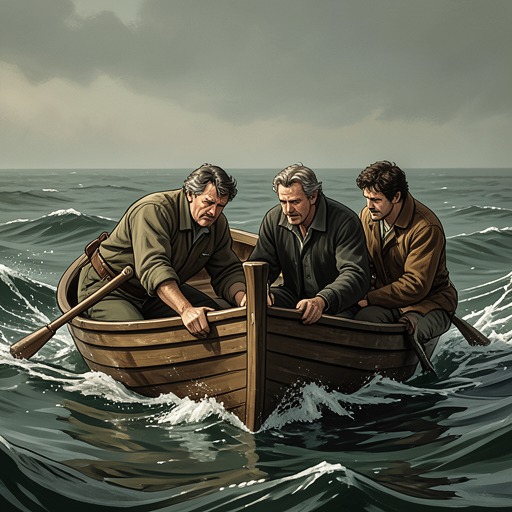
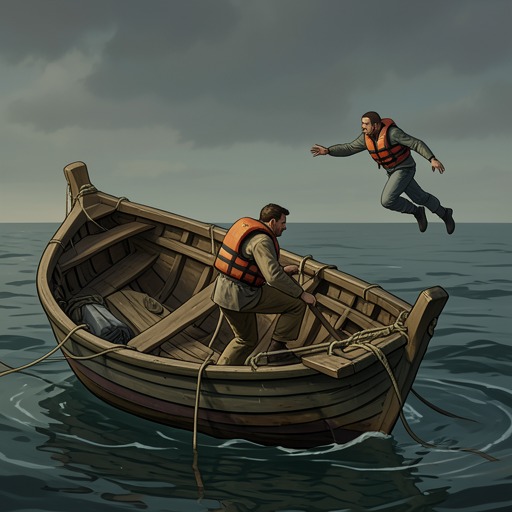
Marquis Cooper’s 21-foot Everglades boat
Not Without HopeMarquis Cooper’s 21-foot Everglades boat is both the immediate mechanism of the disaster and the material center of the survival narrative. Intended for offshore fishing in the Gulf of Mexico, the vessel carried Marquis Cooper, Nick Schuyler, Corey Smith, and Will Bleakley seventy-five miles west of Clearwater before capsizing in worsening seas. After the overturn, the boat became paradoxical: the same hull that had trapped the men in a lethal accident kept them visible and gave Nick Schuyler a platform from which the Coast Guard eventually rescued him.
Design and Offshore Setting
The boat was a twenty-one-foot Everglades model used by Marquis Cooper for deep-sea fishing. The trip took place in the Gulf of Mexico, an immense working and recreational environment whose depth, fisheries, and distance from shore magnified every equipment and judgment failure. The men had traveled more than seventy miles on an earlier outing and reached the primary fishing spot on this trip seventy-five miles west of Clearwater, where the water was 150 feet deep and a supposed shipwreck served as an artificial reef.
The vessel was built with the Rapid Molded Core Assembly Process, or RAMCAP. In that construction system, the hull, deck, and structural core were bonded together under extreme pressure, while a premolded, high-density, closed-cell urethane core created air-filled pockets. Coast Guard Captain Timothy Close compared the result to Styrofoam rather than a sponge: the closed cells were intended to preserve buoyancy instead of absorbing water. The design meant that the boat could remain afloat even in harsh seas, but buoyancy did not make it easy to see. Once overturned, only a small portion of its white hull might appear among the whitecaps.
The Anchor-Line Failure
The boat’s danger emerged from the decision to return after a difficult day of fishing. Marquis Cooper had monitored a cold front and warned that the water might become rough enough to shorten the trip. By the afternoon, the chop had developed into seven-foot swells. The men decided to head back, but the anchor was stuck on the bottom, as it had been during the previous weekend’s trip. Will Bleakley and Corey Smith pulled from different directions while Marquis maneuvered the boat around the anchor for roughly half an hour, yet even their combined strength could not free it.
Marquis Cooper’s frustration led to the decisive maneuver. Rather than abandon another anchor, he tightened the line and applied engine power while Will Bleakley held the line at the stern. The anchor blades apparently dug in more deeply. The stern squatted, water poured into the boat, the bow rose, and the vessel listed toward port. The men had no time to send a Mayday call. As the boat rolled, Nick Schuyler grabbed a starboard handrail and was catapulted into the Gulf.
The later investigation by the Florida Fish and Wildlife Conservation Commission identified three connected causes: the anchor line had been tied improperly to an eye bracket on the port side of the transom; the crew attempted to throttle forward to pull the anchor free; and there was not enough slack in the line. Together, those conditions allowed the stern to submerge and caused the boat to capsize. The physical chain was brutally simple: a secured line, engine force, a sinking stern, and a vessel turned upside down in open water.
The Capsized Hull as a Survival Platform
Once the line was cut, the boat’s stern rose slightly and the four men tried to right the vessel. Nick Schuyler and Corey Smith lay across the stern and kicked downward, while Marquis Cooper and Will Bleakley pulled from the front and pushed upward from the starboard side. The attempt failed not because the men lacked strength but because the overturned boat offered no leverage; the submerged center console acted as a large resistant rudder, and the harder Marquis Cooper and Will Bleakley pushed, the deeper they went underwater.
The hull then became the men’s only stable reference in the sea. They clung to different parts of it as daylight faded and waves repeatedly forced them underwater. Will Bleakley began organizing the emergency, asking about an emergency beacon, flares, a working radio, drinking water, and the location of the life jackets. The boat contained potential supplies, but reaching them was difficult, and the absence of an emergency position-indicating radio beacon meant that the vessel could not transmit its location automatically or provide the Coast Guard with an immediate identifying signal.
For much of the night, the four men maintained a precarious arrangement around the overturned boat: Corey Smith remained in the water, Will Bleakley stood on the swim platform with a seat cushion, Nick Schuyler kept one leg on the platform and the other on the boat, and Marquis Cooper lay on top of the cooler while holding Nick’s leg. The hull therefore served simultaneously as shelter, anchor point, elevation above the water, and a source of physical strain. It offered survival without safety.
Search and Detection
The overturned boat complicated the Coast Guard’s search. Searchers had to distinguish a low white hull from hundreds of thousands of whitecaps, floating debris, and the constantly changing troughs and crests of the sea. A person sitting on the hull or floating nearby could disappear behind a six-foot swell, while an upright vessel would have presented a much larger visual target. The lack of a distress signal further widened the uncertainty about the boat’s position and the men’s drift.
The Coast Guard did not assume that the Everglades boat would sink completely. Its RAMCAP construction made continued flotation likely, yet that very fact created a difficult search problem: a vessel could remain afloat while presenting almost nothing to the lookout except a fleeting fragment of hull. Lookouts were trained to scan in repeated S-shaped movements or in a typewriter-like sweep, varying their visual pattern so fatigue would not erase a small object from attention.
At 11:43 on Monday morning, about thirty-eight miles west of Tampa, chief boatswain’s mate Michael Briner noticed an orange speck and a white wave that did not disappear with the surrounding motion. The apparent buoy was roughly five hundred yards off the starboard side of USCGC Tornado, but there were no buoys in that location. The object was the overturned boat, with Nick Schuyler visible on the hull. From the rescue boat, the crew saw him repeatedly vanish behind waves and reappear, his head bowed and his shoulders slumped as he held the motor.
Consequences and Significance
The boat’s construction helped preserve a possible rescue target, but its handling and equipment exposed several avoidable vulnerabilities. The weather had been monitored, yet the return decision unfolded after the sea had grown substantially rougher. The anchor problem had occurred before, but the earlier experience did not prevent the same kind of difficulty from becoming an emergency. The vessel had no EPIRB, the men were not wearing life jackets while underway, and they had not established an exact destination for others on shore. These omissions extended the interval between capsizing and location.
In retrospect, Nick Schuyler questioned how a vessel weighing more than 3,000 pounds, carrying four large men and a load of fish, could be pulled down by an inch-thick anchor rope. That disbelief captures the boat’s narrative importance. Its apparent solidity encouraged ordinary confidence: it was heavy, engineered for buoyancy, and familiar as Marquis Cooper’s fishing boat. Yet under the wrong arrangement of line, throttle, wave, and stern geometry, its strength became part of the danger.
After the accident, the Everglades boat remained in the men’s memories as the object around which preparation, error, endurance, and rescue converged. It was the source of the capsizing, the surface the survivors fought to right, the shape the searchers struggled to identify, and the platform that made Nick Schuyler’s rescue possible. The book therefore presents the boat neither as a simple failed machine nor as a neutral setting, but as a vessel whose design, placement, equipment, and physical interaction with the sea determined the narrow boundaries between disappearance and discovery.