Michael Briner
Not Without HopeMichael Briner is the Coast Guard chief boatswain’s mate whose trained eye finds Nick Schuyler alive in the Gulf of Mexico. His decisive observation comes after the fishing boat’s anchor arrangement, throttle maneuver, and lack of slack cause the stern to submerge and the vessel to capsize. In a search in which an overturned hull may show only a small white fragment among countless whitecaps, Briner’s patient, methodical scanning becomes the human act that converts uncertainty into rescue.
Identity and Professional Role
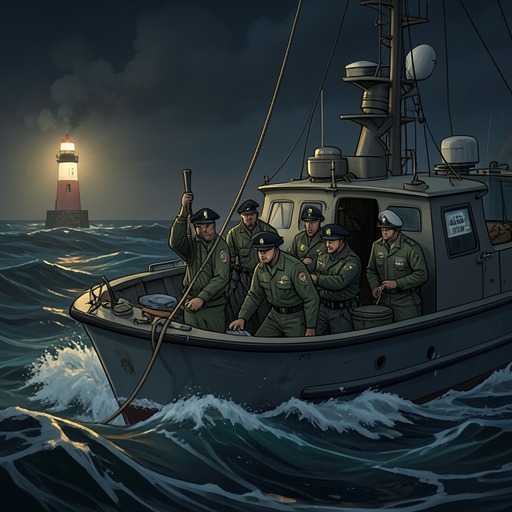
Michael Briner is thirty-nine and has sixteen years of Coast Guard experience. He serves aboard the USCGC Tornado, where his work is presented not as a matter of dramatic instinct alone but as the disciplined application of maritime search-and-rescue lookout training. Coast Guard personnel are expected to look through the bridge windows whenever they are there, whether officially on watch or merely taking a break. Briner therefore belongs to a search culture in which every available person is treated as an additional visual instrument.
His professional knowledge includes the recognition that objects are often found more quickly through peripheral vision than through direct staring. He has twice participated in earlier rescues: he spotted two divers who had been in the water away from their boat for three days off Florida’s Atlantic coast, and he helped locate a family stranded on Lake Superior after their small boat ran out of gas and was blown back from shore. Those experiences give his vigilance a history. The sighting aboard the Tornado is not an isolated flash of luck but the culmination of practiced attention and prior rescue work.
Method and Search Discipline
The search confronts Briner with an environment designed to defeat perception. If the boat is overturned but still afloat, far less of it will be visible than if it remains upright; searchers may be looking for only a fingernail of white hull amid hundreds of thousands of whitecaps. Cloud cover from a cold front suppresses the limited moonlight, while wind and current may carry a drifting boat and people in different directions. The absence of an emergency position-indicating radio beacon further deprives the Coast Guard of an immediate satellite location. These conditions make visual discipline indispensable.
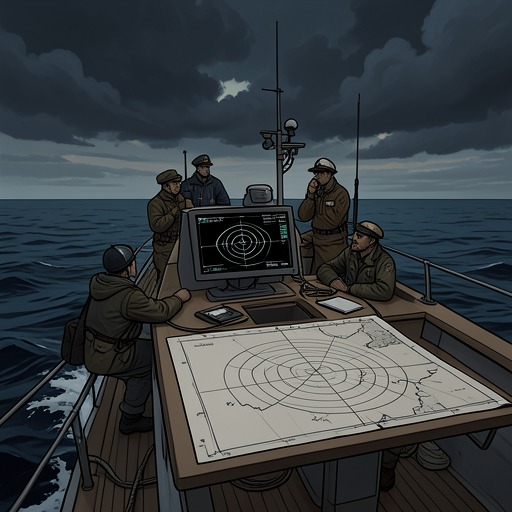
Briner uses the dozen bridge windows of the Tornado to frame the waterline, dividing each window into sections and sweeping from left to right. The method complements the broader lookout practice of moving the eyes in a repeating pattern rather than allowing the gaze to fix on a single patch of sea. Even advanced electronics are treated as vulnerable; Briner’s professional principle is that people on the bridge remain necessary because equipment can fail when it matters most. The search thus depends on repeated bodily labor: framing, sweeping, resisting fatigue, and allowing peripheral vision to register an object before conscious recognition catches up.
The Sighting of Nick Schuyler
On Monday morning, Briner has stood watch from midnight to four, slept, and awakened at nine thirty. In late morning he goes to the bridge with a cup of coffee, intending to see daylight and stretch his legs, but joins three lookouts in scanning the water. At 11:43, about thirty-eight miles west of Tampa, he notices an orange speck and a white wave that does not break and disappear with the surrounding rough water. At first the object resembles a misplaced buoy, yet there are no buoys in that open-water location.
Briner announces that he has found something and hurries to the window, keeping the object in view about five hundred yards off the Tornado’s starboard side. The initial visual impression is extraordinarily small—roughly like a basketball in the water—but he maintains his lock on it while reaching for binoculars. Then the uncertain object resolves into a person. When Briner identifies a human figure, the bridge crew confirms that someone is alive, and the atmosphere aboard the Tornado changes immediately from sustained searching to urgent rescue action.
Narrative Significance
Briner’s role gains force from the accident chain that precedes his discovery. On the fishing trip, Marquis Cooper drives toward the anchor while Will Bleakley and Corey Smith pull from different positions, but the anchor remains stuck. When the throttle is applied, the anchor blades dig in, the stern squats, water pours aboard, and the bow rises before the boat lists to port and overturns. Later reconstruction identifies three linked failures: the anchor line was improperly tied to an eye bracket on the port side of the transom; the crew attempted to throttle forward to free the anchor; and insufficient slack allowed the stern to submerge. Briner does not erase those failures, but his search marks the recovery side of the same causal system.
The contrast is especially sharp because the four men at sea have almost no margin for error. They cannot make a Mayday call before the capsizing, and the boat is not equipped with an emergency beacon. After the overturning, they try to right the hull but cannot gain leverage; the submerged center console acts as a resistant rudder, and the boat does not come close to flipping upright. They huddle against the cold, with Nick Schuyler resting against Marquis Cooper’s back, Will leaning against Nick, and Corey leaning in from the stern. Around nine, Corey’s waterproof watch helps them keep track of time as they say the Lord’s Prayer. Against this long passage of darkness, cold, exhaustion, and dwindling certainty, Briner’s 11:43 sighting is a narrow but decisive reversal.
His discovery also prepares the emotional consequences of survival. Nick is later found in Urgent Care, lying on a bed with intravenous tubes while doctors work around him; his mother, Marcia Schuyler, touches his cold hand and hears him answer her. Nick remains alive because the Tornado’s search reaches him, while Marquis Cooper, Corey Smith, and Will Bleakley do not survive. At Will’s funeral, Nick recognizes that Will’s efforts helped keep him alive and describes him as the angel who saved his life. The rescue therefore cannot be separated from loss: Briner’s visual act preserves one life within a disaster that leaves three families grieving.
Human Attention as a Rescue Instrument
Briner represents the book’s most concrete answer to the question of how rescue becomes possible when systems are incomplete. The missing beacon means that the search cannot simply follow an electronic signal, and the overturned hull reduces the target to a nearly imperceptible shape. Briner’s methodical attention supplies the missing link between the Coast Guard’s broad search operation and Nick’s individual body in the water. The scene gives practical meaning to the claim that the most valuable equipment may still be the human eye.
That emphasis also prevents the rescue from becoming a simple story of individual heroism. Briner’s sighting matters because it is embedded in training, bridge procedure, previous experience, coordinated lookout work, and the Tornado’s capacity to act once a living person is identified. His achievement is both personal and institutional: a single observer notices the orange speck, but a professional culture has taught him how to search, how not to stare past a target, and how to keep looking when the sea appears to contain nothing but waves. In the book’s larger structure, Michael Briner is the figure through whom the blankness of the ocean briefly yields a human presence.