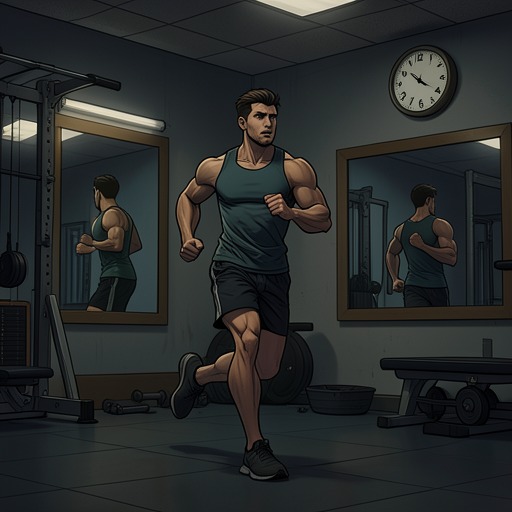
Nick Schuyler–Corey Smith training partnership
Not Without HopeThe Nick Schuyler–Corey Smith training partnership was a demanding friendship built through shared athletic discipline. It brought together Nick Schuyler, a personal trainer whose own football career had ended before he played a college game, and Corey Smith, a durable National Football League defensive end who had made a career despite being undersized for his position. In the gym, their competitiveness was intimate rather than merely professional: they pushed each other through punishing workouts, measured themselves against one another, and created an intensity that Schuyler later found impossible to reproduce after Smith’s death.
Formation in the Gym
Nick Schuyler met Corey Smith at the gym in Lutz, Florida, a few months after meeting Marquis Cooper there. Schuyler recognized Smith as an athlete partly through the NFL logos on his clothing and equipment, then learned that Smith stood 6 feet 3 inches, weighed 265 pounds, and carried approximately 12 percent body fat. Like Cooper, Smith was considered undersized in professional football; as a defensive end, he sometimes faced tackles who outweighed him by sixty or seventy pounds. That mismatch made physical preparation central to Smith’s career and gave the two men a natural basis for connection.
Smith had gone undrafted out of North Carolina State in 2002 but had signed with Tampa Bay as a free agent. He played in six of the Buccaneers’ first nine games that season before an injury placed him on injured reserve, keeping him out of the Super Bowl victory over the Oakland Raiders. His later career included both extremes: he had been part of a championship team as a rookie and then played for the 2008 Detroit Lions team that lost all sixteen games. He was nevertheless known as a durable, reliable backup, and his high-school nickname, the Tasmanian Devil, reflected the relentless style he carried into professional football.
Training Method and Competitive Bond
Schuyler’s own training philosophy gave the partnership its distinctive character. He described endurance lifting as a continuous ninety-minute-to-two-hour effort in which one body part rested while another worked. He had trained that way for so long that the method was new to Cooper and Smith, and he believed he was in as good physical condition as both professional players. The workouts were therefore not simply sessions in which a trainer instructed an athlete; they were tests among highly conditioned men, with Schuyler eager to demonstrate that his nonprofessional status did not make him physically inferior.
The training carried a mixture of strain and pleasure. Schuyler remembered wanting to show Smith and Cooper that he was stronger and better conditioned in various aspects, yet he also emphasized that the work never felt like an ordinary job. They added sets when they were already exhausted, sometimes reaching the point at which nausea seemed imminent, and still experienced accomplishment in continuing. The repeated demand to do another set or another exercise turned physical pain into a shared language of commitment. Their competitiveness reinforced friendship rather than eroding it because each man’s effort gave the others a standard to meet.
The partnership also sat within a broader athletic network. Schuyler had trained with Cooper and Smith while working as a personal trainer, and the three men’s football backgrounds made the gym a place where professional status, former ambition, and current physical ability could be compared directly. Schuyler had once hoped to play football at the University of South Florida, but the NCAA transfer eligibility rule forced him to sit out the 2006 season after transferring from Kent State. Rather than wait another year for his remaining eligibility, he left the team. Training with Smith and Cooper allowed him to continue inhabiting an athlete’s identity even after the formal route to college football had closed.
Athletic Identity Under Disaster
The partnership acquired a darker meaning when the four men went into the Gulf of Mexico and Marquis Cooper’s fishing boat capsized. Schuyler’s account presents the men as young, strong, and accustomed to thinking of themselves as difficult to break. He later compared their physical capacities directly, recalling that Will Bleakley weighed about 230 pounds, while Schuyler weighed about 240, and that the small life jackets could keep them afloat without reliably holding them above the crashing waves. Athletic strength remained useful, but it did not make the men invulnerable to cold water, exhaustion, and progressive physiological decline.
During the survival ordeal, Schuyler’s relationship with Smith became an immediate obligation of care. Smith was among those who had attempted to get beneath the overturned boat, and the experience terrified Schuyler even though he knew Smith was an exceptional athlete. Later, after Smith became ill and disappeared, Schuyler was left with Bleakley as the last companion he could actively assist. The memory of trying to keep Bleakley afloat was therefore also a memory of the earlier losses of Cooper and Smith: strength and teamwork could delay catastrophe, but they could not guarantee that a friend could be brought back.
Schuyler’s physical efforts to save Bleakley reveal the partnership’s practical ethic more clearly than any abstract statement about friendship. When Bleakley was in the water, Schuyler repeatedly swam out to pull him toward the boat. Because of their combined weight and the weakness of the life jackets, the two men went underwater amid the waves. Schuyler became so exhausted that his legs were difficult to move, yet his attention shifted away from his own cold and thirst toward Smith’s surviving companion. The training culture of continuing through pain thus reappeared in a transformed form: not as competition or performance, but as sustained action for another person.
Loss, Memory, and Moral Meaning
After the accident, Schuyler did not reduce Smith’s final behavior to a personal failure. When he spoke with Smith’s siblings, he described the aggression and disorientation that had accompanied Smith’s deterioration, including the moment when Schuyler lost his grip on Smith’s life jacket and saw him dive toward the ocean floor. He also explained that Smith’s words and actions were produced by hypothermia and suffering, not by the character his family knew. The family understood that distinction, and Schuyler’s insistence on telling the painful truth became an act of loyalty to the man beneath the symptoms.
Smith’s death also shaped the public memory of the partnership through the athletic world. Three weeks after the accident, the Detroit Lions announced that no player would wear number 93 during the 2009 season, preserving the number Smith had worn for the team. The tribute emphasized the same relentlessness that had defined Smith in the gym and on the field. His professional identity could not restore him, but it provided a language through which teammates and the organization could recognize his work ethic and continuing place within the team.
For Schuyler, the partnership remained physically present after the funeral and media attention had receded. He returned to weight training to direct stress and anger into the weights, but the work no longer had the same intensity. He changed gyms partly because doing so was more practical for his career, yet he also acknowledged that he missed training with Smith and Cooper and had not been able to push himself in the same way. The loss was not simply the absence of a workout partner; it was the disappearance of the particular challenge, audience, and mutual pressure that had made his strongest athletic self feel fully alive.
Memorial and Continuing Significance
Schuyler eventually made the training partnership part of a permanent memorial. He designed a tattoo around a Celtic cross bearing the initials of Cooper, Bleakley, and Smith, with a rope intertwined through the cross, an anchor below it, the Persian proverb “In the hour of adversity, be not without hope” in the background, and the date 3/1/2009 beneath. The design connected the men’s physical struggle at sea to the principle that had governed their training: no one was supposed to stop while effort remained possible. It also turned the body that had survived into a record of the bodies and relationships that had been lost.
Schuyler’s later reflections keep Smith’s memory tied to ordinary athletic movement. He could work with other clients, but the sessions lacked the old intensity; the partnership had made training feel like shared purpose rather than employment. That contrast explains why the bond remains significant even though its original setting was a gym. Smith’s influence survived in Schuyler’s habits of effort, his understanding of endurance, his account of the men’s mutual dependence, and his refusal to treat survival as a solitary achievement. Without Corey Smith and the others, Schuyler said, he did not think he would be alive; the partnership therefore becomes one of the relationships through which the book explains both how he endured and why enduring carried an enduring burden.