Nick Schuyler–Kristen Schuyler sibling relationship
Not Without HopeThe Nick Schuyler–Kristen Schuyler sibling relationship joins affectionate rivalry to steadfast loyalty. Kristen Schuyler is three years older than Nick Schuyler, an accomplished athlete and highly driven professional whose closeness to her brother becomes a central emotional thread before, during, and after the 2009 Clearwater boating accident. When Nick Schuyler is missing at sea, the relationship shifts from ordinary family affection into urgent vigilance; when he is found alive, Kristen Schuyler becomes one of the people who helps restore him to the world.
Identity and Early Dynamic
Kristen Schuyler is presented as Nick Schuyler’s older sister and longtime confidante. At twenty-seven, she is tall, athletic, and accomplished, with a background in fast-pitch softball as a high-school shortstop and outfielder. She once played in a tournament in Lyon, France, and received scholarship offers from institutions including Ohio State, but chose to study in Florida at USF. Her sporting ability made her an early model for Nick Schuyler: when he was younger, he wanted to be like her and regarded her as his idol.
Their childhood closeness included teasing, physical horseplay, and a competitive imbalance that Nick Schuyler remembered with humor. Kristen Schuyler was cool and popular, moved easily among athletes, and could overpower her younger brother in play, even holding him down and threatening to spit in his face. Their parents spoiled the two children differently, giving Kristen Schuyler a car, large parties, and eventually a house built for her in Tampa when she attended USF. These details establish a relationship comfortable enough to contain mock aggression without threatening affection.
The siblings also differed sharply in their attitudes toward education. Kristen Schuyler enjoyed school, studied constantly, took community-college courses while still in high school, completed college at twenty, finished her undergraduate degree at Kent State University after returning to Ohio, and earned an MBA from Cleveland State at twenty-three. By contrast, Nick Schuyler measured himself against her achievements, regretting that he had only just finished college at twenty-three while she already had a master’s degree at the same age. His comparison conveys admiration as much as insecurity: Kristen Schuyler’s drive was precisely what he loved about her.
Shared Life Before the Accident
By the time of the fishing trip, Nick Schuyler and Kristen Schuyler remained close despite their different paths. Kristen Schuyler was working as a representative for a company distributing dental supplies and living with Marcia Schuyler in Fort Myers. She drove to Nick Schuyler’s home to run a 5K race on Saturday morning and stayed there Friday night. The domestic arrangement placed the siblings in an ordinary, intimate setting immediately before the disaster: Kristen Schuyler slept in Will Bleakley’s room, while Will Bleakley took the sofa in the living room and kept the television on late into the night.
The next morning, their parting was affectionate and explicitly future-oriented. As they left the house, Kristen Schuyler told Nick Schuyler, “Have fun, see you later. Love you.” She added that if she performed well in the race, he would have to come watch her run the next one. The exchange is significant because it assumes continuity. Neither sibling treats the goodbye as final; the promised next race becomes an image of the ordinary future that the accident interrupts.
Crisis and Vigilance
When Nick Schuyler failed to return from the fishing trip, Kristen Schuyler became an immediate link between the missing men and their families. She had texted Nick Schuyler on Saturday night about Major League baseball players attending a black-tie breast-cancer fund-raiser, but his failure to reply did not initially alarm her because he sometimes ignored messages unless she asked a direct question. On Sunday morning, she called again to tell him about her 5K race. The call went directly to voice mail, and the meaning of that silence changed when she learned that he had not returned.
Kristen Schuyler understood the danger through the combination of missing contact and deteriorating weather. The morning had turned cold and windy, and the Coast Guard was preparing a television announcement. Yet fear did not immediately become certainty. She could not imagine that Nick Schuyler would fail to come home safely and pictured the four men still standing aboard the boat, wet and frustrated but out of harm’s way. Her hope was not passive denial; it was the emotional assumption of a sister who knew Nick Schuyler as strong, athletic, and dependable.
After speaking with Paula Oliveira, Kristen Schuyler paced through her bedroom, went outside without speaking to Marcia Schuyler, and waited for a reassuring call that never came. Ten minutes later, she returned to sit beside her mother. When she told Marcia Schuyler that Nick Schuyler had not come home, Marcia Schuyler became physically ill. The two women gathered clothes, showered, and headed toward Tampa, with Kristen Schuyler hearing her mother sob in the shower. Their journey across the Sunshine Skyway Bridge toward St. Petersburg took place beneath rain and over whitecaps in Tampa Bay, turning the familiar route into a passage through mounting dread.
Kristen Schuyler also used communication as a form of care. She sent a mass text to friends explaining that her brother was one of the missing boaters and asking them to pray. She repeatedly went outside for air, experiencing a cold that felt unprecedented in Florida, while still holding to the belief that Nick Schuyler would return. The movement between public notification, private fear, and prayer shows how the sibling relationship expanded into a network of people mobilized around his disappearance.
The Rescue and Reunion
On Monday morning, while the search continued, Kristen Schuyler put on one of Nick Schuyler’s sweatshirts so that she could have a part of him wrapped around her. Marcia Schuyler did the same, wearing Nick Schuyler’s socks and sitting in his favorite recliner while crying, praying, and urging him to keep going. For Kristen Schuyler, the sweatshirt was more than clothing: it was a tactile substitute for the absent brother whose condition remained unknown.
When a message arrived claiming that Nick Schuyler had been found, Kristen Schuyler recognized that its source was unreliable and not even in Tampa. Nevertheless, she began running and crying, her knees and legs giving way as she tried to return to the house. The uncertainty of the report did not lessen its force. A short time later, Marcia Schuyler screamed, “They found Nick,” and fainted, dropping her cell phone. The family’s emotional state shifted instantly from suspended terror to the possibility of survival.
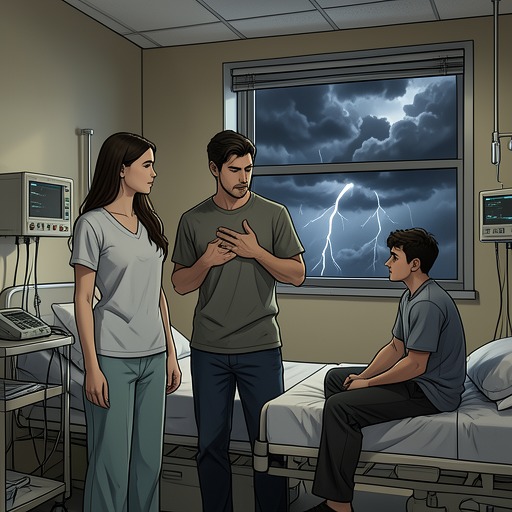
At Urgent Care, Marcia Schuyler saw Nick Schuyler lying on a bed with intravenous tubes and doctors around him, an encounter she experienced as surreal. Kristen Schuyler noticed that Nick Schuyler was bleeding and struggling to keep his eyes open. He was salty-skinned, ice-cold in the toes, thin, pale, dehydrated, and barely able to speak. When he asked, “Who’s in here?” Kristen Schuyler answered, “Hi, Nick,” kissed him, and occupied the first recognizable human space around him after his 43 hours at sea. When investigators asked about the other men, Nick Schuyler shook his head and indicated that they were all gone, bringing the deaths of Marquis Cooper, Corey Smith, and Will Bleakley into the family’s immediate reality.
Grief, Loyalty, and Lasting Meaning
The rescue did not restore the siblings’ former life. Nick Schuyler survived while Marquis Cooper, Corey Smith, and Will Bleakley died, leaving him haunted by the question of why he alone came out of the Gulf of Mexico. Kristen Schuyler’s presence during the crisis therefore belongs to both sides of survival: she helped sustain hope for the living brother while entering the grief surrounding the three who were lost.
Her loyalty continued after the hospital. Nick Schuyler later thanked Kristen Schuyler for being as positive as possible and for always standing by him. The praise identifies her principal role in his recovery: not a rescuer in the physical sense, but a constant companion through fear, uncertainty, medical vulnerability, and bereavement. Her support also counters the isolation of survivor guilt by preserving a familial bond that does not require Nick Schuyler to explain why he lived before he can be loved.
The relationship’s significance is therefore cumulative. It begins with an older sister who served as an athletic and academic ideal, continues through joking intimacy and shared domestic routines, and is tested when ordinary plans collapse into a Coast Guard search. The final image is not only of Kristen Schuyler waiting for news, but of a sister using Nick Schuyler’s sweatshirt as a physical sign of attachment, then greeting him at the hospital when he is barely conscious. In that movement from admiration to guardianship, the sibling relationship becomes one of the book’s clearest forms of continuity: the sea takes Nick Schuyler’s friends, but it does not erase the bond that brings him back into family life.