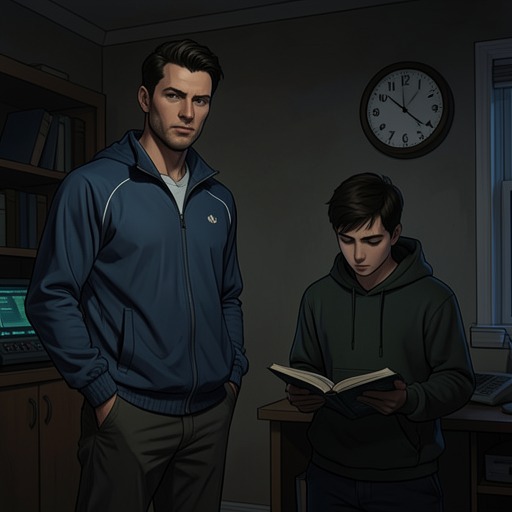
Nick Schuyler–Stu Schuyler father-son relationship
Not Without HopeThe Nick Schuyler–Stu Schuyler father-son relationship is one of the central emotional bonds surrounding the 2009 Clearwater boating accident. It joins a history of material provision and parental pride to an urgent pattern of warning, regret, waiting, and renewed gratitude. Stu Schuyler cannot prevent Nick from going offshore, but his repeated attempts to make him return early, followed by his desperate vigil and explosive joy when Nick is found alive, give the relationship its decisive shape: love appears first as advice, then as helplessness, and finally as the strength to receive a survivor home.
Identity and Family Background
Stu Schuyler is Nick Schuyler’s father and lives in Tarpon Springs, where he owns a painting business. His background as a working parent is part of the relationship’s foundation. Nick remembers that Stu worked extremely hard with the painting business when the family was in Ohio, while also providing a materially comfortable childhood. The family had a vacation home in Orlando, drove a thirty-foot camper to Disney World during Christmas breaks, traveled to Myrtle Beach and Virginia Beach, and skied in Vermont at Killington. Nick describes himself as spoiled and recalls having four-wheelers and Jet Skis, details that make Stu’s provision concrete rather than abstract.
That history does not reduce the relationship to money or indulgence. Nick also remembers Stu as a father whose pride mattered deeply to him. By the time of the boating accident, Stu had moved to Florida and had endured divorce and financial difficulties while continuing his painting business. Nick knew that these hardships made his own survival important not only for himself but also for his father, whose life could become still harder if Nick failed to escape the overturned boat. The son’s thoughts therefore turn from childhood privilege to adult responsibility: he understands that the father who once supplied security now needs the reassurance of his son’s return.
Warnings Before the Accident
Stu had recent knowledge of Nick’s plans. Two days before the trip, he had seen Nick and Corey Smith at the gym, and they had told him they intended to fish at the same area they had visited the previous weekend. On the morning of the departure, Stu woke early in Tarpon Springs, went back to sleep, then rose again at seven and turned on the television. He saw that a forceful upper-air disturbance was moving toward the southeastern United States from the northwest.
The weather report immediately became parental information. Stu called Nick the morning before the accident and told him that the weather was expected to worsen and that he should come home early. The warning was not casual: he had already seen the approaching disturbance and understood that the offshore conditions might become dangerous. Nick’s father was trying to translate distant meteorological information into a direct instruction to his son, but Nick and the others still went out.
Marquis Cooper had also been monitoring the weather. He had said that a cold front was approaching, that the water might become rough, and that the trip might have to be shortened; that morning he again expressed uncertainty about going all the way offshore. Stu’s warning thus existed within a broader field of concern, but its later emotional force came from its failure. When the boat became overdue, Stu knew that he had recognized the danger without being able to alter Nick’s decision.
Fear, Anger, and the Search
When Nick’s sister, Kristen Schuyler, told Stu that the boat was missing, he reacted with anger as much as fear. He said that he had told Nick not to go out, converting the earlier warning into a sentence of self-reproach. The Coast Guard’s initial information was itself uncertain: the report described a twenty-one-foot Everglades fishing boat that had left the Seminole Boat Ramp in Clearwater for a wreck fifty nautical miles west of Clearwater Pass, but the caller mistakenly reported only two other passengers and said that the men had little maritime experience. Such errors complicated the family’s understanding of what had happened while the search was already losing time.
The search conditions intensified Stu’s helplessness. The overturned boat would present searchers with only a small portion of white hull among hundreds of thousands of whitecaps, while storm-clouded darkness and the absence of an Emergency position-indicating radio beacon made the men harder to locate. Captain Timothy Close later emphasized that an earlier alert might have preserved an hour or two of daylight and that the missing fishermen might already have been in the water for hours. The Coast Guard considered searching closer to shore because inexperienced boaters might have remained within sight of land, and officials urged relatives to check credit-card use and departure details. For Stu, every uncertainty widened the distance between warning and rescue.
At the Coast Guard station, Marcia Schuyler and Kristen left around three-thirty while avoiding the media outside, and Stu arrived upset. His distress then reached a more dangerous intensity. He told Kristen that he would kill himself if Nick were gone and that he could not live without him. The statement shows the father’s fear overwhelming ordinary emotional boundaries: Nick’s absence was not experienced as a separate loss that Stu could endure, but as a threat to Stu’s own ability to continue.
Waiting and Hope
Stu went home to Tarpon Springs and attached himself to the television, calling the Coast Guard regularly for updates. He also contacted an old high-school friend from Ohio who had served with the Navy SEALs in Vietnam. The friend offered a conditional form of hope: if Nick had remained with the boat, had extra clothes, and could pull himself out of the water, he might survive for two or three days. The reassurance did not promise rescue, but it gave Stu a sequence of physical possibilities by which survival could still be imagined.
The waiting became repetitive and intimate. Stu turned on the television in his bedroom, held a picture of Nick against his chest, dozed off, and woke when the wind rattled the screened-in patio. He cried out to God for help. The photograph and the television occupied opposite ends of the crisis: one preserved the absent son as a personal image, while the other converted the search into a public spectacle. Between them, Stu remained fixed in the role of a father who could do little more than call, watch, remember, and hope.
The information environment repeatedly threatened that hope. Paula Oliveira was told by the Coast Guard that she might want to notify Nick’s family because the media would soon be alerted, and the official account was being revised from three missing men to four. Later, television carried an unconfirmed report that Marquis Cooper had been found, prompting Kristen to doubt Nick’s account for a moment and wonder whether he might be hallucinating. These shifting reports made the family’s emotional condition dependent on fragments whose source, timing, and certainty were unstable.
Rescue and Lasting Meaning
The relationship’s immediate crisis changed when Captain Timothy Close received a call from Stu at the St. Petersburg Coast Guard station. Nick was aboard a Coast Guard cutter and would be airlifted to Tampa General Hospital. Stu was at home in Tarpon Springs with his sister; after hanging up, he ran outside yelling, and she chased after him. The movement reverses the earlier stillness of the vigil. The father who had been glued to the television and clutching a photograph suddenly has a living son to pursue through the next stage of rescue.
Marcia, Paula, and Kristen were driven to Tampa General Hospital, where they met Stu. During the drive, a friend from Ohio, Bill Lally, called after watching videotaped rescue footage and told Stu that he was seeing Nick being lifted into a helicopter and that Nick looked fine. The rescue therefore reached Stu through several channels—Coast Guard communication, family travel, and a friend’s televised image—yet its meaning remained singular: Nick had survived.
Nick’s own final thoughts during the ordeal return directly to his father. Facing what he believed might be death, he asked God to protect his family and to give his dad strength to find whatever would make him happy. He said that he loved his father and was proud of him despite mistakes in the past, adding that he and his sister loved him. This imagined farewell reveals a reciprocal bond: Stu’s love is expressed through warnings and desperate searching, while Nick’s is expressed through concern for Stu’s future emotional life and an explicit acknowledgment of imperfection.
The relationship remains present after the rescue rather than ending with it. Nick later thanked his father for supporting him through everything and affirmed that he knew Stu was proud of him. That closing acknowledgment gathers the relationship’s competing elements—childhood indulgence, adult hardship, parental anger, fear of loss, and pride—into a durable statement of connection. Stu could not control the sea or undo the accident, but his warnings, waiting, prayers, and response to the rescue become the clearest record of what Nick meant to him.