Overturned-boat anchor-line safety rule
Not Without HopeThe Overturned-boat anchor-line safety rule is the decisive safety principle emerging from the 2009 Clearwater boating accident. It links an apparently practical attempt to free a stuck anchor to the rapid flooding, capsizing, and loss of life aboard Marquis Cooper’s fishing boat, while also showing that survival depends on more than one precaution: anchor-line placement, slack, life jackets, distress equipment, weather judgment, and accurate communication all form part of the same protective system.
Definition and Safety Principle
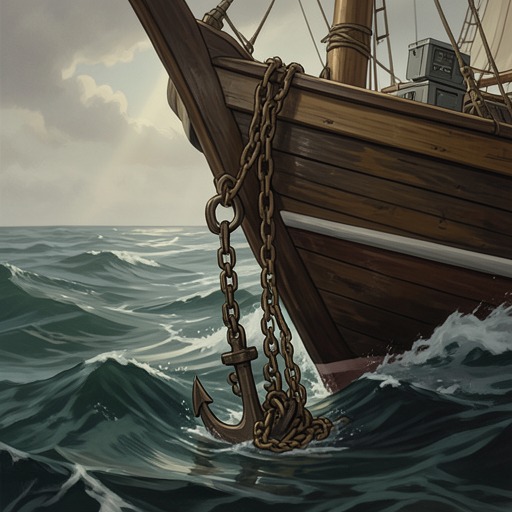
The rule concerns the placement and handling of an anchor line when a boat is at risk of being pulled or held down. The line should not be fastened to the stern in a configuration that allows forward engine thrust to force the transom beneath the water. The account makes the danger concrete: the boat’s anchor remained fixed on the bottom, and after repeated attempts from different positions failed, Will Bleakley proposed moving the one-inch line from the bow to a cleat at the stern so the motor could yank the anchor free.
That arrangement converted the anchor from a resisting object into a point capable of dragging the boat downward. The boat’s occupants could not see what held the anchor—possibly a shipwreck, cable, debris, or muck roughly 150 feet below—but they knew the line was immovable. The safety problem was therefore not simply that the anchor was stuck; it was that the proposed solution transferred the load to the least safe part of the hull.
How the Accident Developed
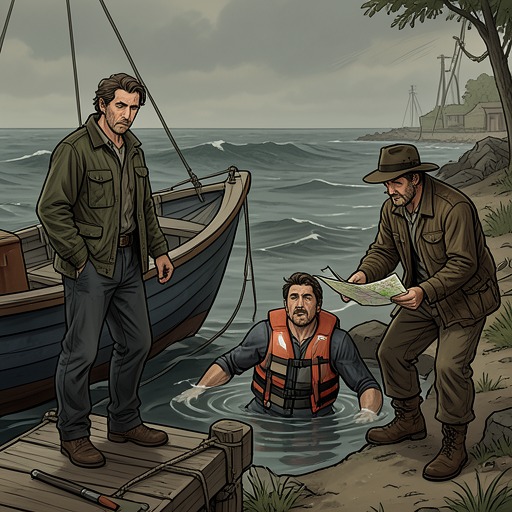
At about four o’clock, the sea had built into seven-foot swells, and the four men were already exhausted and sick. Marquis Cooper was driving, while Nick Schuyler sat beside him on the captain’s bench. They were about a hundred yards downwind from the anchor site. Marquis maneuvered the boat over the anchor as Will and Corey Smith pulled on the line, but even their combined strength could not free it. The previous week, the group had faced the same problem and had ultimately cut an anchor line, forcing Marquis to spend two hundred dollars on a replacement anchor and rope.
The frustration shaped the decision. Will untied the line from the bow and secured it to the stern, telling Marquis that either the anchor would come loose or the line would snap. Marquis agreed to try. The men were not simply intoxicated and acting without awareness: Corey Smith did not drink, Nick Schuyler had consumed about a beer and a half and vomited it up, Will had consumed seven or eight beers, and Marquis had consumed five or six over ten hours. The evidence presents them as generally clearheaded, but also as inexperienced boaters confronting worsening weather and a stubborn mechanical problem.
As Marquis tightened the line and throttled the motor, the engine first produced a high-pitched sound and then a low rumble. Will warned him two or three times not to push the throttle too hard. The anchor blades apparently dug in more firmly rather than releasing. The stern squatted, water poured into the boat, the bow lifted toward the sky, and the hull listed to port. Marquis shouted for everyone to get to the top, but the boat rolled so quickly that there was no opportunity to transmit a Mayday call. Nick Schuyler took one step, seized a starboard handrail, and was catapulted into the Gulf of Mexico.
Why Reversing the Capsize Failed
Once the men were in the water, the same physical relationship that had caused the accident made recovery nearly impossible. They first believed the boat was being held down because the anchor line remained tight. After drifting enough to create a small amount of slack, Will and Marquis cut the rope where it was caught around the propeller. The stern rose slightly, and the group initially believed that releasing the line would allow them to turn the boat upright.
The attempt failed because the men had no leverage. Corey Smith and Nick Schuyler lay across the stern and kicked downward while trying to pull the hull toward them. Marquis Cooper and Will Bleakley tried to lift it from the front and then pushed upward from the starboard side while in the water. The more they pushed, the farther underwater they went. The submerged center console acted as a large resistant rudder, preventing the waves from supplying the needed rotation. The boat did not merely come close to flipping upright; despite the men’s combined athletic strength, it came nowhere near doing so.
This sequence clarifies the rule’s importance. The anchor-line error was not an isolated detail later added to the story. It determined the geometry of the capsize, left the hull inverted, deprived the men of a stable platform, and helped create the conditions in which they had to remain in cold, rough water beside the overturned boat.
Official Findings and Wider Precautions
The Florida Fish and Wildlife Conservation Commission identified three causal factors: the anchor line had been tied improperly to an eye bracket on the port side of the transom; the engine had been throttled forward to pull the anchor free; and insufficient slack in the line allowed the stern to submerge and the boat to capsize. The finding gives the rule a precise investigative basis rather than treating the accident as an unpredictable act of bad weather alone.
The survivors’ retrospective account broadens the lesson beyond the line itself. The men should have been better prepared to send a distress signal, should have told others the exact location of their trip, and should have carried or placed more reliably accessible flares and flashlights. They also should have worn life jackets aboard the boat or known exactly where those jackets were stored. These omissions mattered after the capsizing, when the boat sent no emergency position-indicating radio beacon signal and the Coast Guard had to search for a small, overturned hull in storm-darkened seas.
The missing beacon made the search especially difficult. An overturned boat would expose only a small portion of white hull among vast numbers of whitecaps, while cloud cover and a cold front reduced the available light. Captain Timothy Close later explained that an emergency position-indicating radio beacon would have changed the operation from a search into a rescue by transmitting the boat’s position and identity through the international satellite system. The anchor-line rule therefore belongs within a chain of defenses: even a correctly handled anchor cannot compensate for missing flotation, signaling, preparation, or timely information.
Consequences and Meaning
The consequences were magnified by the conditions already present. The men faced rough seas, cold-water immersion, exhaustion, and the dangers of swallowing seawater, which could produce a dangerous sodium imbalance, cellular dehydration, delirium, seizures, cardiac failure, and death. As the ordeal continued, Marquis Cooper became increasingly slow to answer, began slurring and rambling, gagged and dry-heaved after taking in salt water, and suffered constant chattering teeth. The overturned boat offered the only possible refuge, yet the earlier line arrangement had left it inverted and unusable as a normal vessel.
Nick Schuyler later had to explain the decision to Will Bleakley’s parents. They questioned the choices made during the emergency, especially placing the anchor line at the back of the boat. Schuyler acknowledged the seriousness of that choice while insisting that Will had done everything he could to help the others, including going beneath the boat for life jackets, Gatorade, and pretzels. The conversation transformed a technical safety error into a human burden: a survivor had to describe the chain of decisions that preceded his friend’s death.
The rule ultimately functions as both accident-reconstruction principle and memorial warning. Schuyler remembered wondering whether he would have recognized the danger if illness had not impaired him, and whether a different choice about clothing, equipment, or the steering cable might have altered the outcome. The official finding does not erase those counterfactuals, but it gives them a clear center: a stern-tied anchor line, forward throttle, and inadequate slack allowed the force of a stuck anchor to overpower a 21-foot boat. The practical lesson is simple, but the story shows why it must be treated as non-negotiable: a line intended to free a vessel can instead pull it beneath the sea.