Retrieval of life jackets and food from the overturned boat
Not Without HopeRetrieval of life jackets and food from the overturned boat is a central survival action in the account of the capsizing and its aftermath. It links Will Bleakley’s practical leadership to Nick Schuyler’s later, increasingly desperate effort to reach the overturned vessel’s remaining supplies. The action does not reverse the disaster, but it creates the narrow margin that allows Nick to endure cold, dehydration, exhaustion, and the loss of the other three boaters.
The Supplies and the Disaster
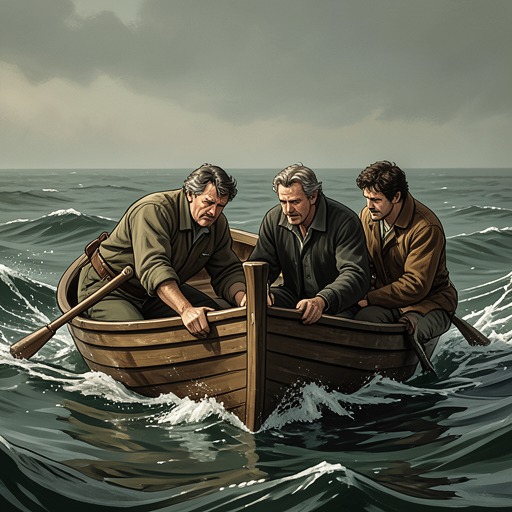
The need for life jackets and food arose from the boat’s sudden transformation from a fishing platform into a capsized, partially submerged refuge. Before the accident, the four men were already weakened by rough weather and illness. The anchor had remained fixed to the bottom while Will Bleakley and Corey Smith pulled from the bow, and Marquis Cooper maneuvered the boat for roughly half an hour without freeing it. When the anchor line was tightened and the motor was throttled forward, the anchor blades dug in more deeply: the stern sank, water poured aboard, the bow rose, and the boat listed to port. The men had no time to make a Mayday call before the vessel rolled and they were thrown into the Gulf of Mexico.
The later investigation by the Florida Fish and Wildlife Conservation Commission identified three linked causes: the anchor line had been tied improperly to an eye bracket on the port side of the transom, the motor had been throttled forward in an attempt to pull the anchor free, and there had not been enough slack in the line. Together, those failures submerged the stern and caused the capsizing. The same accident also left the men dependent on equipment that had not been immediately available to them. Nick Schuyler later recognized that they should have been wearing life jackets or at least known more clearly where they were stored, and should have been better prepared with distress signals, flares, flashlights, and a precise report of their location.
Will Bleakley’s Recovery Effort
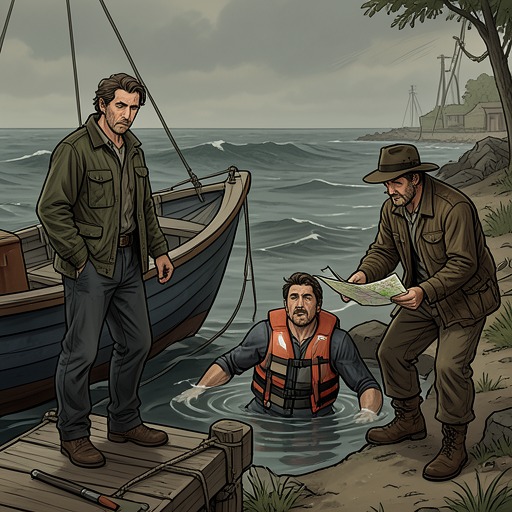
Will Bleakley’s recovery of survival supplies became one of the decisive acts in the group’s first hours on the overturned boat. Nick later credited Will with sacrificing himself to act as a leader and said that they probably would not have had life jackets without him. Will also went beneath or into the overturned boat to retrieve Gatorade and pretzels. Those supplies were small, but in the conditions they faced they carried unusual importance: the men were exposed to five- to seven-foot waves, cold water, and repeated physical exertion while trying to remain attached to the hull.
Nick understood the value of Will’s contribution only more fully after Will died. He remembered Will as a careful, prepared person who made detailed lists, arrived on time, completed his work, and brought more than enough provisions when camping or tailgating. That habitual preparedness appears in the emergency as a form of practical care. Will’s actions did not merely supply objects; they gave the group a way to organize itself around immediate tasks. Nick later said that the Gatorade and pretzels provided enough additional calories to coat his system and give him just enough energy, and that working with Will on the second day was an essential part of his survival.
The recovery also carried a physical cost. In order to help secure the men’s chances of surviving, Will exposed himself to the same cold and exhaustion that eventually impaired the others. Nick later told Will’s parents that he would not have been able to make that conversation without Will’s going beneath the boat for the life jackets, Gatorade, and pretzels, and without the two men working together. In Nick’s reconstruction, the supplies were therefore inseparable from Will’s sacrifice: the food and flotation equipment extended the survivor’s life while the effort to obtain them consumed the strength of the man who obtained them.
Nick Schuyler’s Attempts to Reach the Cooler
After many hours in the water, Nick began to experience the mental and physical deterioration that had already affected the others. He was seeing things and making random yells, recognized that dehydration and hypothermia had caused Marquis Cooper, Corey Smith, and Will Bleakley to lose their judgment, and feared that the same process was beginning in him. He understood that the cold itself might not be what killed him; dehydration or starvation could finish what the capsizing had begun. That recognition turned the cooler into a final objective rather than a mere object aboard the boat.
Nick’s first attempt to reach it failed. He struggled to straighten his legs, whose muscles had tightened after prolonged immersion, and tried to prepare himself while clinging to the hull and motor. The sea had become somewhat calmer and clearer, but the overturned boat still rose and fell on swells of roughly five to eight feet. His clothing made him too buoyant, while the cold made removing it dangerous. A wave struck him as he inhaled before diving, forcing him to swallow water and cough and gag.
On the second attempt, Nick waited for the wave to pass, seized the railing, and pushed beneath the hull. Through the clear water he could see the surviving contents of the boat: gas cans still secured by bungee cords, fishing rods that had been swept away, other poles remaining in their grooves, and the large white Igloo cooler held by a red bungee cord between the deck and the captain’s chair at the center console. The cooler was the same one from which Will had found Gatorade earlier. Nick believed it might contain sandwiches, snacks, more Gatorade, or water, and the possibility of those supplies gave the dive its urgency.
Nick reached almost to the cooler but could only touch it. As his feet went beneath the boat, his back struck the railing and the impact threw him off balance. He had been underwater for perhaps five seconds, yet he felt as though he had exhausted himself swimming across a pool. He surfaced gasping, regrouped at the stern, and recognized that this brief dive had winded him more severely than years of demanding football workouts, including two-a-day practices in extreme heat. The attempt showed both the promise and the danger of retrieval: the food was visible and nearly within reach, but the overturned hull made access consume the very energy Nick needed to remain alive.
Survival Value and Medical Context
The retrieved life jackets and food functioned as overlapping defenses against different dangers. Life jackets reduced the continuous labor of staying afloat, while Gatorade and pretzels supplied limited energy during prolonged exposure. Without those forms of assistance, the men had to fight the water, waves, and cold with their bodies alone. The Coast Guard’s later assessment emphasized that immersion could produce dangerous salt-water ingestion, a sodium imbalance, cellular dehydration, delirium, seizures, heart failure, and death. Cold water could lower body temperature below 95 degrees and progress from shivering and clumsy hands to shallow breathing, blue lips, confusion, slurred speech, and irrational behavior.
The men’s strength did not make the emergency straightforward. A military survival guide estimated that an average twenty-five-year-old man immersed in 65-degree water might remain functional for 9.9 hours and survive for 15 hours, while a fifty-year-old man might remain functional for 11.6 hours and survive for 17.6 hours. The explanation offered by the St. Petersburg Coast Guard station was that younger, more muscular football players could have less insulation and less flotation, forcing them to expend more energy treading water. Retrieval therefore mattered not only because it provided calories or flotation, but because it potentially reduced the physical work imposed by the sea.
The later behavior of Marquis and Corey demonstrates why the supplies could not be treated as evidence of a simple failure of will. Marquis began responding slowly, slurring and rambling, gagging after swallowing salt water, dry heaving, and chattering his teeth. Corey later developed similar symptoms and then made a sudden, forceful attempt to climb onto the boat, grabbing at Marquis’s legs and behaving in a way Nick recognized as unlike his friend. Medical analysis concluded that hypothermia could cause delirium, potassium loss, and a breakdown of the heart’s cell membranes, leaving the heart unable to contract. The men were confused rather than calmly choosing to give up. The food and life jackets created a survival barrier, but they could not eliminate the physiological damage caused by hours in the water.
Meaning in Nick Schuyler’s Survival
The retrieval of supplies becomes both a material episode and a measure of the bonds among the four men. Will Bleakley’s actions helped make survival possible, while Nick’s later dive shows the survivor attempting to extend that possibility after the group had been reduced to him and the damaged boat. Nick’s gratitude toward Will is inseparable from grief: he regarded his friend as someone who planned ahead, worked hard, and repeatedly made sure others were not left without what they needed, even in ordinary social life.
The action also sharpens the book’s distinction between individual endurance and the larger accident chain. The men’s physical fitness, teamwork, and improvisation mattered, but the official reconstruction placed the capsizing in a sequence of equipment and decision failures rather than in personal weakness alone. The absence of an emergency position-indicating radio beacon further complicated rescue; the Coast Guard had to search for a barely visible portion of a white overturned hull among countless whitecaps, in storm-darkened conditions. A beacon costing roughly five hundred dollars could have transmitted the vessel’s identity and location immediately, but the boat had sent no distress signal.
Nick’s later reflections preserve the unresolved counterfactuals surrounding the retrieval. He wished the group had handled the anchor differently, prepared better communications and signaling equipment, worn the life jackets, and understood where the equipment was stored. He also wondered whether giving Will his winter jacket or sweatshirt might have prolonged Will’s life, while acknowledging that the same choice might have shortened Nick’s. The supplies could be retrieved, shared, and used, but they could not make the disaster fair. Their significance lies in the narrow interval they purchased: enough protection and nourishment to sustain Nick, but not enough to prevent the sea, cold, and confusion from taking the other three men.