Sea state
Not Without HopeSea state is the book’s central environmental pressure: an unstable Gulf of Mexico condition that begins as an unpleasant fishing hazard and becomes an active force in the destruction of Marquis Cooper’s 21-foot Everglades fishing boat and the deaths of Marquis Cooper, Corey Smith, and Will Bleakley. The sea does not remain constant. Its worsening waves alter every decision, defeat the men’s physical strength, obscure the capsized hull from rescuers, and accelerate dehydration, hypothermia, confusion, and exhaustion. The narrative therefore treats rough water as both immediate circumstance and causal link in the disaster chain.
Definition and Early Conditions
The fishermen entered the Gulf at about seven thirty with the bait tank stocked. Unlike the previous week, when Marquis Cooper had driven toward the shipwreck site at roughly thirty-five miles an hour, the water was choppy enough to force him to slow down. The men repeatedly changed positions in an effort to find comfort as the boat bounced. Nick Schuyler and Will Bleakley sat on the front cooler, where the motion made it feel as if Schuyler’s brain were striking the top of his head; at the stern, water from the bait well splashed over them and had to be covered with a towel. Standing became an attempt to absorb the pounding through the legs rather than a sign that conditions were manageable.
The sea state also made ordinary boating tasks unstable. The group stopped five or six times on the four-hour journey to drop a line, urinate, eat a sandwich, or escape the continuous pounding for a moment. The sky appeared as gray cotton-ball-like puffs, while five- or six-foot seas arrived seemingly from every direction. Each person had to hold onto something to avoid being thrown overboard. Even anchoring became difficult: the anchor failed to catch or was not dropped properly, and the boat drifted downwind while Marquis tried to position it near fish detected on the fish finder.
The rough water directly contributed to Schuyler’s seasickness. Although he had been warned to take Dramamine, he had ignored the advice because he had not become sick on the earlier trip. In the Gulf, dizziness, warmth, dry mouth, excessive spitting, and a turning stomach replaced the earlier ease of the outing. He stopped eating salted sunflower seeds and poured out his second beer, despite the cases of beer aboard. The worsening conditions made Marquis’s warning that he would not turn back if someone became sick increasingly consequential, because Schuyler’s illness later left him less clearheaded during the anchor crisis.
Escalation and Capsizing
By about four o’clock, the chop had developed into seven-foot swells. Schuyler was wearing nearly everything he had brought, including sweatpants, gloves, a skullcap, Nike Shoxx, and a damp orange winter jacket, while the group was already beaten up and discussing how long the return journey would take. At 4:15, Marquis ordered Will to reel in his line because the weather was deteriorating and the trip home would be long. The worsening sea state made the decision to leave urgent, but it also made the anchor difficult to retrieve.
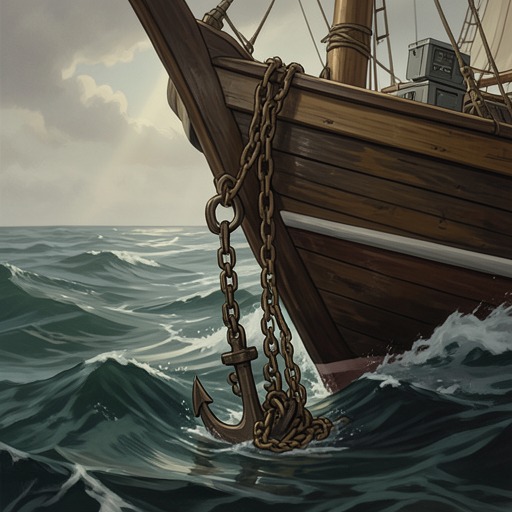
The boat was approximately one hundred yards downwind from the anchored position when Marquis maneuvered back over the anchor. Will pulled the line and Corey Smith joined him at the bow, yet even two large, strong, fit men could not dislodge it. Marquis spent about half an hour circling the anchor and shifting the boat into different positions while the men pulled from successive directions. The same problem had occurred on the previous week’s trip, when the line was eventually cut and Marquis had paid two hundred dollars for a replacement anchor and rope. This recurrence sharpened his frustration and encouraged an increasingly forceful attempt to free the anchor rather than a cautious retreat from the problem.
Marquis tightened the line and gunned the single-engine outboard motor while Will stood at the stern, where the anchor line had been tied, and Corey held the canopy near the center console. The engine produced a high-pitched sound followed by a low rumble. Will warned Marquis two or three times not to apply too much throttle, but the anchor blades apparently dug in more deeply. The stern squatted into the water, water poured aboard, the bow rose toward the sky, and the boat began listing to port. The entire sequence happened too quickly for a Mayday call. The worsening sea state thus became inseparable from the mechanical arrangement of the line and the attempt to overcome the anchor’s resistance.
The Florida Fish and Wildlife Conservation Commission later identified three factors in the accident: the anchor line had been improperly tied to an eye bracket on the port side of the transom; the men had attempted to throttle forward to pull the anchor free; and there had not been enough slack in the line. Together, those conditions allowed the stern to submerge and the boat to capsize. Sea state was therefore not an isolated explanation, but the force that made a flawed anchoring arrangement catastrophic when the motor was used against the fixed line.
The Overturned Boat in Heavy Seas
After the capsizing, the men initially believed the taut line was still holding the boat down. Will Bleakley and Marquis cut the rope from the propeller, a process that took five minutes, and the stern rose slightly before the boat began drifting. The small increase in buoyancy created a brief expectation that the boat could now be flipped upright. Instead, the sea state exposed the limits of their strength. Corey and Schuyler lay across the stern, kicking downward and pulling with their arms, while Marquis and Will first pulled from the front and then entered the water to push upward from the starboard side.
The men could not obtain leverage. Every effort to push the boat higher drove Marquis and Will farther underwater, while the submerged center console acted as a large, resistant rudder. The attempt did not fail because they were almost strong enough or lacked only one additional person; the boat did not come within five percent of being righted. Waves transformed the hull from a possible refuge into an unstable platform whose shape worked against them. The physical fact of the capsized boat mattered, but the moving sea made that fact continuously dangerous.
After sunset, the waves became rougher and louder, reaching consistent eight-footers with breaking caps. The storm was arriving. Later, the men experienced a period of roughly twenty minutes in which giant waves repeatedly wiped all of them away from the boat. Schuyler was thrown about ten feet from the hull several times and had to scream while trying to locate Marquis and Corey again. The sea repeatedly separated the men from the only object that could keep them afloat, turning proximity into a temporary achievement rather than a stable condition.
The next morning, storm rain struck almost horizontally and painfully, while the sky became the color of dishwater and visibility fell so low that the men could not tell whether the current had carried them five miles in one direction or ten miles in another. Schuyler and Will coordinated their movements when they could see an approaching wave, shouting warnings and leaning together into side swells. Waves arriving from behind were worse because they could not always be anticipated; they threw the men over the motor, forced them underwater, and sometimes left them unable to regain the hull for a full minute. This cycle continued for hours.
The waves eventually changed form as well as size. They began as choppy eight- to ten-foot seas and gathered into swells fifteen feet tall. Schuyler’s earlier experience with seven- or eight-foot waves on Lake Erie no longer provided an adequate comparison. On an upright boat, a wave is encountered from a position of relative height and protection; on a capsized hull or in a life jacket, a person sees, feels, and tastes the entire wall of water. The men rose toward the crest, dropped into the valley, and fell down the back of the swell, experiencing the wave as a dark mound and a stomach-lurching descent rather than as an abstract measurement.
Search, Exposure, and Bodily Consequences
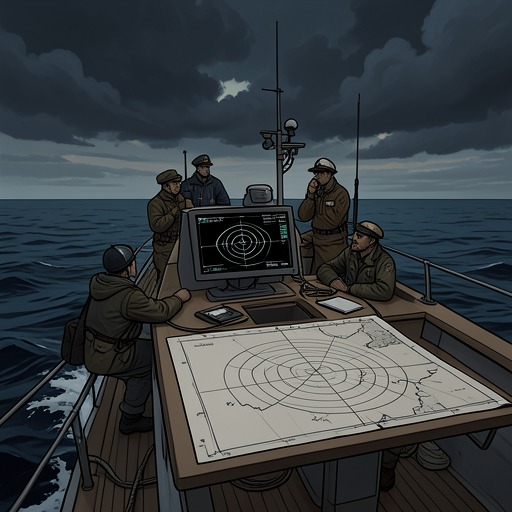
The sea state made the overdue boat difficult to find. If the Everglades boat remained afloat while overturned, searchers would see only a small portion of its white hull among hundreds of thousands of whitecaps. Storm clouds suppressed the limited moonlight, and the absence of an emergency position-indicating radio beacon meant that rescuers had no automatic or manually transmitted signal identifying the craft’s location. Wind, waves, and currents also affected the boat and human bodies differently, complicating the Coast Guard’s calculations of where the men might have drifted.
For anyone thrown into the Gulf, the rough water carried medical consequences beyond the immediate risk of drowning. Swallowing large amounts of seawater could produce a poisonous sodium imbalance, draw water out of cells, and progress to delirium, seizures, heart attack, and death from dehydration. Immersion also lowered body temperature below ninety-five degrees, causing constriction of the limbs’ blood vessels as the body redirected heat toward the heart, lungs, and brain. As hypothermia advanced, shivering could give way to clumsy hands, shallow breathing, blue lips, confusion, slurred speech, and irrational or confrontational behavior.
The account emphasizes that physical fitness offered no simple protection. In water around sixty-five degrees, a military survival guide estimated that an average twenty-five-year-old man might remain functional for 9.9 hours and survive for fifteen hours, while a fifty-year-old man might remain functional for 11.6 hours and survive for 17.6 hours. Greater muscle mass could reduce flotation and increase the effort required to tread water, while additional body fat could provide insulation. The sea therefore challenged the athletic identity that had given the fishermen confidence on land: strength could help with a rope or hull, but endurance, flotation, insulation, and exposure time governed survival in the water.
Marquis’s decline illustrates how the sea state became visible through behavior. His responses to repeated calls grew slower, he slurred and rambled, gagged after taking in salt water, dry-heaved, and shivered continuously. Corey Smith later developed similar symptoms. After twelve hours in the water, Corey suddenly showed desperate energy and tried to climb aboard by pulling on Marquis’s legs. His face appeared angry and mean, and he repeatedly made brief efforts before going lifeless. The behavior was not presented as a deliberate abandonment of the group or a moral failure; it was the outward expression of cold and confusion acting on a body trapped in severe conditions.
When Nick Schuyler was finally recovered, his temperature was 89.5 degrees rather than the normal 98.6. His breathing was labored, his lips were turning blue, his skin was cool and clammy, and he appeared to be entering the early stages of shock. He had leg pain and minor cuts made more painful by salt water. Although he could identify himself, his location, and the month, he could not at that moment remember who was president of the United States. The medical examination gives the sea state a precise physiological endpoint: the waves and immersion were measurable in a body approaching collapse.
Meaning and Retrospective Judgment
The book resists treating the deaths of Marquis, Corey, and Will as evidence that they simply gave up. Dr. Mark Rumbak explains that hypothermia can produce delirium, falling potassium levels, and the breakdown of heart-cell membranes until the heart can no longer contract. Their apparent passivity or confusion reflected a physiological process in which cold reached the brain and disrupted judgment. In this account, the sea state does not merely test courage; it progressively removes the capacity on which a conventional heroic survival story depends.
Schuyler’s later reflections preserve the sea’s role as a source of counterfactual guilt. He wished the men had been better prepared to send a distress signal, communicate their exact location, carry adequate flares and flashlights, and wear or better organize their life jackets. He also wondered whether giving Will his winter jacket or sweatshirt might have prolonged Will’s life, while acknowledging that doing so might instead have caused Schuyler to die sooner. These questions show how an environmental force becomes absorbed into personal responsibility after the event: the waves remain impersonal, but every decision made against them becomes a possible object of blame.
Sea state ultimately links weather, equipment, judgment, and physiology into one continuous chain. Five- and six-foot seas made the journey punishing; seven-foot swells made return difficult; eight-foot breaking waves overwhelmed the overturned boat; fifteen-foot swells made each attempt to hold the hull a renewed struggle. The same water that hid the boat from searchers and scattered the men also drove salt-water ingestion, cold exposure, delirium, and shock. Its decisive significance lies in that cumulative pressure: not a single dramatic wave alone, but a changing sea that converted small vulnerabilities into an irreversible maritime disaster.