Shock
Not Without HopeShock, in the account of the 2009 Clearwater boating accident, is the early stage of physiological collapse produced by prolonged cold-water immersion and compounded by dehydration, salt-water exposure, exhaustion, and hypothermia. It is decisive because it changes the meaning of the men’s final actions: what might appear to be surrender, irrationality, or a failure of will is presented instead as the body and brain losing their ability to function under lethal environmental pressure.
Definition and Medical Setting
Shock appears in the narrative as part of a larger chain of cold injury rather than as an isolated diagnosis. After Marquis Cooper’s 21-foot Everglades boat capsized, the men were left in the Gulf of Mexico amid rough seas and water in the mid-sixties Fahrenheit. A person immersed in such water would first lose heat from the body’s surface; blood vessels in the arms and legs would constrict, redirecting warmth toward the heart, lungs, and brain. As hypothermia advanced, shivering could give way to clumsy hands, shallow breathing, blue lips, confusion, slurred speech, and irrational or confrontational behavior.
The danger was intensified by seawater. If the boaters swallowed large amounts of it, the resulting sodium imbalance could draw water out of their cells and lead to delirium, seizures, heart failure, and death from dehydration. Shock therefore belongs to a sequence in which cold, salt, fatigue, and fluid loss reinforce one another. The body’s attempts to preserve its core temperature do not restore normal function; they narrow the margin in which a person can think clearly, coordinate movement, or remain safely attached to the boat.
The Accident and the Opening of the Crisis
The accident began when the anchor failed to come free as the fishermen prepared to return from a shipwreck site roughly sixty-five or seventy miles west of Clearwater Pass. Marquis drove the boat while Will Bleakley and Corey Smith tried to pull the anchor line from different positions. After the anchor remained fixed for about half an hour, Marquis tightened the line and applied power. The anchor’s blades apparently dug in more deeply. The stern squatted, water poured aboard, the bow rose, and the boat listed toward the port side before overturning in the seven-foot swells.
The men cut the line and attempted to right the hull, but the effort was physically impossible. They could not gain leverage, and the submerged center console acted as a resistant rudder. Even four exceptionally strong men could not bring the more-than-three-thousand-pound boat within five percent of flipping upright. The official investigation later identified the accident chain as improper attachment of the anchor line to a port-side transom eye bracket, throttling forward to free the anchor, and failing to leave sufficient slack, which allowed the stern to submerge and the boat to capsize.
The search conditions made the medical emergency still more dangerous. An overturned boat presented searchers with little more than a small white portion of hull amid vast numbers of whitecaps, while cloud cover and a cold front reduced visibility. The boat had transmitted no distress signal and apparently lacked an emergency position-indicating radio beacon, a device that could have sent rescuers the craft’s location automatically or manually. The Coast Guard therefore had to search through uncertainty while the men’s functional survival time in the water continued to decline.
Progression Among the Men
Marquis’s deterioration showed how shock could develop through repeated cold exposure and salt-water ingestion. He had taken in substantial seawater, gagged, and then begun to dry heave. His teeth chattered continuously. His replies became progressively slower: at first he answered when called, but later the others had to call his name four or five times or shake him on the hull. He began to slur and ramble, signs that the cold and physiological stress were affecting his speech and mental clarity.
The surrounding sea repeatedly separated the men from the hull. During one sustained period of violent waves, everyone was thrown away from the boat and had to scramble back within reach. Nick Schuyler was knocked roughly ten feet from the hull more than once, while Marquis and Corey disappeared from view for moments at a time. This was not a stable ordeal in which the men could simply conserve energy; each wave forced them to spend more of the energy and heat that remained.
Corey’s later behavior made the distinction between deliberate action and hypothermic confusion especially stark. After twelve hours in the water, he began rambling and moaning and failed to respond until Nick Schuyler and Will called his name repeatedly. Then he suddenly summoned desperate energy and tried to climb onto the hull, pulling on Marquis’s legs and grabbing at anything that might help him rise from the water. His face appeared angry and mean, unlike the easygoing person his companions knew. He would struggle for ten or fifteen seconds, become lifeless, and then try again. Nick recognized that Corey was no longer mentally himself and that the cold had begun to take hold.
Nick Schuyler’s Rescue Condition
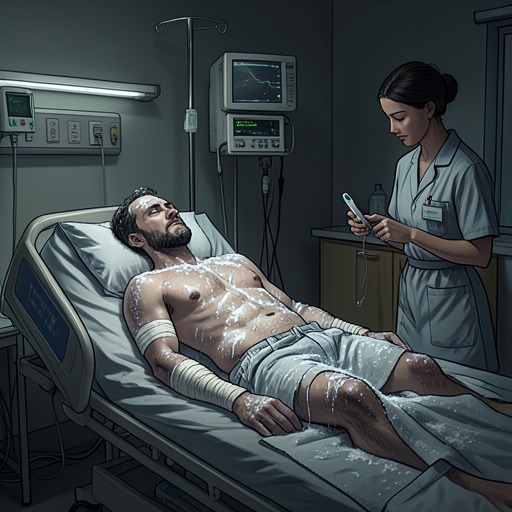
When the USCGC Tornado recovered Nick, the rescuers treated him as a severely chilled survivor approaching shock. Adam Best and David Earles guided him to the executive officer’s bathroom, removed his wet clothing, dried him, put him in Coast Guard coveralls, and wrapped him in wool blankets. The largest sandals aboard were size twelve, but Nick wore size fifteen, a small practical detail that conveyed how poorly the available equipment fit the scale of the rescue.
His temperature was 89.5 degrees Fahrenheit, far below the normal 98.6. His breathing was somewhat labored; his lips were turning blue; his skin was cool and clammy; and he appeared to be entering the early stages of shock. Minor cuts on his legs were made painfully raw by the salt water, and he reported pain in his legs. Although he remained mostly coherent and knew his name, location, and the month, he could not remember who was president of the United States. The impairment was therefore partial rather than absolute: enough awareness remained for communication, but ordinary orientation and memory were already compromised.
The crew worked to prevent further heat loss. They repeatedly replaced his wet blankets with dry ones and warned that his temperature had to be raised immediately. After he reached the ship, his temperature rose to 93 degrees, still dangerously low. His skin was scabbed and coated with dried salt, and he looked beaten up and exhausted. David Earles directed warm air exhausted from the engine toward Nick’s head and feet while the crew continued to cover him with wool. These measures did not make him suddenly well; they created the conditions in which his temperature could stop falling and begin a slow recovery.
Nick’s thirst showed the simultaneous presence of dehydration. The water offered to him seemed strangely lukewarm, and he wanted far more than the small sips initially provided. Later, on the helicopter, he was given three large bottles, but he was too weak to lift one. He tipped his head back and let the water fall into his mouth. The rescue thus treated shock as a continuing emergency: warmth, dry clothing, blankets, controlled water, monitoring, and rapid evacuation were all necessary because the underlying cold injury had not ended when Nick was pulled from the sea.
Shock, Survival, and Misread Behavior
The condition also reshaped how the deaths of Marquis Cooper, Corey Smith, and Will Bleakley had to be understood. Their disappearance could be mistaken for a conscious decision to stop fighting, but Dr. Mark Rumbak rejected that interpretation. Hypothermia can produce delirium, lower potassium levels, and damage the heart’s cell membranes until the heart can no longer contract. The men were not simply choosing to give up; as their bodies cooled, confusion progressively displaced judgment and purposeful action.
That medical explanation also qualifies the apparent contrast between Nick Schuyler’s survival and the others’ deaths. Nick had been a personal trainer and an exceptionally fit athlete, while Marquis was a powerful professional football player, yet physical strength did not make the men immune to cold. Younger, fitter bodies could be more vulnerable because they carried less insulating fat, while greater muscle mass could reduce flotation and demand more effort to remain on the surface. A military survival estimate gave an average twenty-five-year-old man immersed in sixty-five-degree water about 9.9 hours of functional survival and fifteen hours of total survival, figures that made the men’s prolonged exposure an increasingly narrow physiological contest rather than a test of character alone.
Shock Within the Accident Chain
Shock was not an isolated medical event detached from the boating error. The anchor remained fixed while the men attempted to leave the fishing site, and the decision to pull against it caused the stern to submerge and the boat to overturn. Once the hull was capsized, the men had to cling to a partially submerged boat in rough water, repeatedly expend energy to keep within reach of it, and endure continued contact with cold seawater. The physical arrangement created by the accident became part of the medical crisis: every attempt to hold position or regain the hull consumed heat and strength, while every separation from the boat increased exposure.
The absence of effective emergency equipment prolonged that chain. The men had no emergency position-indicating radio beacon to transmit an immediate location, and they had not adequately prepared to send a distress signal with flares or flashlights. Their exact position had not been communicated to people on shore. Consequently, the Coast Guard had to calculate probable drift amid darkness, storm-driven cloud cover, wind, currents, and whitecaps while the survivors’ temperatures continued to fall. The delayed search did not cause shock by itself, but it removed opportunities for early rescue before cold injury and dehydration became irreversible.
Nick’s later reflections placed the accident among several preventable failures rather than attributing it to one man’s weakness. He wished the group had handled the anchor differently, had recognized the danger of placing the line at the back of the boat, had been better prepared to send a distress signal, and had worn life jackets or known exactly where they were stored. He also revisited the clothing available during the ordeal, wondering whether letting Will wear his winter jacket or sweatshirt might have changed the outcome, while acknowledging that such a choice might instead have shortened Nick’s own survival. Shock therefore stands at the endpoint of an interacting system of weather, equipment, procedure, exposure, and finite human energy.
Medical Meaning and Narrative Significance
The narrative uses shock to convert frightening behavior into bodily evidence. Marquis’s delayed responses, slurred speech, dry heaving, and constant chattering teeth; Corey’s sudden aggression and repeated failed attempts to climb onto the hull; and Nick’s impaired memory after rescue all belong to the same downward movement from cold stress toward neurological and cardiovascular failure. The differences among them reflect changing exposure, clothing, exhaustion, seawater ingestion, body composition, and access to the hull, not a simple ranking of courage.
Nick’s rescue gives the state its clearest measurable form: a body temperature of 89.5 degrees, blue lips, cool clammy skin, labored breathing, confusion, and the early signs of shock. The ship’s blankets, dry clothing, warm engine air, water, and helicopter evacuation interrupted the progression before his heart and brain failed. By contrast, the men who remained in the water lost the protective barrier that rescue medicine could provide. The sequence makes survival appear neither miraculous in a purely abstract sense nor reducible to willpower; it was the result of a body retaining enough function for rescue to reach it.
Shock also governs the book’s treatment of survivor’s guilt. Nick felt guilty that his best friend and Marquis and Corey were not aboard the USCGC Tornado with him, and afterward he repeatedly asked what might have happened if he had acted differently. Dr. Rumbak insisted that the deaths were not the consequence of Nick’s decision to survive. Their hearts might have stopped before rescuers found them even if Nick had tied them to the boat, because hypothermia had already driven them toward confusion and cardiac failure. In this account, recognizing shock is an ethical act as well as a medical one: it resists turning physiological collapse into moral blame and preserves the dead men’s humanity at the moment their minds and bodies could no longer protect them.