Sleep deprivation
Not Without HopeSleep deprivation is the extreme loss of restorative sleep experienced by Nick Schuyler during his survival at sea after Marquis Cooper’s 21-foot Everglades boat capsized in the Gulf of Mexico. It becomes decisive because Nick must remain conscious and physically attached to the overturned hull while cold water, hunger, thirst, pain, delirium, and the absence of rescue steadily erode his capacity to act. The state also changes the meaning of time: hours stretch into apparent eternities, and the ordinary boundary between waking, dozing, memory, and hallucination begins to fail.
Definition and Physical Conditions
Sleep deprivation develops within a larger medical emergency rather than as a separate psychological problem. The four men were already exhausted by the attempt to free the anchor and by the violent conditions that followed the capsizing. The anchor had remained fixed to the bottom despite the efforts of Marquis Cooper and Will Bleakley, and when the boat was throttled forward, the anchor blades dug in, the stern submerged, and water poured aboard. Once the boat overturned, repeated attempts to right it required the men to push, pull, kick, and dive without gaining leverage.
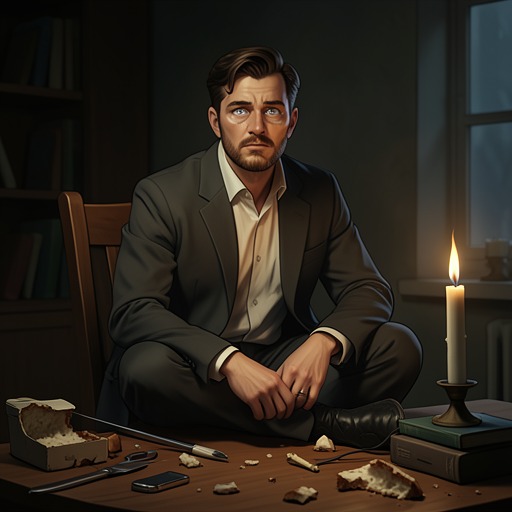
The physical setting made sleep especially dangerous. Nick had been awake for almost forty hours and had spent more than twenty-four hours in the water, fighting to survive while trying to help the other three men. He was starving, drained, and unable to keep his eyes open, but waves startled him awake whenever he began to doze. He feared that sleep would loosen his grip, allow him to fall from the hull, or prevent him from seeing a plane, boat, or helicopter that might offer his only chance of rescue.
His body provided constant evidence of the cost. He hugged the motor, endured severe pain whenever a wave threw him against the outboard, and suffered raw skin on his neck, cuts and gashes on his hands and feet, and bleeding from his hamstrings and buttocks. By midnight on Sunday, after being alone for almost six hours, he was slouched and hunchbacked, unable to find a comfortable position because of the pain. Every fall into the water produced an immediate shock, so he repeatedly hauled himself back onto the hull and tried to remain as dry as possible while five- to seven-foot, choppy waves struck the boat.
Progression During the Survival
Nick’s sleep deprivation is marked first by intermittent dozing rather than complete sleep. His eyes would close for moments, then a wave would wake him. This pattern kept him technically alert but denied him the recovery that sustained wakefulness requires. The narrative presents vigilance as both necessity and burden: he has to watch for rescue, hold the boat, and protect himself from being swept away, yet the same vigilance consumes the strength he needs to continue.
After Will Bleakley floated away and Marquis Cooper and Corey Smith died, the psychological pressure intensified. Nick had no one left to speak to or hold on to, and he felt guilty even for recognizing that there was no longer anyone else to monitor. Without Will’s presence, the night seemed longer than the first one. When Nick expected dawn, it was only three o’clock; when he estimated that an hour had passed, only twenty or twenty-five minutes had elapsed. Sleep deprivation therefore becomes a distortion of duration, turning the ocean into a space where waiting itself is physically exhausting.
At one point Nick checked Corey Smith’s watch and thought it must be two or three in the morning, only to discover that it was nine thirty. He interpreted the discrepancy as evidence that he might not survive the night. His water-resistant phone still powered on, but repeated attempts to call 9-1-1, Paula Oliveira, and his mother failed because the screen showed no service. The inability to sleep, communicate, or measure time left him with only the mechanical tasks of gripping the motor, enduring the waves, and continuing to try.
Relation to Hypothermia and Delirium
Sleep deprivation overlaps with the other physiological threats in the water. Salt-water ingestion could produce a dangerous sodium imbalance, draw water from the body’s cells, and progress toward delirium, seizures, heart failure, and death from dehydration. Cold-water exposure could lower body temperature below 95 degrees, producing clumsiness, shallow breathing, blue lips, confusion, slurred speech, and irrational or confrontational behavior. These processes make apparent surrender difficult to interpret: a person may be losing the ability to think and move before consciously choosing to stop.
The narrative repeatedly shows this progression in the other boaters. Marquis Cooper’s responses became slower, he slurred and rambled, gagged after swallowing salt water, dry-heaved, and chattered his teeth. Corey Smith later developed similar symptoms, then suddenly displayed desperate energy, pulling at Marquis’s legs and trying to climb onto the hull with an angry, physically aggressive expression. Nick understood that Corey was no longer mentally himself and that the cold was taking hold after twelve hours in the water. The behavior was a manifestation of physiological collapse, not a simple failure of courage.
Medical evidence after the rescue reinforces the connection. Nick’s temperature was 89.5 degrees, far below the normal 98.6, and he was showing early shock, labored breathing, blue lips, cool clammy skin, and leg pain. Dr. Mark Rumbak explained that hypothermia could cause delirium, lower potassium levels, and damage the heart’s cell membranes until the heart could no longer contract. In his account, Marquis Cooper, Corey Smith, and Will Bleakley had not simply given up; confusion and cold had overtaken them. Sleep deprivation belongs to this same chain of impairment, helping explain why wakefulness becomes progressively less reliable even when survival requires it.
Time, Perception, and Survival
The state transforms Nick’s perception of the sea. He was barely able to keep his head up, and the next two or three hours felt like an eternity. He feared sleep because it could cost him his grip, yet he also could not remain fully awake. His body was being driven by hunger and exhaustion: he imagined his mother’s eggs Benedict, recognized that his remaining fat had been consumed, and concluded that his body was beginning to consume muscle. The physical desire for food and the mental need for rest converged as signs that his reserves were nearly exhausted.
Even the night’s beauty intensified the isolation. Nick saw hundreds or thousands of stars and a thin, bright moon, imagining that his family and Paula Oliveira might be looking at the same sky. With no reliable phone service, no dependable sense of time, and no companion remaining, looking and hoping became the only available forms of orientation. His repeated decision not to quit was therefore not a triumphant absence of fatigue; it was a fragile action renewed against fatigue, fear, and the possibility that consciousness itself would fail.
Sleep deprivation also clarifies why the survival cannot be reduced to individual willpower. The accident’s official causal chain began with the anchor line being improperly tied to an eye bracket on the port side of the transom, the attempt to throttle forward to free the anchor, and insufficient slack, which submerged the stern and capsized the boat. The absence of an emergency position-indicating radio beacon made the search more difficult, while darkness, cloud cover, whitecaps, and the barely visible overturned hull delayed detection. Nick’s exhaustion was produced and prolonged by this entire system of mechanical failure, inadequate preparation, environmental danger, and delayed rescue.
Narrative Significance
Sleep deprivation gives the survival narrative its fractured rhythm. The account moves between exact times, uncertain estimates, sudden awakenings, repeated checks of a failing watch, and stretches in which minutes seem to become hours. This structure makes the reader experience the loss of ordinary temporal control while preserving the concrete sequence of deterioration. The state is both a medical condition and a narrative instrument: it shows how the mind records crisis in fragments when continuous attention is no longer possible.
Its deepest significance lies in the contrast between the survivors’ visible behavior and the hidden physiology beneath it. Nick remained awake because he had to keep hold of the motor and watch for rescue, while the others’ confusion and death could appear from the outside as passivity or abandonment. The medical explanation rejects that moral simplification. By linking wakefulness, cold, dehydration, salt-water exposure, and cardiac failure, the narrative presents survival as a narrowing physical contest rather than a judgment on who wanted life more.
After rescue, Nick’s continued struggle with guilt shows that sleep deprivation did not end when the Coast Guard found him. He later questioned whether he should have given Will Bleakley his winter jacket or allowed him to use his sweatshirt, while admitting that such a choice might have caused both men to die sooner. The questions arise from the same altered moral landscape as the night itself, in which every movement, garment, grip, and minute seemed potentially decisive. Sleep deprivation thus remains part of the story’s lasting wound: it marks the period when Nick’s body had to continue functioning after ordinary endurance, ordinary time, and ordinary explanations had already run out.