single-engine outboard motor
Not Without HopeThe single-engine outboard motor is the 200-horsepower engine mounted on Marquis Cooper’s twenty-one-foot fishing boat. It gives the vessel its offshore range and maneuverability, but during the 2009 Clearwater boating accident it also becomes the central mechanical element in the capsizing: the attempt to use engine power against a stuck anchor pulls the stern down, floods the boat, and leaves the survivors clinging to the motor for hours. The same object that helps create the emergency becomes one of the few structures that keeps Nick Schuyler, Will Bleakley, and the others attached to the overturned hull.
Design and Place on the Boat
The motor belongs to a boat built for a small offshore group rather than a large passenger load. Marquis Cooper’s boat could carry ten people, but he preferred no more than four aboard, particularly when the occupants were large men and the trip extended far from shore. The vessel was twenty-one feet long, had a center-console helm beneath a small canopy, carried sixty-six gallons of fuel, and used five additional five-gallon fuel cans secured at the stern. Within that arrangement, the single-engine outboard motor was not merely a source of propulsion; it was part of the stern’s weight, geometry, and working equipment, positioned where the anchor line would later produce its most dangerous effect.
Before the accident, the motor represented ordinary boating competence and the expectation of a controlled return. Marquis Cooper monitored a cold front and warned that rough water might force the group to shorten the trip, but the boat nevertheless went out toward the fishing grounds. The motor’s presence made the journey possible, yet the vessel’s reliance on a single engine also meant that propulsion, maneuvering, and any attempt to free the anchor were concentrated in one mechanical system.
The Anchor Attempt and Capsizing
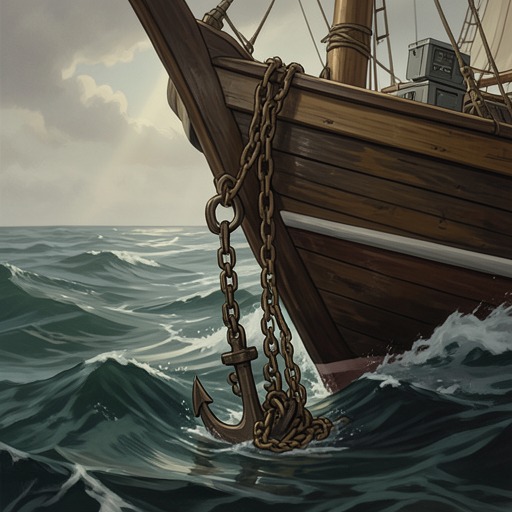
The motor becomes decisive when the group prepares to leave. The anchor is stuck on the bottom, and Will Bleakley and Corey Smith cannot pull it free despite their strength. Marquis Cooper maneuvers the boat through several positions for roughly half an hour while the two men pull from different directions. The repeated failure is not a minor inconvenience: the worsening seas make the delay increasingly dangerous, and the group is already cold, sick, and eager to return to shore.
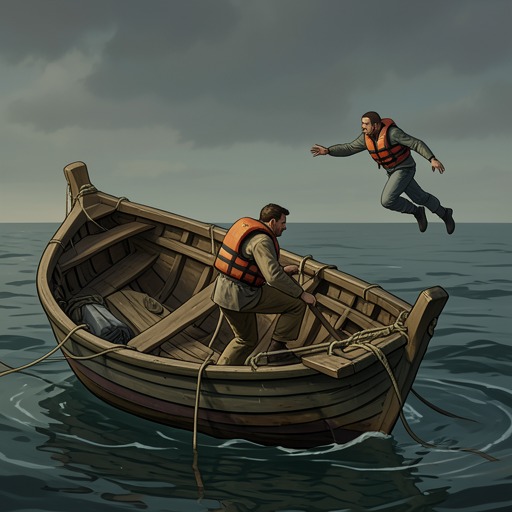
The anchor line is tied at the rear of the boat, and Marquis Cooper eventually tightens it while Corey Smith stands behind Nick Schuyler at the center console and Will Bleakley holds the line at the stern. Marquis then guns the motor. The engine produces a high, motorcycle-like whine followed by a lower rumble, while Will warns him two or three times not to push the throttle too hard. The anchor blades appear to dig in more deeply rather than release. The stern squats, water pours aboard, the bow rises, and the boat lists toward port before rolling over so quickly that the men have no opportunity to send a Mayday call.
The Florida Fish and Wildlife Conservation Commission later identified three connected causes: the improper attachment of the anchor line to an eye bracket on the port side of the transom, the decision to apply forward throttle in order to pull the anchor free, and the failure to leave enough slack in the line. Together, those conditions allowed the tightened line to submerge the stern and capsize the boat. In the survivor’s retrospective account, the danger lies in the disproportion between the apparently manageable object and the result: an inch-thick rope, acting through the motor and the boat’s stern, brings down a more-than-three-thousand-pound vessel carrying four large men and a load of fish.
The Motor as an Inverted Handhold
Once the boat is upside down, the motor’s function changes completely. The propeller projects above the water, while the stern’s swim platform and trim tabs jut out around it. The ladder, platform, and stainless-steel trim tabs were designed to assist boarding, adjust the boat’s pitch, reduce pounding, and correct a list; after the capsizing, they become improvised life-saving equipment. Nick Schuyler stands to the right of the motor with water reaching about mid-thigh, holding the outboard with his left hand and placing his left foot on the platform or a trim tab. Will Bleakley remains close in the cramped space, Corey Smith stands on the opposite trim tab, and Marquis Cooper braces himself against the hull and cooler.
The motor is therefore both obstacle and anchor. The men cannot use it to restore the boat, but they can use its hard surfaces and surrounding fittings to keep their bodies from being swept away. During a period of repeated violent waves, they disappear from one another’s sight, are thrown as far as ten feet from the hull, and scramble back toward the motor and boat. The object becomes the center of a fragile arrangement in which every handhold matters and the difference between remaining attached and being lost in the Gulf of Mexico is measured in inches.
Pain, Improvisation, and Survival
As the hours pass, the motor also becomes the source of severe bodily injury. Nick Schuyler and Will Bleakley position themselves on the hull with Nick straddling the motor and Will bear-hugging him from behind. The arrangement resembles riding a Jet Ski, but the front man must grip the motor and brace with his feet while the rear man has nothing to hold except his companion. When waves strike from behind, more than 450 pounds of body weight rocket forward into the engine. Nick’s body repeatedly slams against the motor, producing pain more severe than impacts he had experienced on a football field.
The men adapt rather than abandon the position. They switch places after being thrown off, climb back onto the hull, watch for incoming waves, and warn one another to hold on. Their clothing is soaked, they are coughing and gagging from seawater, and they have been awake for more than a day, but the motor remains a usable point of support. The scene turns athletic strength into a limited resource: the men’s size helps them hold one another, yet their weight also makes the impacts harder and increases the effort required to stay afloat.
Later, Will Bleakley dives beneath the overturned boat and retrieves a seat cushion. Nick Schuyler places it between his crotch and the motor, where it functions like a protective cup. The cushion does not make the position safe, but it changes the repeated collision from nearly unbearable to tolerable. This small alteration captures the logic of their survival: the motor cannot be overcome or removed, so the men modify the space around it with whatever material they can recover.
Mechanical Cause and Narrative Significance
The single-engine outboard motor gives the accident its clearest chain of physical causation. A deteriorating sea state, an anchor that will not come free, a line secured in the wrong place, insufficient slack, and forward throttle converge through the engine into a flooded stern and a capsized boat. The motor is not presented as an independent villain, nor is the disaster reduced to one person’s decision. Its force operates inside a wider failure of preparation that includes the absence of an emergency position-indicating radio beacon, inadequate distress equipment, uncertainty about the life jackets, and insufficient planning for communication and location.
That dual role gives the motor its lasting symbolic weight without turning it into a mere symbol. It is an active material participant in the accident and then a material condition of survival. The same engine that helps pull the boat beneath the water becomes the structure Nick Schuyler and Will Bleakley straddle, grip, and use to absorb the sea’s violence. In the book’s retrospective understanding of the event, the motor embodies the narrow boundary between ordinary equipment and lethal force: safety depends not only on possessing a powerful machine, but on understanding how its power interacts with the anchor, the stern, the weather, and the people who control it.